USAID DEC
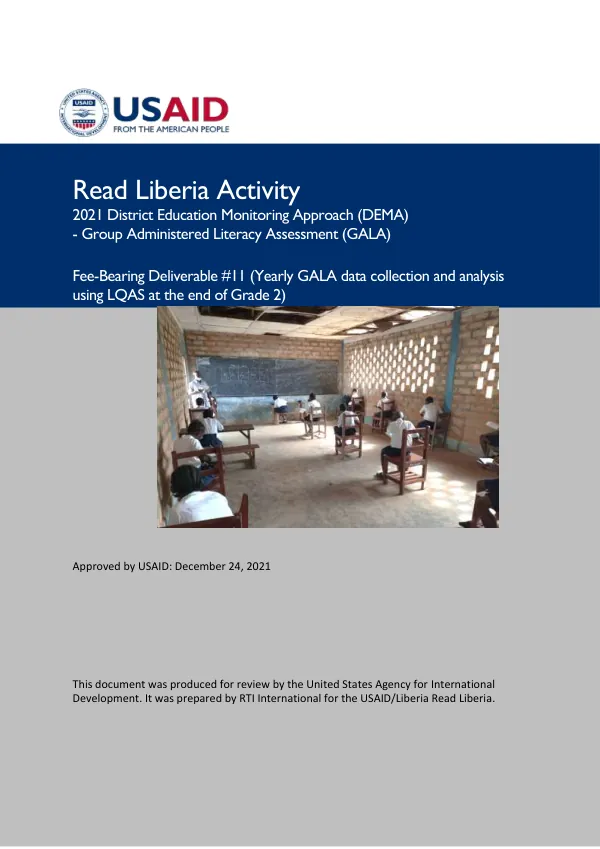
Read Liberia Activity 2021 District Education Monitoring Approach (DEMA) - Group Administered Literacy Assessment (GALA)
Sign inRTI INTERNATIONAL
Read Liberia Activity 2021 District Education Monitoring Approach (DEMA) - Group Administered Literacy Assessment (GALA)
The Read Liberia Activity, a USAID-funded initiative, conducted its 2021 District Education Monitoring Approach (DEMA)-Group Administered Literacy Assessment (GALA) in 61 districts across seven counties in Liberia.
2021 · 52 pages
Sign in to readA free account is required to download.
Abstract
The assessment aimed to evaluate the effectiveness of the Read Liberia intervention in improving literacy skills among Grade 2 students. A total of 114 schools were visited, with 1,296 students assessed, 114 Grade 2 teachers observed teaching, and 114 principals interviewed. The assessment focused on measuring teacher practice, school inputs, and student reading performance. Data were collected by District Education Officers (DEOs) on teacher practice, school inputs, and students' reading performance. The assessment received increased support and ownership from the Liberia Ministry of Education (MOE), leading to its successful implementation in 16 district schools, including both Read Liberia-supported and non-Read Liberia-supported MOE schools. The assessment was conducted after a year of school closures due to the COVID-19 pandemic. The pandemic had a significant impact on schools across Liberia, including Read Liberia-supported schools, with low student enrollment due to economic constraints faced by parents. The assessment aimed to provide insights into the effectiveness of the Read Liberia intervention in improving literacy skills among Grade 2 students, despite the challenges posed by the pandemic. The assessment used a variety of indicators to measure performance, including teacher practice, school inputs, and student reading performance. The indicators were designed to evaluate the effectiveness of the Read Liberia intervention in improving literacy skills among Grade 2 students. The assessment also aimed to provide recommendations for improving the effectiveness of the Read Liberia intervention. The assessment results showed that the Read Liberia intervention had a positive impact on literacy skills among Grade 2 students. The results also highlighted the importance of teacher practice, school inputs, and student reading performance in improving literacy skills. The assessment provided recommendations for improving the effectiveness of the Read Liberia intervention, including the need for continued support and ownership from the MOE. The assessment was conducted in 61 districts across seven counties in Liberia, including Montserrado 1, Montserrado 2, Margibi, Grand Bassa, Bong, Lofa, and Nimba. The assessment received increased support and ownership from the MOE, leading to its successful implementation in 16 district schools. The assessment results provided insights into the effectiveness of the Read Liberia intervention in improving literacy skills among Grade 2 students, despite the challenges posed by the pandemic. The assessment used a variety of instruments to collect data, including teacher practice, school inputs, and student reading performance. The instruments were designed to evaluate the effectiveness of the Read Liberia intervention in improving literacy skills among Grade 2 students. The assessment also aimed to provide recommendations for improving the effectiveness of the Read Liberia intervention. The assessment was conducted in a challenging environment, with schools across Liberia facing low student enrollment due to economic constraints faced by parents. The assessment results provided insights into the effectiveness of the Read Liberia intervention in improving literacy skills among Grade 2 students, despite the challenges posed by the pandemic. The assessment highlighted the importance of continued support and ownership from the MOE in improving the effectiveness of the Read Liberia intervention.
Related documents