USAID DEC
USAID Medicines, Technologies, and Pharmaceutical Services (MTAPS) Program: Improved Access. Improved Services. Better Health Outcomes.
Sign inBANK FOR WEST AFRICAN DEVELOPMENT
USAID Medicines, Technologies, and Pharmaceutical Services (MTAPS) Program: Improved Access. Improved Services. Better Health Outcomes.
The USAID Medicines, Technologies, and Pharmaceutical Services (MTaPS) program in the Philippines aimed to improve access to safe, effective, and quality-assured medicines and health technologies.
2024 · 5 pages
Sign in to readA free account is required to download.
Abstract
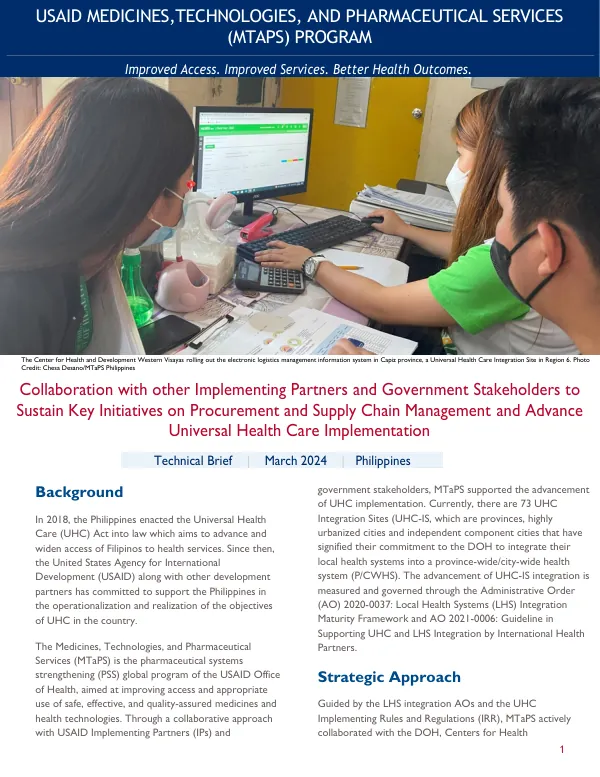
The program supported the advancement of Universal Health Care (UHC) implementation in the country, with a focus on procurement and supply chain management (PSCM) system strengthening. The MTaPS program collaborated with the Department of Health (DOH), Centers for Health Development (CHDs), USAID, and other development partners to sustain key initiatives on PSCM system and advance UHC implementation. The program worked closely with the national level and collaborated with partners in cascading PSCM interventions at the sub-national and local levels. One of the key interventions implemented by MTaPS was the electronic logistics management information system (eLMIS). The eLMIS is a required information system needed to achieve UHC in the Philippines, as identified in the UHC Implementing Rules and Regulations (IRR). MTaPS supported the DOH in acquiring, configuring, and implementing an off-the-shelf eLMIS in all levels of the country's health system. The eLMIS was implemented in 224 national, regional, and local government unit (LGU) sites, with 68% of UHC Integration Sites (UHC-IS) achieving interoperable electronic supply chain/logistics management system within the province-wide/city-wide health system. MTaPS also developed quality PSCM e-learning courses for wider reach. The program partnered with the DOH offices and the Food and Drug Administration (FDA) to develop and upload 9 e-learning courses relevant to PSCM and pharmacovigilance (PV) to the DOH Academy. The courses were designed to enhance access to free quality training opportunities by health workers, with around 19,250 health workers having received training through the DOH Academy as of February 2024. In addition, MTaPS tested a digital platform to integrate a primary care provider network (PCPN). The program collaborated with ReachHealth to implement the Provider Integration and Engagement System (PIES), an initiative to pilot test the integration of PCPN of 12 sites in Batangas and Laguna, through a digital tool called MyCure. The pilot testing is still in the initial stage of implementation, with some initial target sites preferring to use their old system. The MTaPS program also strengthened private sector engagement. The UHC IRR recognizes that engaging the private sector would contribute to achieving UHC in the country. As part of its sustainability strategy, MTaPS worked with the DOH to identify a pool of capable local individuals and organizations capable to support strengthening the PSCM in the country, through the Local Technical Assistance Providers (LTAPs) initiative. Through the LTAPs initiatives, MTaPS identified and contracted Procurement and Supply Institute of Asia (PASIA) to support the DOH in the development of the 2024-2028 National PSCM Strategic Plan. The MTaPS program has fully transitioned its task in the PIES initiative to ReachHealth, with ReachHealth continuing to work with Team OPS to produce the proof of concept for the MyCure implementation. The successful implementation of the PIES initiative will help Batangas and Laguna achieve Information System KRA II.2 Functional EMR system among health facilities within the province-wide/city-wide health system.