USAID DEC
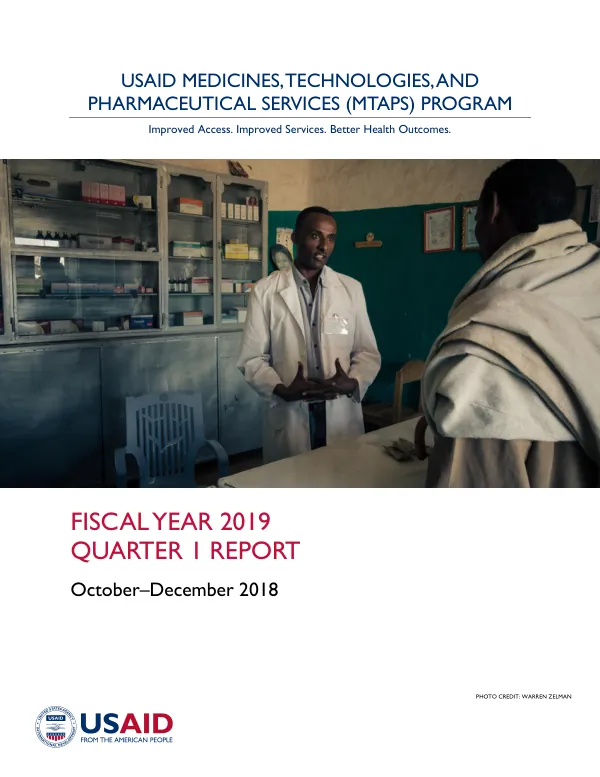
USAID Medicines, Technologies, and Pharmaceutical Services (MTaPS) Program: Quarterly Report Fiscal Year 2019, Quarter 1 (October–December 2018)
Sign inDELOITTE USA
USAID Medicines, Technologies, and Pharmaceutical Services (MTaPS) Program: Quarterly Report Fiscal Year 2019, Quarter 1 (October–December 2018)
The USAID Medicines, Technologies, and Pharmaceutical Services (MTaPS) Program is a global initiative aimed at improving access to essential medicines, technologies, and pharmaceutical services.
2019 · 38 pages
Sign in to readA free account is required to download.
Abstract
The program is implemented by Management Sciences for Health and is funded by the US Agency for International Development (USAID) through Contract No.: 7200AA18C00074. The program's primary objectives are to strengthen pharmaceutical sector governance, increase institutional and human resource capacity for pharmaceutical management and services, enhance the availability and use of pharmaceutical information for decision making, optimize pharmaceutical sector financing, and improve pharmaceutical services to achieve desired health outcomes. The program operates in several countries, including Afghanistan, Bangladesh, Mozambique, the Philippines, and Rwanda. In the first quarter of Fiscal Year 2019 (October-December 2018), the program made significant progress in various health areas. In Maternal, Newborn, and Child Health, the program supported the development of a national pharmaceutical policy and provided training to healthcare workers on the use of essential medicines. In the Global Health Security Agenda, the program assisted in the development of a national antimicrobial resistance (AMR) strategy and provided technical assistance to healthcare facilities on infection prevention and control. The program also made progress in strengthening pharmaceutical sector governance, including the development of a national pharmaceutical regulatory authority and the implementation of a pharmaceutical management information system. In addition, the program provided technical assistance to healthcare facilities on procurement and supply chain management, resulting in improved availability of essential medicines. In terms of regional progress, the program reported significant achievements in Asia, particularly in Bangladesh and the Philippines. In Afghanistan, the program supported the development of a national pharmaceutical policy and provided training to healthcare workers on the use of essential medicines. In Mozambique, the program assisted in the development of a national pharmaceutical regulatory authority and provided technical assistance to healthcare facilities on pharmaceutical management. The program's monitoring and evaluation plan is designed to track progress towards its objectives and identify areas for improvement. The plan includes performance indicators, data collection tools, and a reporting schedule. The program's financial management system is designed to ensure transparency and accountability in the use of program funds. Overall, the USAID MTaPS Program is making significant progress in improving access to essential medicines, technologies, and pharmaceutical services in low- and middle-income countries. The program's achievements in strengthening pharmaceutical sector governance, increasing institutional and human resource capacity, and improving pharmaceutical services are expected to have a positive impact on health outcomes in the countries where it operates.
Related documents
Documents in this collection
 2019
2019USAID DEC
USAID Medicines, Technologies, and Pharmaceutical Services (MTaPS) Program: Annual Report Fiscal Year 2019 and Quarterly Report Fiscal Year 2019, Quarter 4 (July–September 2019)
Open record 2019
2019USAID DEC