USAID DEC
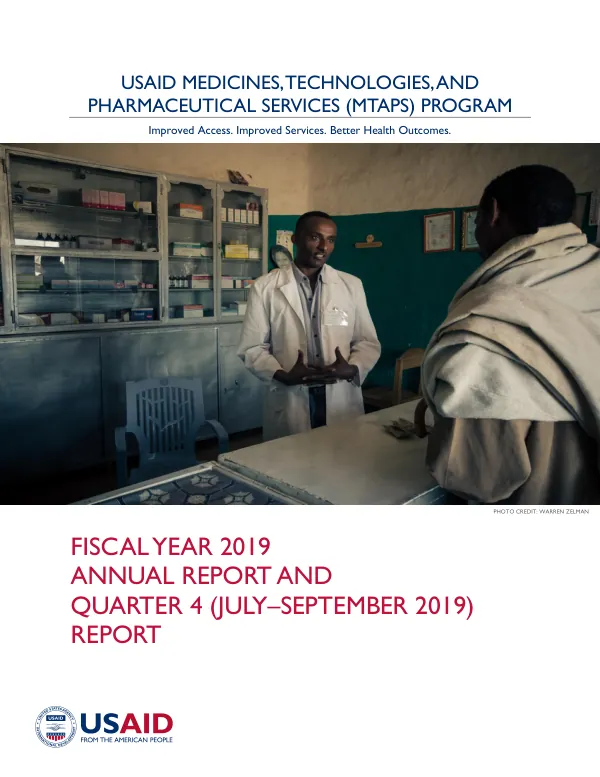
USAID Medicines, Technologies, and Pharmaceutical Services (MTaPS) Program: Annual Report Fiscal Year 2019 and Quarterly Report Fiscal Year 2019, Quarter 4 (July–September 2019)
Sign inDELOITTE USA
USAID Medicines, Technologies, and Pharmaceutical Services (MTaPS) Program: Annual Report Fiscal Year 2019 and Quarterly Report Fiscal Year 2019, Quarter 4 (July–September 2019)
The USAID Medicines, Technologies, and Pharmaceutical Services (MTaPS) Program is a five-year initiative aimed at strengthening pharmaceutical systems in low- and middle-income countries.
2019 · 94 pages
Sign in to readA free account is required to download.
Abstract
Funded by the US Agency for International Development (USAID) and implemented by Management Sciences for Health (MSH), the program seeks to improve health system performance and advance USAID's goals of preventing child and maternal deaths, controlling the HIV/AIDS epidemic, and combating infectious disease threats. The program's goal is to help low- and middle-income countries strengthen their pharmaceutical systems to ensure sustainable access to and appropriate use of safe, effective, quality-assured, and affordable essential medicines, vaccines, and other health technologies and pharmaceutical services. The program's approach to strengthening pharmaceutical systems is based on USAID's Vision for Pharmaceutical Systems Strengthening, which posits six functions of health systems that must be strengthened to achieve sustained and equitable access to essential, high-quality services. The MTaPS Program focuses on six key functions: human resources, health finance, health governance, health information, medical products/vaccines/technologies, and service delivery. The program's theory of change is based on a comprehensive set of dynamic relationships among a health system's functions, with an overarching focus on the role medical products are expected to play in improving health system performance. The program's progress is organized by core funding, objective, and country. The report highlights key achievements and challenges in the program's first year, including the establishment of a robust monitoring and evaluation system, the development of a comprehensive pharmaceutical management information system, and the implementation of a range of interventions to improve access to essential medicines and health technologies. In the Global Health Security Agenda (GHSA) portfolio, the program supported the development of national pharmaceutical management plans in several countries, including Bangladesh, Burkina Faso, and Cameroon. The program also provided technical assistance to strengthen pharmaceutical regulatory systems and improve the availability and use of pharmaceutical information for decision-making. In the Maternal, Newborn, and Child Health (MNCH) portfolio, the program supported the implementation of a range of interventions to improve access to essential medicines and health technologies, including the development of a comprehensive pharmaceutical management information system and the implementation of a range of quality improvement initiatives. The program's progress in the Office of Health Systems, Cross Bureau Funding portfolio was marked by the development of a comprehensive pharmaceutical management information system and the implementation of a range of interventions to improve access to essential medicines and health technologies. The program's progress in the Asia Regional Bureau portfolio was marked by the development of a comprehensive pharmaceutical management information system and the implementation of a range of interventions to improve access to essential medicines and health technologies in several countries, including Bangladesh, Cambodia, and Indonesia. The program's progress in the Intergovernmental Authority on Development and East African Community portfolio was marked by the development of a comprehensive pharmaceutical management information system and the implementation of a range of interventions to improve access to essential medicines and health technologies in several countries, including Kenya, Tanzania, and Uganda. The program's progress in the country-specific portfolios was marked by the development of comprehensive pharmaceutical management information systems and the implementation of a range of interventions to improve access to essential medicines and health technologies in several countries, including Bangladesh, Burkina Faso, Cameroon, Côte d'Ivoire, Democratic Republic of Congo, Ethiopia, Jordan, Kenya, Mali, Mozambique, Nepal, The Philippines, Rwanda, Senegal, Tanzania, Uganda, and others. The program's monitoring, evaluation, and learning (MEL) system is designed to track progress against program objectives and identify areas for improvement. The system includes a range of indicators and metrics to measure program performance, including the number of countries with functional pharmaceutical management information systems, the number of healthcare facilities with access to essential medicines and health technologies, and the number of healthcare workers trained in pharmaceutical management and services. Overall, the MTaPS Program has made significant progress in its first year, with a range of achievements and challenges across the program's various portfolios. The program's focus on strengthening pharmaceutical systems and improving access to essential medicines and health technologies is critical to achieving the program's goal of improving health system performance and advancing USAID's goals of preventing child and maternal deaths, controlling the HIV/AIDS epidemic, and combating infectious disease threats.
Related documents
Documents in this collection
 2020
2020USAID DEC
USAID Medicines, Technologies, and Pharmaceutical Services (MTaPS) Program: Quarterly Report Fiscal Year 2020, Quarter 3 (April-June 2020)
Open record 2020
2020USAID DEC