USAID DEC
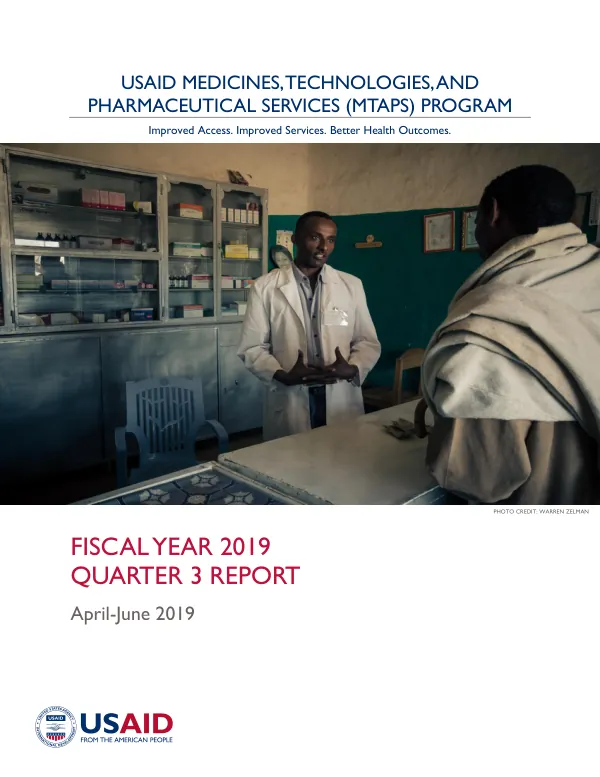
USAID Medicines, Technologies, and Pharmaceutical Services (MTaPS) Program: Quarterly Report Fiscal Year 2019, Quarter 3 (April-June 2019)
Sign inDELOITTE USA
USAID Medicines, Technologies, and Pharmaceutical Services (MTaPS) Program: Quarterly Report Fiscal Year 2019, Quarter 3 (April-June 2019)
The USAID Medicines, Technologies, and Pharmaceutical Services (MTaPS) Program is a global initiative aimed at improving access to medicines, technologies, and pharmaceutical services.
2019 · 65 pages
Sign in to readA free account is required to download.
Abstract
The program is implemented by Management Sciences for Health and is funded by the US Agency for International Development (USAID). The program's primary objective is to strengthen pharmaceutical sector governance, increase institutional and human resource capacity for pharmaceutical management and services, and improve the availability and use of pharmaceutical information for decision-making. The MTaPS program operates in multiple countries, including Bangladesh, Burkina Faso, Cameroon, Cote d'Ivoire, Democratic Republic of Congo, Ethiopia, Kenya, Mali, Mozambique, Nepal, The Philippines, Rwanda, Senegal, Tanzania, and Uganda. The program's activities are focused on improving pharmaceutical management, supply chain management, and regulatory capacity. In Bangladesh, for example, the program has been working to strengthen the country's pharmaceutical regulatory system, while in Burkina Faso, the program has been implementing a project to improve the availability and use of essential medicines. The program's progress is monitored and evaluated through a range of indicators, including the number of countries with functional pharmaceutical regulatory systems, the number of healthcare facilities with improved pharmaceutical management practices, and the number of healthcare workers trained in pharmaceutical management. The program's monitoring and evaluation framework is designed to track progress towards the program's objectives and identify areas for improvement. One of the key areas of focus for the MTaPS program is the improvement of pharmaceutical management information systems (PMIS). The program has been working to strengthen PMIS in multiple countries, including Bangladesh, Burkina Faso, and Cameroon. The program has also been implementing a range of interventions to improve the availability and use of essential medicines, including the development of standard treatment guidelines and the implementation of continuous quality improvement (CQI) programs. The MTaPS program has also been working to strengthen the capacity of healthcare workers in pharmaceutical management. The program has been implementing a range of training programs, including training of trainers (TOT) programs, to improve the skills and knowledge of healthcare workers in pharmaceutical management. The program has also been working to improve the availability and use of pharmaceutical information for decision-making, including the development of health technology assessments (HTA) and the implementation of pharmacovigilance programs. Overall, the MTaPS program is making significant progress towards its objectives, including the strengthening of pharmaceutical sector governance, the increase of institutional and human resource capacity for pharmaceutical management and services, and the improvement of the availability and use of pharmaceutical information for decision-making. The program's activities are focused on improving pharmaceutical management, supply chain management, and regulatory capacity, and are being implemented in multiple countries across Africa and Asia.
Related documents
Documents in this collection
 2020
2020USAID DEC
USAID Medicines, Technologies, and Pharmaceutical Services (MTaPS) Program: Quarterly Report Fiscal Year 2020, Quarter 1 (October–December 2019)
Open record 2020
2020USAID DEC