ABT ASSOCIATES
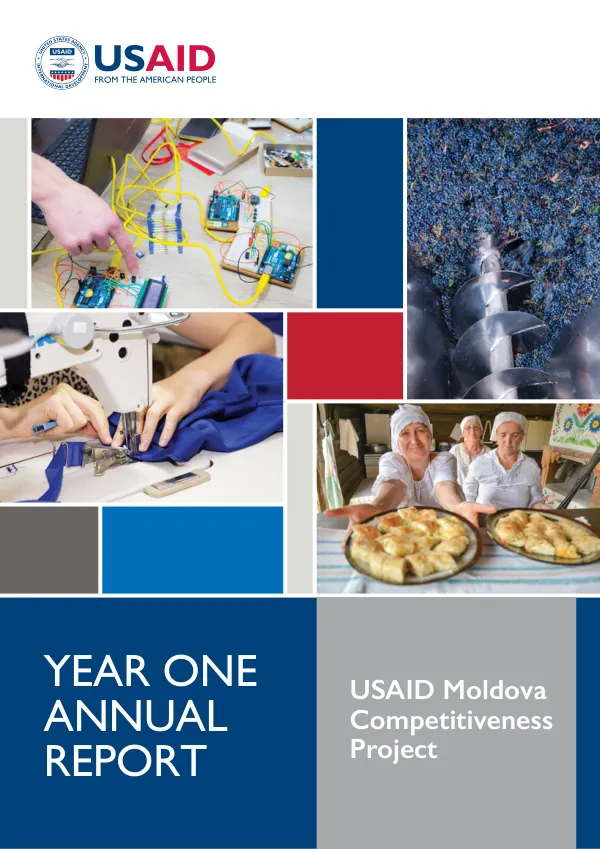
USAID Moldova Competitiveness Project Year One Annual Report
The USAID Moldova Competitiveness Project (MCP) is a five-year initiative launched on September 30, 2015, to promote a strong, diverse, and export-oriented economy in Moldova.
2016 · 218 pages
Sign in to readA free account is required to download.
Abstract
The project aims to increase competitiveness and efficiency in key Moldovan industries, including wine production, tourism, light industry, and information and communications technology (ICT). These industries are export-oriented and collectively account for 13% of GDP and 40% of Moldovan exports. The project focuses on developing key competitive and growth-ready industries through increased productivity and quality, expanded market linkages, and improved sector-enabling environment. USAID MCP supports four Moldovan industries, with the goal of assisting 450 enterprises that employ up to 25,000 people, generate $145 million of new sales, and bring $57 million of increased investments over five years. The project is strongly aligned with national strategies and reform goals of Moldova and will contribute directly to the achievement of Deep and Comprehensive Free Trade Area (DCFTA) goals. During Year 1, MCP strengthened industry competitiveness by working with private and public stakeholders along value chains and within broad clusters. The project assisted more than 250 small and medium-sized enterprises (SMEs) to adopt new technologies, heighten targeted marketing, and make critical investments in equipment and people. As a result, SMEs receiving USAID assistance registered $28 million growth in sales, including $20.8 million in exports on regional and global markets. New investments generated by USAID-assisted firms added up to $10 million, primarily for upgrades of production facilities, new equipment, and quality improvements. The project's workforce development initiatives benefited 3,400 people, focusing largely on cultivating job skills aligned with industry needs. USAID MCP also supported the implementation of EU quality standards in the wine industry, resulting in the release of the first wines with Protected Geographic Indication (PGI) in Moldovan winemaking history. PGI enables higher value added, facilitates access to the EU market, offers additional quality guarantee, and links wine to its region of origin, contributing to wine tourism. Moldova's wine industry has an outsize potential despite its lessened role in the economy impacted by the two Russian embargoes. The industry has undertaken necessary and positive structural reforms to reposition its market focus from Russian and Commonwealth of Independent States (CIS) markets to high-value EU and emerging markets. With USAID assistance, the Moldovan wine industry has developed a new vision and has made significant progress in quality, with two-thirds of the 130 Moldovan wineries receiving awards at reputable international contests, such as Decanter. The project's focus on quality growth is key to preparing Moldova's private sector to compete on EU and other high-value markets. USAID MCP's assistance is focused on increased quality and productivity achieved through modern technology and streamlined sector strategies. The project's workforce development initiatives are critical not only for economic growth but also for the democratic aspirations of the country, as Moldova has some of the highest levels of out-migration in the region, with up to 25% of the active labor force residing outside of the country.