USAID DEC
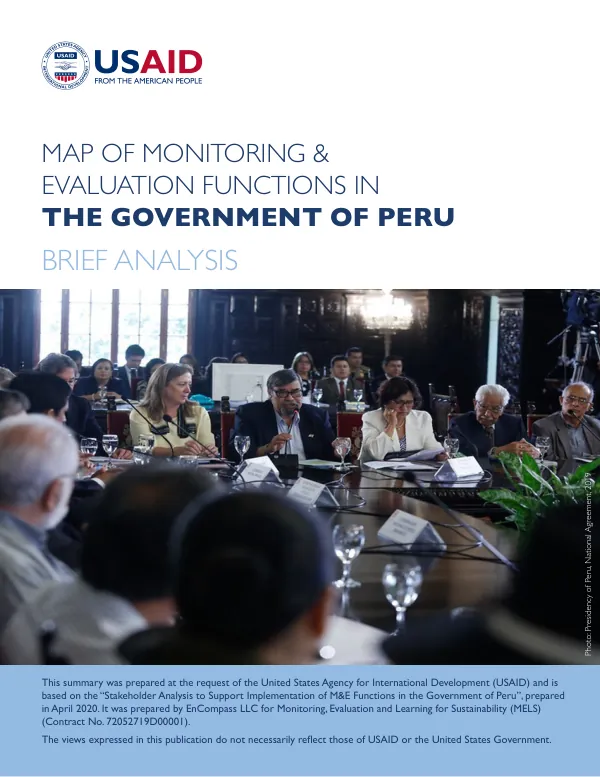
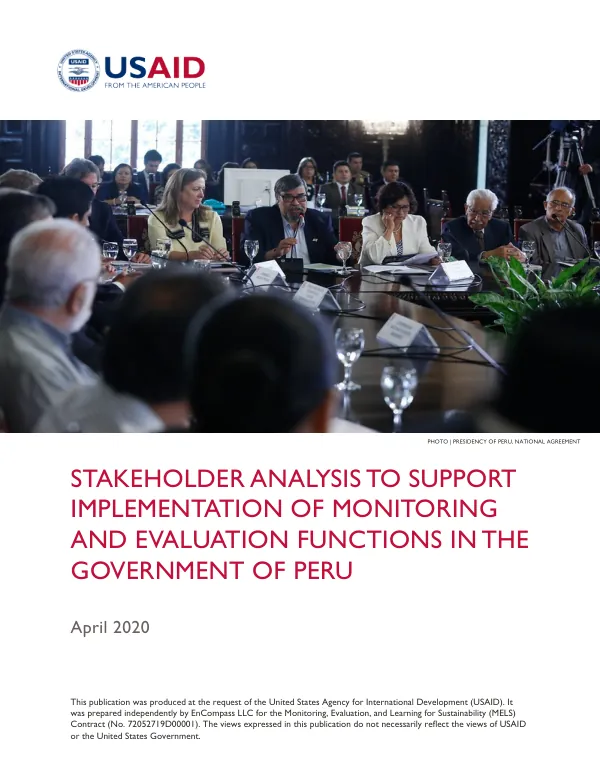
Stakeholder Analysis to Support Implementation of Monitoring and Evaluation Functions in the Government of Peru
Sign inENCOMPASS, LLC
Stakeholder Analysis to Support Implementation of Monitoring and Evaluation Functions in the Government of Peru
The Monitoring, Evaluation and Learning for Sustainability (MELS) Activity in Peru aims to strengthen monitoring and evaluation (M&E) capacities and functions among USAID/Peru partners.
2020 · 57 pages
Sign in to readA free account is required to download.
Abstract
This initiative seeks to generate and use evidence in decision making to support the achievement and sustainability of development results. The MELS Activity provides MEL services to the South American portfolio and USAID missions in Brazil and Paraguay, in addition to USAID's bilateral portfolio. The study was conducted to analyze the government sector actors that guide the implementation of Peru's monitoring and evaluation functions. The research employed qualitative techniques, including documentary review and in-depth interviews, to analyze all the ministries, regional governments, and a sample of decentralized public organizations. The study found a favorable political and regulatory environment for developing M&E capacities and progress in organizational structures for their implementation, especially in national entities. However, the study also identified limitations, including the absence of a leading entity in M&E matters and an unsatisfied demand in M&E capacity building. The research highlighted the importance of strengthening M&E systems and practices for effective and transparent management of public programs, as well as facilitating the country's admission to the Organisation for Economic Co-operation and Development (OECD). The MELS Activity aims to enhance the M&E functions and capacities of the Government of Peru's institutions to strengthen the effectiveness, transparency, and sustainability of public programs. The study's results will be key in fine-tuning and giving meaning to the MELS strategy known as Monitoring and Evaluation Strategic Actors for Sustainability (MESA). MESA will recruit strategic stakeholders across public and private sectors to jointly promote local solutions and adaptation of approaches to ensure activities MELS envisages are appropriate for the Peruvian and regional context. The study's findings will inform the development of MESA, which will focus on promoting the use of evaluation and evidence in programmatic decision-making activities. The research will also contribute to the strengthening of M&E capacities and functions among USAID/Peru partners, ultimately supporting the achievement and sustainability of development results. The study's results will be used to inform the development of MESA, which will aim to promote local solutions and adaptation of approaches to ensure activities MELS envisages are appropriate for the Peruvian and regional context. The study's methodology involved the analysis of all the ministries, regional governments, and a sample of decentralized public organizations. The research employed qualitative techniques, including documentary review and in-depth interviews, to gather data and information. The study's findings highlighted the importance of strengthening M&E systems and practices for effective and transparent management of public programs, as well as facilitating the country's admission to the OECD.