DAI
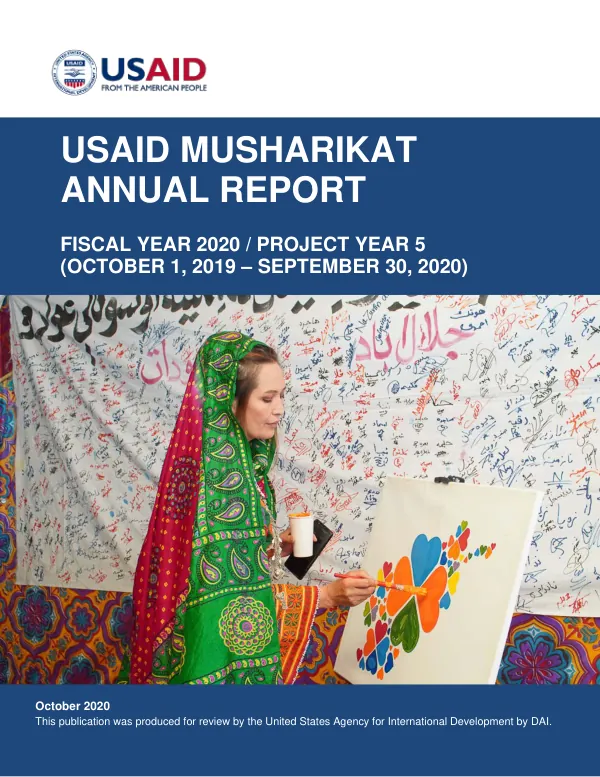
USAID Musharikat Annual Report (FY20 / PY5)
The USAID Musharikat project, which translates to "partnership" or "participation" in Dari and Pashto, is a five-year initiative aimed at empowering Afghan women.
2020 · 116 pages
Sign in to readA free account is required to download.
Abstract
The project, which began on September 2, 2015, and is set to conclude on September 1, 2021, is funded by the United States Agency for International Development (USAID) with a total budget of $29.5 million. The project's primary objective is to build constituencies among national, provincial, and local activists and civil society organizations (CSOs) focused on promoting women's equality and empowerment. To achieve this goal, the project works with a minimum of 300 CSOs and 5,000 activists across all 34 provinces in Afghanistan. The project employs inclusive, transparent, and competitive processes to bring CSOs and activists together to form coalitions, each designed to tackle a priority concern as determined by Afghan women. Led by Afghan women leaders, these coalitions engage with a wide set of stakeholders, including interested citizens, government and private sector partners, community and religious leaders, and media, to advance collective advocacy campaigns. In Fiscal Year 2020 (FY2020) / Project Year 5, Musharikat met or exceeded all Life of Project targets. The project also met all but two FY2020 Performance Indicator (PI) targets. The project's achievements in FY2020 include the establishment of 15 coalitions, with a total of 1,500 members, and the implementation of 12 advocacy campaigns. The project also trained 1,200 activists and CSO staff members on advocacy and coalition-building skills. The project's coalitions focus on various issues, including women's political participation, access to education, healthcare, and economic opportunities. The coalitions also work to address issues related to gender-based violence, access to justice, and anti-harassment of women and girls. The project's advocacy campaigns have resulted in significant gains, including the passage of several laws and policies that promote women's rights and empowerment. One of the project's key achievements is the establishment of the Women in the Peace Process Coalition, which brings together women from various backgrounds to advocate for their rights and interests in the peace process. The coalition has played a crucial role in shaping the peace process and ensuring that women's voices are heard. The project also works closely with government partners, including the Ministry of Women's Affairs, the Ministry of Education, and the Ministry of Public Health, to promote women's rights and empowerment. The project's partnership with these government agencies has resulted in significant gains, including the establishment of women's desks in various government ministries and the implementation of policies that promote women's participation in decision-making processes. In addition to its work with government partners, the project also engages with civil society organizations, including women's rights organizations, to promote women's empowerment and participation. The project provides training and capacity-building support to these organizations, enabling them to effectively advocate for women's rights and interests. The project's achievements in FY2020 demonstrate its commitment to promoting women's equality and empowerment in Afghanistan. The project's inclusive and transparent approach has enabled it to build strong partnerships with government and civil society partners, resulting in significant gains for women's rights and empowerment. The project's success can be attributed to its focus on building constituencies among national, provincial, and local activists and CSOs. By working with a wide range of stakeholders, the project has been able to promote women's rights and empowerment across all 34 provinces in Afghanistan. The project's commitment to inclusive and transparent processes has also enabled it to build trust and credibility with its partners, resulting in significant gains for women's rights and empowerment. In conclusion, the USAID Musharikat project has made significant progress in promoting women's equality and empowerment in Afghanistan. The project's achievements in FY2020 demonstrate its commitment to building strong partnerships with government and civil society partners, and its focus on promoting women's rights and empowerment across all 34 provinces in Afghanistan. The project's success serves as a model for future initiatives aimed at promoting women's empowerment and participation in decision-making processes.
Related documents