USAID
USAID NTD Program Historically Reported Results to Date (Complete Results)
The USAID NTD Program has reported significant progress in controlling and eliminating neglected tropical diseases (NTDs) in supported countries.
2021 · 2 pages
Sign in to readA free account is required to download.
Abstract
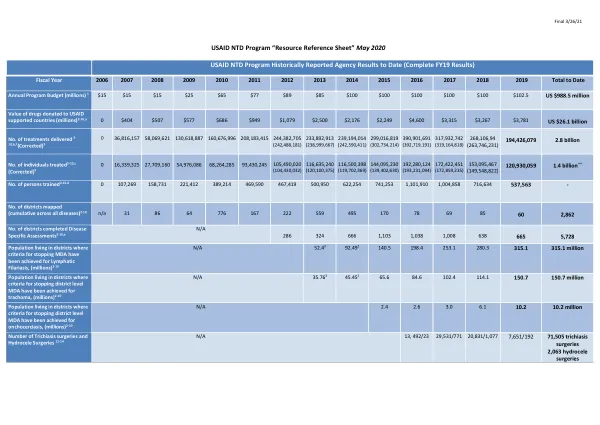
The program's annual budget has increased steadily, reaching $102.5 million in fiscal year 2019, with a total of $988.5 million allocated since 2006. The program has facilitated the donation of a substantial amount of drugs to supported countries, with a total value of $26.1 billion. This includes donations from pharmaceutical companies such as Johnson & Johnson, GlaxoSmithKline, Pfizer, and Merck, as well as the World Health Organization. The donated drugs have been used to treat a large number of individuals, with over 2.8 billion treatments delivered since 2006. The program has also trained a significant number of individuals in efforts to eliminate or control NTDs. Since 2006, over 1.4 billion persons have been trained, with a peak of 741,253 individuals trained in 2015. The program has also mapped over 2,862 districts across supported countries, with a cumulative total of 5,728 districts completing disease-specific assessments. The program has achieved significant progress in controlling and eliminating NTDs, particularly in lymphatic filariasis, trachoma, and onchocerciasis. The population living in districts where criteria for stopping mass drug administration (MDA) have been achieved for lymphatic filariasis has increased to 315.1 million, while the population living in districts where criteria for stopping district-level MDA have been achieved for trachoma has reached 150.7 million. The program has also reported a significant number of trichiasis surgeries and hydrocele surgeries, with over 71,505 trichiasis surgeries and 2,063 hydrocele surgeries performed since 2006. The program's progress has been documented through various reports and databases, including the ENVISION FY14 PY3 Annual Report, the ENVISION FY13 PY2 Semiannual Report, and the USAID NTD database. The program's indicators have been defined and calculated to capture the number and value of donated drugs, the number of treatments delivered, the number of individuals trained, and the number of districts mapped and completing disease-specific assessments.
Related documents