USAID
USAID Oceans and Fisheries Partnership: Labor Profile of Philippine Fisheries
The Oceans and Fisheries Partnership conducted a study on the labor profile of Philippine fisheries, focusing on General Santos City.
2016 · 4 pages
Sign in to readA free account is required to download.
Abstract
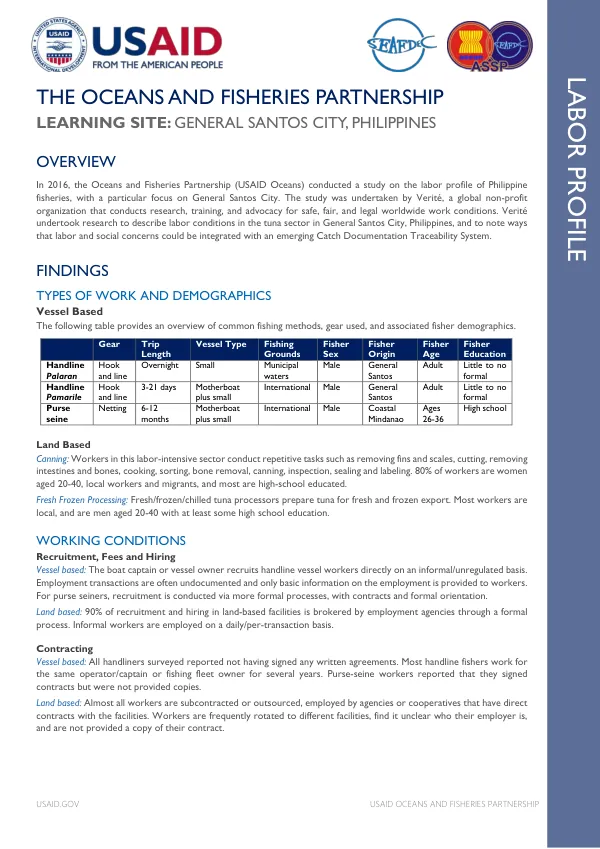
The study aimed to describe labor concerns in the tuna sector and identify ways to integrate social and labor concerns with an emerging Catch Documentation and Traceability System. The study found that vessel-based fishers primarily work in the tuna sector, with most handline fishers lacking formal documentation. Handline fishers reported working for extended periods, often without advance notice, and may be stuck on the vessel unpaid when replaced. Purse-seine workers, on the other hand, have formal employment arrangements, including contracts and orientation. In contrast, land-based workers, primarily employed in canning and processing facilities, work in labor-intensive tasks such as removing fish scales, cutting, and canning. Most land-based workers are local, with 80% of canning workers being women aged 20-40. Fresh/frozen/chilled tuna processors are mostly local men aged 20-40 with some high school education. The study identified several labor concerns, including recruitment and hiring practices, working conditions, and working hours. Vessel-based fishers reported a lack of formal training and written policies, while land-based workers experienced verbal and physical abuse, and occasional physical abuse from management. The study also highlighted the importance of freedom of association, with some fishers represented by a national labor federation, but none able to join a union. Workers reported being scared to report grievances for fear of being blacklisted. The General Santos Fish Port supports the FishR system, which aims to register municipal fishers to develop a national registration system. The study recommends collecting additional data on recruitment and hiring practices, onsite management, and working conditions to improve transparency and standardization. The data collection should include production capacity, production schedules, registry of workers, contracts, and payroll records. The study also recommends improving working conditions, including providing safety training, providing safety equipment, and reducing working hours. Additionally, the study suggests that employers should provide benefits, including health insurance, and ensure that workers receive their wages on time. The study emphasizes the importance of addressing labor concerns in the tuna sector to improve working conditions and improve the livelihoods of fishers and processing workers.
Related documents