U.S.G.S.
USAID/OFDA DISASTER RISK REDUCTION: EARTHQUAKES
Earthquake disaster risk reduction is a critical component of disaster management, particularly in regions prone to seismic activity.
2012 · 2 pages
Sign in to readA free account is required to download.
Abstract
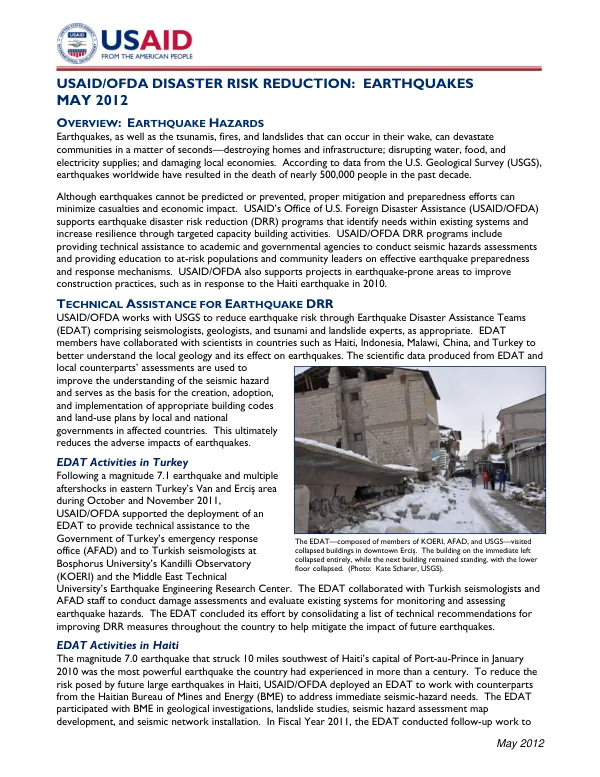
Earthquakes can cause widespread destruction, resulting in significant loss of life and economic impact. According to data from the U.S. Geological Survey (USGS), earthquakes worldwide have resulted in the death of nearly 500,000 people in the past decade. USAID's Office of U.S. Foreign Disaster Assistance (USAID/OFDA) supports earthquake disaster risk reduction programs that identify needs within existing systems and increase resilience through targeted capacity building activities. These programs include providing technical assistance to academic and governmental agencies to conduct seismic hazards assessments and providing education to at-risk populations and community leaders on effective earthquake preparedness and response mechanisms. USAID/OFDA also supports projects in earthquake-prone areas to improve construction practices, such as in response to the Haiti earthquake in 2010. The Earthquake Disaster Assistance Teams (EDAT) are a key component of USAID/OFDA's earthquake disaster risk reduction efforts. EDAT members, comprising seismologists, geologists, and tsunami and landslide experts, collaborate with scientists in countries such as Haiti, Indonesia, Malawi, China, and Turkey to better understand the local geology and its effect on earthquakes. The scientific data produced from EDAT and local counterparts' assessments are used to improve the understanding of the seismic hazard and serve as the basis for the creation, adoption, and implementation of appropriate building codes and land-use plans by local and national governments in affected countries. In Turkey, following a magnitude 7.1 earthquake and multiple aftershocks in eastern Turkey's Van and Erciş area in October and November 2011, USAID/OFDA supported the deployment of an EDAT to provide technical assistance to the Government of Turkey's emergency response office (AFAD) and to Turkish seismologists at Bosphorus University's Kandilli Observatory (KOERI) and the Middle East Technical University's Earthquake Engineering Research Center. The EDAT collaborated with Turkish seismologists and AFAD staff to conduct damage assessments and evaluate existing systems for monitoring and assessing earthquake hazards. The EDAT concluded its effort by consolidating a list of technical recommendations for improving disaster risk reduction measures throughout the country to help mitigate the impact of future earthquakes. The Global Earthquake Model Foundation (GEM) is a public-private partnership that aims to establish uniform and accessible standards for calculating and communicating earthquake risk. GEM's mission is to engage a global collaborative effort in the design, development, and deployment of state-of-the-art models and tools for earthquake risk assessment. GEM provides a collaborative space for hundreds of organizations, including the World Bank, several U.N. agencies, government agencies, and independent technical experts, to create a dynamic and open model for calculating the probability of potential damage from earthquakes worldwide. The resulting earthquake models will not only analyze earthquake hazard exposure and vulnerability but will also allow for assessment of risk and impact on societies and local economies in the short, medium, and long term.