MERCY CORPS INTERNATIONAL
USAID OFDA East Asia and Pacific Newsletter Jan and Feb 2011
The USAID Office of U.S.
2011 · 2 pages
Sign in to readA free account is required to download.
Abstract
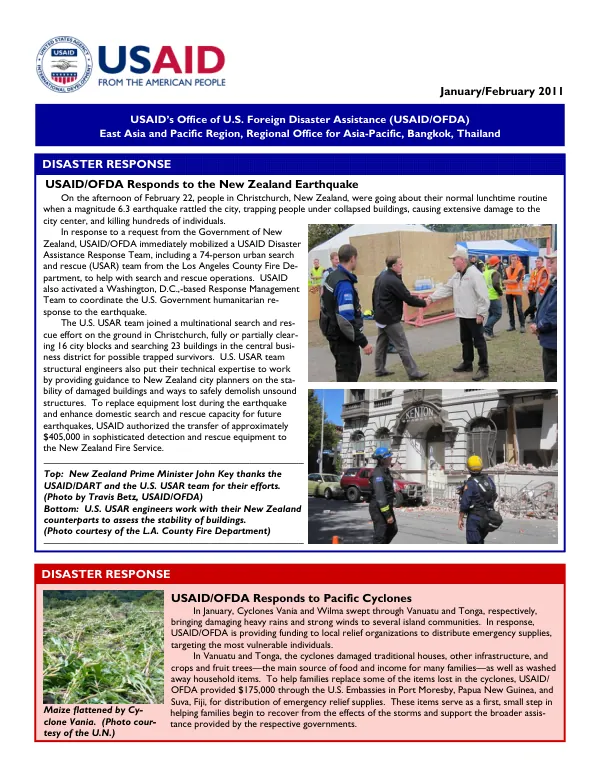
Foreign Disaster Assistance (USAID/OFDA) Regional Office for Asia-Pacific in Bangkok, Thailand, responded to several disasters in the Asia-Pacific region in 2011. In February, a magnitude 6.3 earthquake struck Christchurch, New Zealand, causing extensive damage and killing hundreds of people. In response, USAID/OFDA mobilized a 74-person urban search and rescue (USAR) team from the Los Angeles County Fire Department to assist with search and rescue operations. The USAR team joined a multinational effort, fully or partially clearing 16 city blocks and searching 23 buildings in the central business district. In January, Cyclones Vania and Wilma swept through Vanuatu and Tonga, respectively, bringing heavy rains and strong winds to several island communities. USAID/OFDA provided funding to local relief organizations to distribute emergency supplies, targeting the most vulnerable individuals. The cyclones damaged traditional houses, infrastructure, and crops, and USAID/OFDA provided $175,000 for the distribution of emergency relief supplies. China's vast and diverse landscape makes it vulnerable to a wide range of disasters. Local communities are often the first to respond to disasters, but they require support and tools to plan for and respond to disasters. USAID/OFDA is funding a two-year program to support innovative community-based disaster mitigation and school-based disaster education activities in 250 to 300 communities in three provinces of China. The program builds on previous initiatives that trained teachers on disaster risk reduction (DRR) and helped pilot cities develop hazard maps and emergency plans. The Philippines is one of the most disaster-prone countries in the world, with communities facing an array of disasters, including drought, earthquakes, floods, landslides, typhoons, and volcanic eruptions. Between December and February, several waves of heavy rains inundated central and southeastern Philippines, affecting communities in Eastern Visayas and Caraga regions. According to the Government of the Republic of the Philippines, floods and landslides had killed 110 people, injured 13 others, and damaged nearly 6,000 houses. A subsequent USAID assessment highlighted the importance of DRR initiatives in helping to avert a more serious disaster. Communities where local government units had taken leadership in preparing for and mitigating the impacts of the floods appeared to have sustained less significant impacts from the floods. USAID/OFDA supported the distribution of relief supplies, such as hygiene kits and water purification tablets, to affected families in coordination with USAID/Philippines. To strengthen preparedness and response capacity in the Philippines, USAID/OFDA has provided $750,000 to the U.N. World Food Program (WFP) to provide technical support to the Government of the Philippines Department of Social Welfare and Development (DSWD) and other government agencies. Building on WFP's experience in responding to disasters, this initiative will help DSWD to map and analyze vulnerable areas, implement cash-for-work activities, and manage and track relief items. In October 2010, a tsunami struck the Mentawai Island chain in Indonesia, washing away houses and many families' belongings. In the immediate aftermath of the disaster, several adults and children began to show signs of diarrhea, skin rashes, and breathing problems, increasing concerns regarding the spread of diseases. USAID/OFDA provided support to Mercy Corps to distribute 1,000 water buckets to affected families, which helped to improve access to water and prevent a large-scale outbreak of disease.
Related documents