USAID DEC
USAID/OTI Burma Quarterly Report, January – March 2015
The U.S.
2015 · 7 pages
Sign in to readA free account is required to download.
Abstract
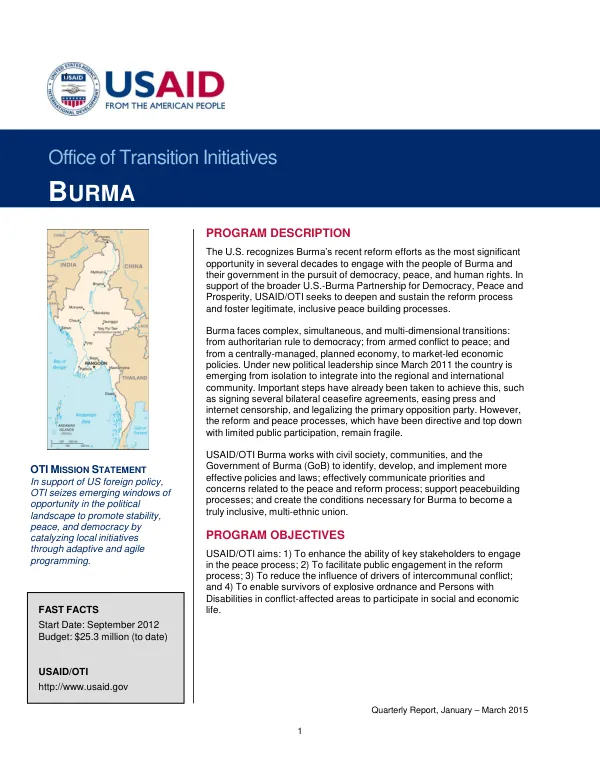
recognizes Burma's recent reform efforts as the most significant opportunity in several decades to engage with the people of Burma and their government in the pursuit of democracy, peace, and human rights. In support of the broader U.S.-Burma Partnership for Democracy, Peace and Prosperity, USAID/OTI seeks to deepen and sustain the reform process and foster legitimate, inclusive peace building processes. Burma faces complex, simultaneous, and multi-dimensional transitions: from authoritarian rule to democracy; from armed conflict to peace; and from a centrally-managed, planned economy to market-led economic policies. Under new political leadership since March 2011, the country is emerging from isolation to integrate into the regional and international community. Important steps have already been taken to achieve this, such as signing several bilateral ceasefire agreements, easing press and internet censorship, and legalizing the primary opposition party. USAID/OTI Burma works with civil society, communities, and the Government of Burma to identify, develop, and implement more effective policies and laws; effectively communicate priorities and concerns related to the peace and reform process; support peacebuilding processes; and create the conditions necessary for Burma to become a truly inclusive, multi-ethnic union. The program aims to enhance the ability of key stakeholders to engage in the peace process, facilitate public engagement in the reform process, reduce the influence of drivers of intercommunal conflict, and enable survivors of explosive ordnance and Persons with Disabilities in conflict-affected areas to participate in social and economic life. The Myanmar National Democratic Alliance Army (MNDAA) led by Peng Jiasheng started clashes with the Government of Burma (GOB) Army in Laukkai (Kokang self-administered region) in North East Shan State on 9 February. The conflict has a long history, linking back to Burma's civil war and communist rebellions. A previous major conflict, the Kokang Incident, occurred between the Kokang and the government in 2009 when Peng Jiasheng's faction of the MNDAA refused to form a pro-government Border Guard Force; approximately 30,000 were displaced into China at that time. In this reporting period, both GOB's Union Peace-Making Working Committee (UPWC) and the Nationwide Ceasefire Coordination Team (NCCT), representing 16 Ethnic Armed Groups (EAGs), tried to restart the peace process that stalled after the sixth round of negotiations in September 2014. A Deed of Commitment for Peace and Reconciliation was signed by some EAGs, political parties, senior government officials, and Burmese military on Union Day, the 12th of February. The document includes a written commitment to federalism and political dialogue by the government. The seventh round of peace negotiation meeting took place from the 17th through the 22nd of March at the Myanmar Peace Center (MPC) office in Yangon. The main discussion points centered around the remaining points of the Nationwide Ceasefire Agreement (NCA) with both sides claiming that the meeting was positive and productive and agreements were made on a number of remaining issues. The meeting continued from the 30th of March and the UPWC and NCCT signed the final draft of NCA on the 31st of March.