CHEMONICS
USAID/OTI Iraq Community Resilience Initiative (ICRI) Final Report
The USAID/OTI Iraq Community Resilience Initiative (ICRI) was established in June 2018 to support the safe and voluntary return of displaced populations, including minorities, in areas liberated from ISIS.
2020 · 6 pages
Sign in to readA free account is required to download.
Abstract
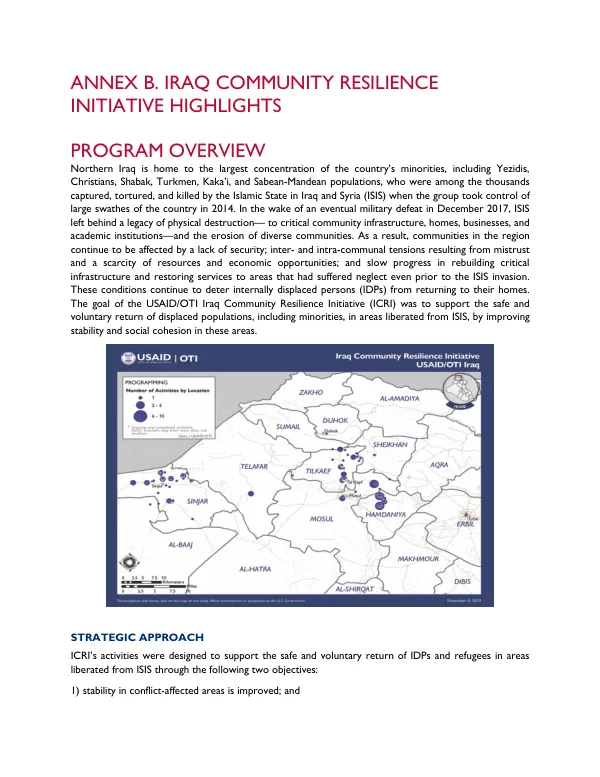
The initiative aimed to improve stability and social cohesion in these areas through visible, quick-impact projects in partnership with civil society organizations, faith-based groups, and local governance bodies. ICRI's activities focused on restoring service delivery, rebuilding livelihoods, and supporting efforts to reduce community tension and increase positive social interactions between diverse groups. ICRI contributed to improving stability in the Ninewa Plains, Mosul, and Western Ninewa by supporting civil society, faith-based organizations, and local governance actors to meet priority early recovery needs. The initiative's efforts to accelerate recovery and reduce the impact of the conflict in communities liberated by ISIS included the restoration of basic services and livelihoods. In Hamdaniya, ICRI supported the Humanitarian Nineveh Relief Organization to coordinate rubble removal from 66 houses, reducing the financial burden on families working to rehabilitate their homes. In Bashiqa, ICRI partnered with the Iraqi NGO Ghasin Al-Zaiton to rehabilitate the Einw Alq olive grove, planting approximately 700 olive trees and providing farmers with the proper equipment for planting. This effort created livelihood opportunities for over 70 Bashiqa residents. In Tal Kayf, ICRI provided excavation vehicles and equipment, water pipe materials, welding equipment, and outreach support to the Tal Kayf District Office to improve water provision in the district. The provision of this equipment allowed for the repair of water pipes at 65 separate leakage locations over the course of five months. ICRI also supported the Sahara Economic Development Organization to bolster small businesses in the periphery of the Sinuni sub-district following the destruction of local businesses and the local economy at the hands of ISIS. Seventy-four family-owned small businesses received equipment and management training that allowed them to re-open and conduct business. In addition to accelerating recovery through the rehabilitation of community infrastructure, livelihoods, and services delivery in minority communities, ICRI aimed to improve social cohesion in Ninewa Province and surrounding communities by fostering positive interactions between diverse political, ethnic, and sectarian groups. ICRI supported the Peace Through Arts Foundation to hold two concerts in both East and West Mosul to promote positive interaction between the diverse communities in the city. The event was well-attended by Moslawis and enjoyed significant media coverage from both Iraqi and international news outlets. ICRI also supported the Youth Bridge Organization to repair and equip the Sinuni Cultural Center, which was destroyed by ISIS in the Sinuni sub-district. These efforts aimed to accelerate the reconciliation process and encourage displaced families to return to their homes. As of September 30, 2019, ICRI cleared a total of 65 activities for implementation with an approximate value of 5,888,987.69 USD, all of which are completed and/or closed. ICRI worked with 38 local partners across Ninewa, including Sinjar, Sinuni, Bandiwaya, Bartella, Bashiqa, Hatara, Wana, Tal Afar, Tal Kayf, Shikan, Mosul, Karamles, Teleskof, and Hamdaniya. The initiative was led by a regional program manager overseeing both operations and programmatic staff, and all staff members either returned to the Chemonics home office following the end of their assignment or transferred to the Iraq Regional Program (IRP).