CHEMONICS
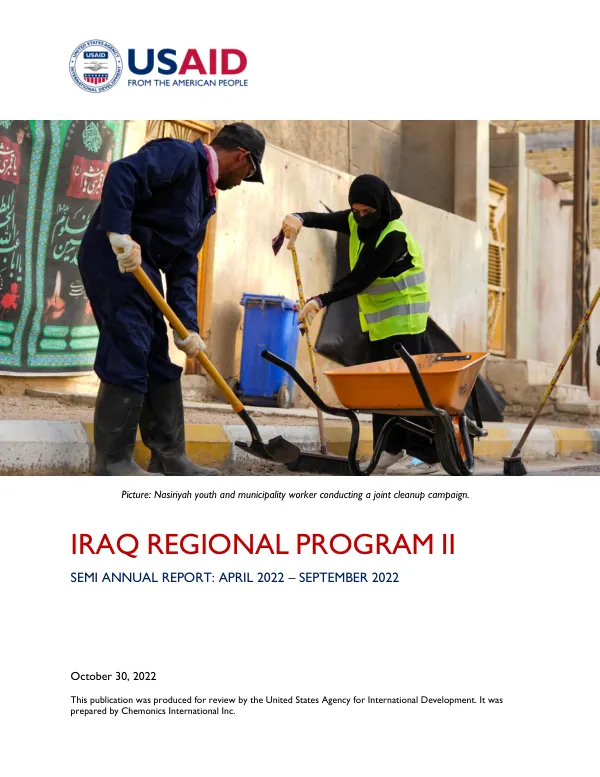
Iraq Regional Program II Semi-Annual Report April 2022- September 2022
The Iraq Regional Program II (IRP II) is a three-year initiative launched in September 2021 by the United States Agency for International Development's Office of Transition Initiatives (USAID/OTI).
2022 · 20 pages
Sign in to readA free account is required to download.
Abstract
The program aims to increase stability in Iraq by promoting equity and inclusion in strategic, marginalized communities, reducing polarization and sectarianism, and mitigating discrete challenges that threaten overall stability. In July 2022, the program underwent a Strategy Review Session, which led to the development of a new strategic framework to support a prosperous and inclusive Iraq. The framework focuses on empowering inclusive civic action and mitigating challenges that threaten stability in strategic areas. To achieve these objectives, IRP II provides direct assistance to Iraqi partners to increase positive perceptions of civic engagement and community mobilization around national causes. As of the semi-annual reporting period, IRP II's portfolio includes 85 activities valued at an estimated $7,386,864 across five areas of focus. Of these, 35 activities have been completed and/or closed, valued $2,762,332; 36 are under implementation, with an estimated value of $3,342,216; and 14 activities are currently pending with an estimated value of $1,126,344. IRP II has provided grants to 51 local partners to design and implement these activities. During the reporting period, Iraq witnessed escalating tensions between political parties, which prevented the Council of Representatives from forming a government nearly a year after elections. The tensions were fueled by claims of voter fraud and the definition of the largest parliamentary bloc. The situation escalated in June 2022 when Muqtada al-Sadr ordered his 73 lawmakers to resign from the Council of Representatives. The protests and violence that followed resulted in approximately 30 deaths and hundreds of injuries. The prospects for Iraq's stability are dependent on the Council of Representatives' ability to form a government capable of responding to citizens' demands. Despite Muqtada al-Sadr's withdrawal from politics, his actions indicate that he intends to remain involved in Iraqi politics and may use other levers of power to exert influence. Other issues, such as Kurdish-Kurdish tensions and the increased tensions between Baghdad and Erbil, also hinder reaching agreements over forming a Federal Government. The prolonged process of government formation has notably increased public frustration, with Iraqis feeling the economic consequences of the war on Ukraine, including price increases in staples such as wheat and sunflower oil. The situation remains uncertain, and the prospects for Iraq's stability depend on the ability of the Council of Representatives to form a government capable of responding to citizens' demands. IRP II has been working to address these challenges by providing support to local partners and promoting inclusive civic action. The program has provided grants to 51 local partners to design and implement activities aimed at increasing positive perceptions of civic engagement and community mobilization around national causes. The program's focus on empowering inclusive civic action and mitigating challenges that threaten stability in strategic areas is critical to promoting stability and prosperity in Iraq. The program's activities have been implemented across five areas of focus, including the National/Media, Mosul, Sinjar, South, and Western Anbar regions. The program has provided support to local partners in these regions, including local and regional government entities, large and small civil society organizations, faith-based groups, and media outlets. The program's activities have been valued at an estimated $7,386,864, with 35 activities completed and/or closed, valued $2,762,332; 36 activities under implementation, with an estimated value of $3,342,216; and 14 activities currently pending, with an estimated value of $1,126,344.