MANAGEMENT SYSTEMS INTERNATIONAL
Iraq MENA II Evaluation Report
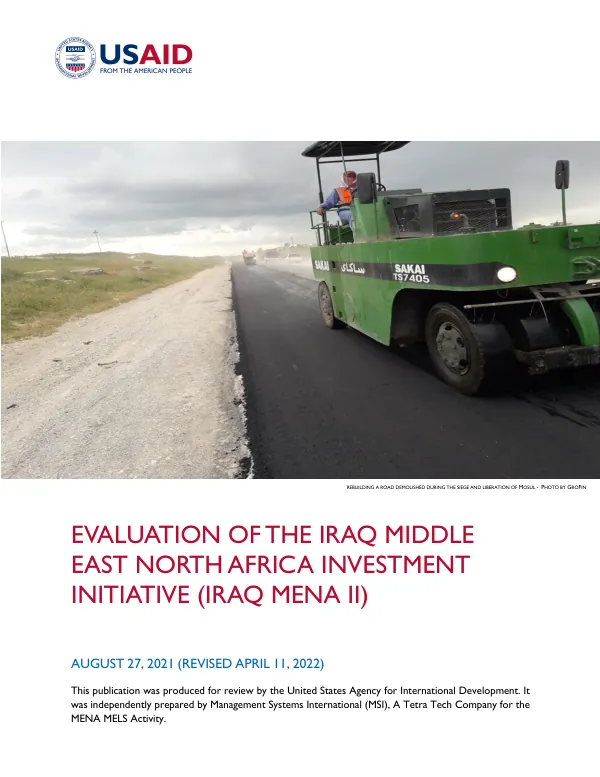
The Iraq Middle East North Africa Investment Initiative (Iraq MENA II) was a USAID-funded activity designed to support early-stage businesses in Iraq, with the goal of improving their competitiveness and revenue growth.
2022 · 84 pages
Sign in to readA free account is required to download.
Abstract
The activity was implemented by Shell Foundation, which established an investment management company, and GroFin, which managed two investment management funds and provided financial assistance and business support to qualified early-stage businesses (QESBs) in Iraq. The evaluation team conducted 54 key informant interviews with 32 entrepreneurs receiving financial assistance and/or business support, as well as representatives of USAID, Shell Foundation, GroFin, and other implementing partners. The team also reviewed available documentation and data and visited 8 operating businesses located in northern Iraq. The evaluation found that the activity had provided access to finance in the form of loans to 35 entrepreneurs, which was greatly valued by those interviewed. However, opinions on the quality and extent of technical assistance and business support provided by GroFin were more mixed, with many entrepreneurs indicating that they had received very limited or no business support services. The evaluation recommendations focused on ways to improve the utility of technical assistance and business support, assess the impact of certain lending practices on female entrepreneurs and those from minority ethnic or religious groups, and to improve communications with applicants for financial assistance. The evaluation also examined the activity's effectiveness in achieving its objectives, its relevance in the Iraq context, and its sustainability. The findings indicated that the activity had made significant progress in providing access to finance for early-stage businesses, but that there were opportunities to improve the quality and extent of technical assistance and business support. The evaluation also highlighted the importance of coordination with other USAID/IRAQ activities and the need to assess the impact of certain lending practices on vulnerable groups. The evaluation team identified several key lessons that can be learned from the activity, including the importance of providing high-quality technical assistance and business support, the need to assess the impact of lending practices on vulnerable groups, and the importance of improving communications with applicants for financial assistance. The team also recommended ways to enhance the effectiveness of similar activities in the future and to help sustain USAID's intended results. The evaluation team conducted a comprehensive review of the activity's implementation, including a review of documentation and data, key informant interviews, and visits to operating businesses. The team's findings and recommendations provide valuable insights into the activity's strengths and weaknesses and highlight opportunities for improvement. The activity's implementation approach was effective in achieving its objectives, with 35 entrepreneurs receiving loans and benefiting from access to finance. However, the quality and extent of technical assistance and business support provided by GroFin were more mixed, with many entrepreneurs indicating that they had received very limited or no business support services. The evaluation team recommended ways to improve the utility of technical assistance and business support, including providing more comprehensive and tailored support to entrepreneurs. The activity's relevance in the Iraq context was also examined, with the evaluation team finding that the activity had made significant progress in providing access to finance for early-stage businesses. However, the team also highlighted the importance of coordination with other USAID/IRAQ activities and the need to assess the impact of certain lending practices on vulnerable groups. The evaluation team's findings and recommendations provide valuable insights into the activity's strengths and weaknesses and highlight opportunities for improvement. The team's recommendations focus on ways to improve the utility of technical assistance and business support, assess the impact of certain lending practices on vulnerable groups, and to improve communications with applicants for financial assistance.