USAID
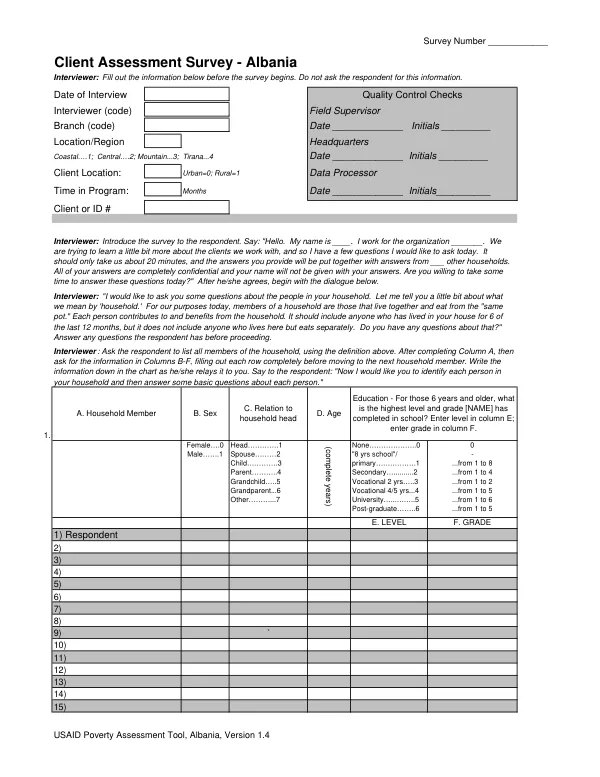
USAID Poverty Assessment Tool, Albania, Version 1.4
The agricultural development initiative in Albania began with the implementation of the USAID Poverty Assessment Tool, Version 1.4.
2011 · 2 pages
Sign in to readA free account is required to download.
Abstract
The survey aimed to gather information on household demographics, economic status, and access to various assets. The tool was designed to assess poverty levels and identify areas for intervention. The survey collected data on household composition, including the number of people living in the household, age of the household head, and the highest level of education attained by the household head. The tool also inquired about the household's ownership of various assets, such as a boiler, car, truck, telephone, cell phone, computer, VCR, refrigerator, water pump, and generator. Additionally, the survey collected information on the household's agricultural land ownership, including the total area of all agricultural land owned. Implementation of the survey involved a structured interview process, where the interviewer would ask the respondent a series of questions about the household members, their education levels, and the household's assets. The survey was designed to be completed within 20 minutes, and the respondent's answers were kept confidential. The survey results provided valuable insights into the economic status and access to assets of households in Albania. The data collected would be used to assess poverty levels and identify areas for intervention, ultimately contributing to the development of effective poverty reduction strategies. The survey's findings on household composition and education levels highlighted the importance of education in reducing poverty. The data showed that households with higher levels of education tended to have better economic outcomes. The survey also found that households with access to various assets, such as a car or computer, were more likely to have higher incomes. The survey's results on agricultural land ownership and access to assets provided valuable insights into the economic status of households in rural areas. The data showed that households with larger areas of agricultural land tended to have higher incomes, and that access to assets such as a water pump or generator was associated with improved economic outcomes. Overall, the USAID Poverty Assessment Tool, Version 1.4, provided a comprehensive framework for assessing poverty levels and identifying areas for intervention in Albania. The survey's findings highlighted the importance of education, access to assets, and agricultural land ownership in reducing poverty and improving economic outcomes.
Related documents