USAID
USAID Poverty Assessment Tool, Azerbaijan, Version 1.3
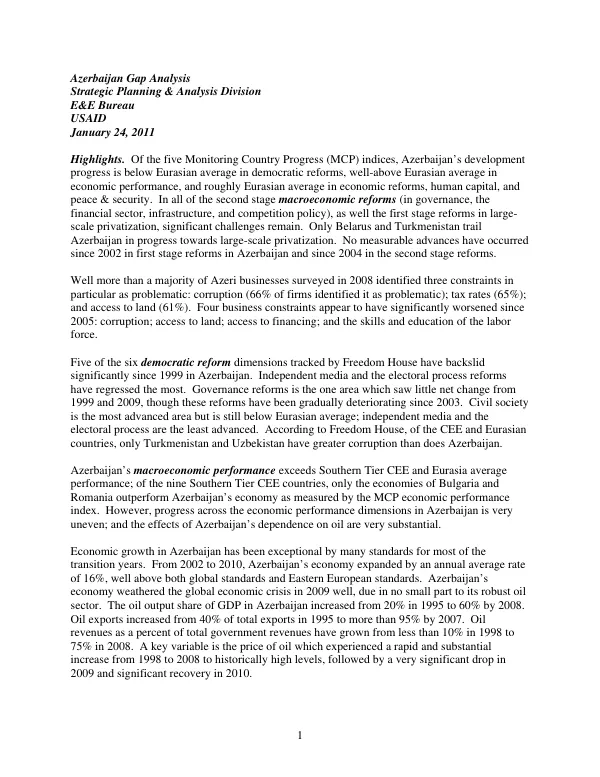
The agricultural development initiative in Azerbaijan began with the implementation of the USAID Poverty Assessment Tool, Version 1.3.
2011 · 2 pages
Sign in to readA free account is required to download.
Abstract
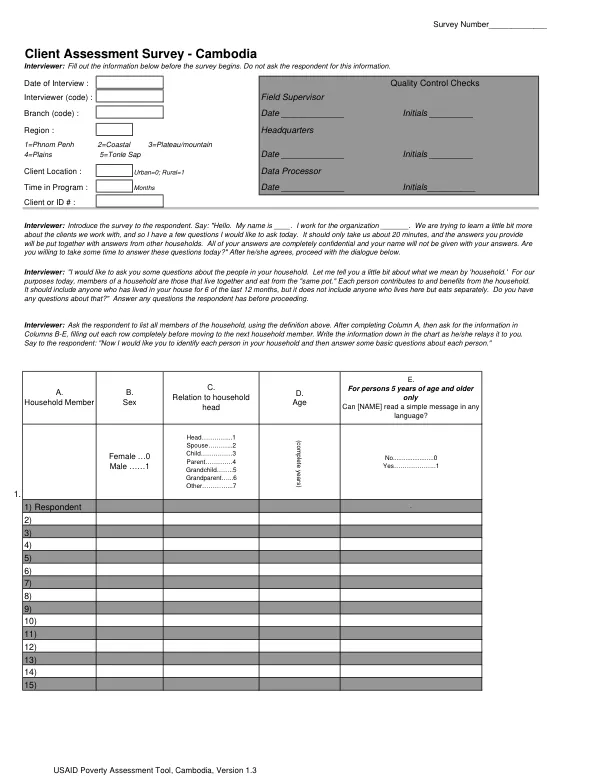
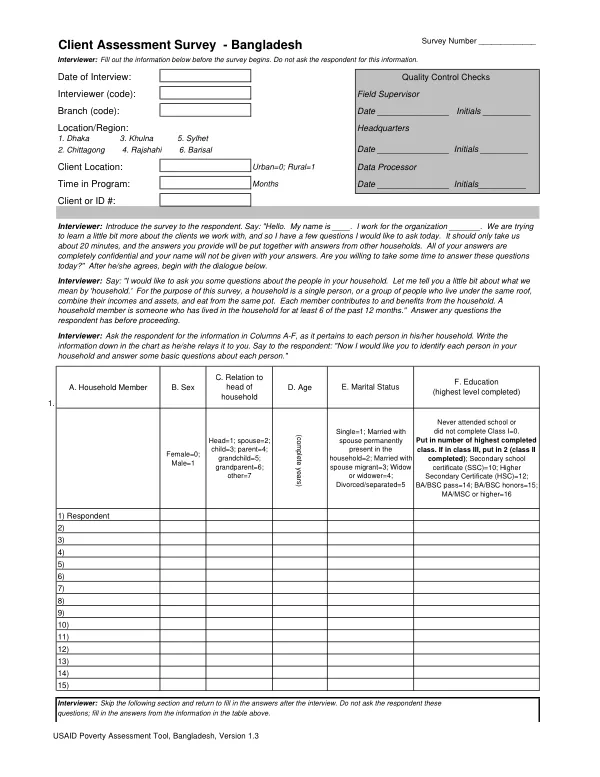
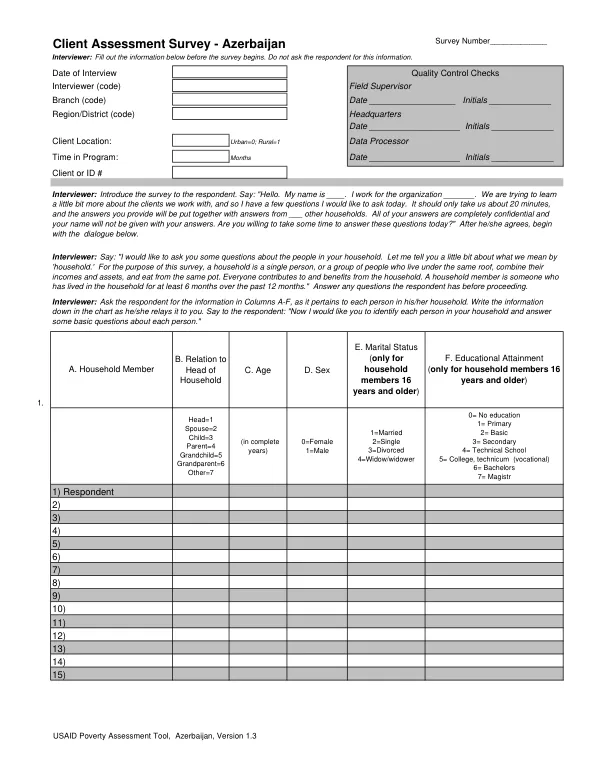
The tool is designed to collect data on household characteristics, housing conditions, and asset ownership. The survey is conducted in a standardized manner, with the interviewer following a set protocol to ensure consistency. The survey begins by collecting demographic information on household members, including age, sex, marital status, and educational attainment. The household head is identified, and their age, sex, marital status, and education level are recorded. The survey also collects information on the number of household members with a Magistr as their highest level of education. The housing situation is assessed through a series of questions, including the type of dwelling, availability of central heat, running water, and primary source of drinking water. The survey also inquires about the ownership of various assets, such as mobile phones, color television sets, sewing machines, and cars. In addition to housing and asset ownership, the survey collects information on livestock ownership, including the number of young cattle, geese and ducks, and other poultry. The survey is designed to provide a comprehensive picture of household characteristics and living conditions, which can be used to inform poverty reduction strategies and development programs. The survey is implemented in a standardized manner, with the interviewer following a set protocol to ensure consistency. The data collected through the survey is used to assess poverty levels, identify areas of need, and inform development programs. The survey is an essential tool for understanding household characteristics and living conditions in Azerbaijan, and its findings can be used to inform policy and program decisions. The data collected through the survey is used to assess poverty levels, identify areas of need, and inform development programs. The survey is an essential tool for understanding household characteristics and living conditions in Azerbaijan, and its findings can be used to inform policy and program decisions. The survey's standardized protocol ensures consistency in data collection, which is essential for making accurate assessments and informed decisions. The survey's findings can be used to identify areas of need and inform development programs. For example, the data on housing conditions can be used to identify households that require assistance with access to basic services such as running water and central heat. Similarly, the data on asset ownership can be used to identify households that require assistance with access to basic goods and services.
Related documents