USAID DEC
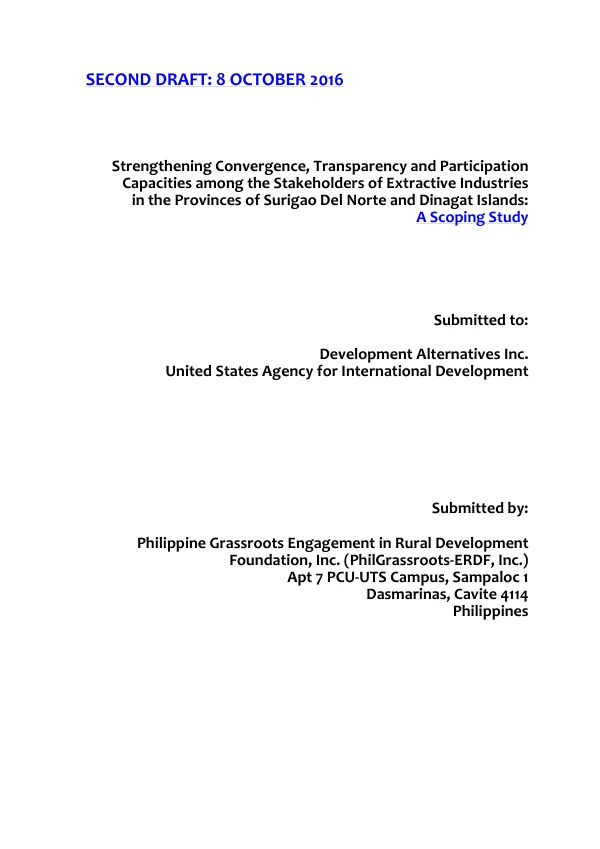
Strengthening Convergence, Transparency and Participation Capacities among the Stakeholders of Extractive Industries in the Provinces of Surigao Del Norte and Dinagat Islands: A Scoping Study
Sign inDEVELOPMENT ALTERNATIVES, INC./FINNET
Strengthening Convergence, Transparency and Participation Capacities among the Stakeholders of Extractive Industries in the Provinces of Surigao Del Norte and Dinagat Islands: A Scoping Study
The extractive industries in the Provinces of Surigao Del Norte and Dinagat Islands have been a major source of revenue for the national government, with an estimated 1.18% contribution to the country's Gross National Product (GNP) between 2009 and 2013.
2016 · 60 pages
Sign in to readA free account is required to download.
Abstract
However, despite this revenue, poverty persists in the region, with almost half of the country's population living in poverty. The poverty eradication strategy of the government has been analyzed by the World Bank, revealing that the nature of poverty and the progress in reducing poverty have been stubborn, with poverty persisting despite the region's impressive growth. The Provinces of Dinagat Islands and Surigao Del Norte are cases in point, where extractive industries are plentiful, but poverty conditions are apparent in the way resources are distributed. The entire human settlement in these areas is largely dependent on whatever they can extract from the available mineral resources or what the mining tenement operators and immediate environment can provide. These groups are observed to be the most vulnerable among the rural poor populace. The national government has been receiving tax payments, fees, shares, and support from the mining companies, which are then shared to the Local Government Units through the National Wealth Shares. However, despite these development initiatives, the living conditions of the people have not improved, and the common incidence of unfunded Social Development and Management Programs (SDMPs) persists. The continuing depletion of the forest areas and mineral lands of the Provinces of Dinagat Islands and Surigao Del Norte as declared mining reserves also need further study. The current economic and environmental conditions of these provinces have led to critical questions regarding transparency and accountability. The level of awareness needed for people to truly participate in the development of the mineral land and contribute to the reduction of poverty is a pressing concern. Local Government Units have difficulties translating their national wealth shares into development services that contribute to the improvement of quality of life. The wealth shares intended for the LGUs and communities around the mining areas are also a concern, as well as the transparency and accountability of the mining stakeholders in doing development interventions to arrest poverty. The objective of this scoping study is to contribute to the quest for convergence, transparency, and participation in the areas where extractive industries are present through a multi-stakeholder co-learning process. This is done as an attempt to create shared actions on how mineral resources extraction can contribute to the improvement of the quality of life of the people in the Provinces of Surigao Del Norte and Dinagat Islands. The results and observations of the study offer some recommendations on the process for strategic assessment on specific parameters that are focused on participation, convergence, and partnership of the stakeholders. The study aims to identify and formulate policies that would strengthen the multi-stakeholder cooperation to enhance environmental sustainability and improve the quality of life of the people in the Provinces of Surigao Del Norte and Dinagat Islands. The study will focus on the techniques of identifying and formulating policies that would strengthen the multi-stakeholder cooperation to enhance environmental sustainability and improve the quality of life of the people in the Provinces of Surigao Del Norte and Dinagat Islands. The stakeholders involved in the extractive industries in the Provinces of Surigao Del Norte and Dinagat Islands include the mining companies, Local Government Units, civil society organizations, and the host communities. The study will assess the level of awareness and participation of these stakeholders in the development of the mineral land and the implementation of development interventions. The study will also examine the transparency and accountability of the mining stakeholders in doing development interventions to arrest poverty. The study will use a multi-stakeholder co-learning process to create shared actions on how mineral resources extraction can contribute to the improvement of the quality of life of the people in the Provinces of Surigao Del Norte and Dinagat Islands. The study will focus on the techniques of identifying and formulating policies that would strengthen the multi-stakeholder cooperation to enhance environmental sustainability and improve the quality of life of the people in the Provinces of Surigao Del Norte and Dinagat Islands. The results of the study will offer some recommendations on the process for strategic assessment on specific parameters that are focused on participation, convergence, and partnership of the stakeholders. The study will also provide some recommendations on the techniques of identifying and formulating policies that would strengthen the multi-stakeholder cooperation to enhance environmental sustainability and improve the quality of life of the people in the Provinces of Surigao Del Norte and Dinagat Islands.
Related documents