USAID DEC
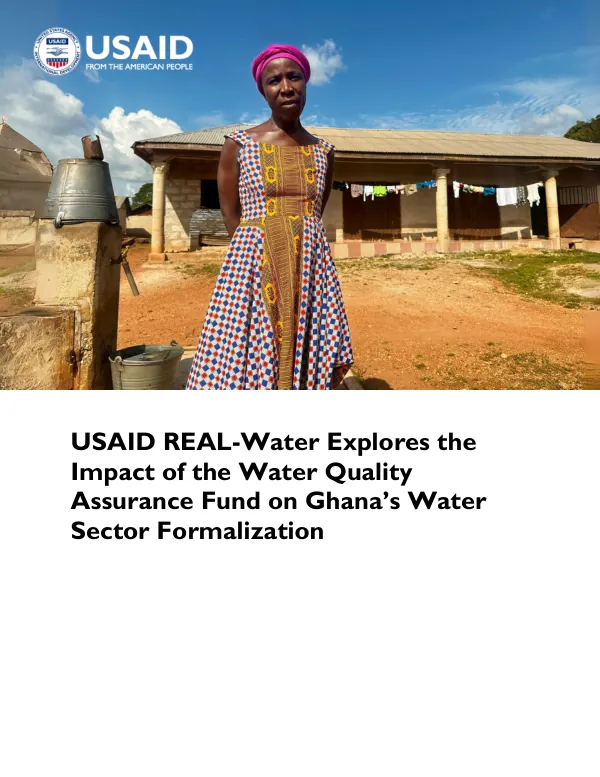
USAID REAL-Water Explores the Impact of the Water Quality Assurance Fund on Ghana’s Water Sector Formalization
Sign inUSAID
USAID REAL-Water Explores the Impact of the Water Quality Assurance Fund on Ghana’s Water Sector Formalization
The Water Quality Assurance Fund in Ghana is a financial innovation that bridges the urban-rural divide by providing water quality testing services to rural water systems.
2024 · 10 pages
Sign in to readA free account is required to download.
Abstract
The Fund acts as a financial safeguard, guaranteeing consistent and reliable payments for testing services to established urban laboratories. This payment guarantee enables laboratories to provide smaller systems with the information they need to maintain safe water quality standards. The Fund's implementation in Ghana has led to an increase in public awareness of safe water practices, particularly in rural areas. Local stakeholders suggest that the Fund is improving the adoption of chlorination practices, increasing revenue for water systems and laboratories, and leading to stronger ownership among water operators. Monthly debrief meetings attended by participating water supply operators and District Assembly officials have been instrumental in promoting water quality awareness and best practices. The Fund's evaluation in Ghana has also highlighted the importance of informal water suppliers in rural areas. These suppliers, often entrepreneurs who pay out-of-pocket for drilling and mechanization of boreholes, serve up to a quarter of the population in some communities. The Fund's implementation has encouraged District Assemblies to begin registering informal operators, which should generate revenues for the local government in the form of registration fees and business taxes. Informal water suppliers have expressed interest in registering with the District Assemblies, citing the desire to join the Water Quality Assurance Fund and access its financial and educational resources. Participation in the Fund would increase their recognition among customers and provide access to learning opportunities, such as monthly debrief meetings. Informal operators are also realizing the importance of water quality testing, with some expressing commitment to providing high-quality service to their community and family. The Fund's implementation has also transformed the financial dynamics of water suppliers, with consumers increasingly preferring regulated suppliers who test their water and display test results. This trend may lead to a loss of income for informal water suppliers who are not participating in the Fund, motivating them to join the program. District Assemblies are also benefiting from the Fund's implementation, as regulating informal water operators fulfills their mandate and increases their revenue base. The increasing interest in registering informal providers among District Assemblies exposed to the Assurance Fund evaluation has not gone unnoticed. USAID Ghana points to the increasing attention on regulation of the informal water sector as an important outcome of the Assurance Fund evaluation. The Fund's unintended effect of increasing attention on informal water is driving an emerging consensus that both formal and informal water supply schemes are important parts of the water supply landscape in rural Ghana, and the collaborative registration and enrollment of informal water operators in the Assurance Fund will improve water quality and, in turn, community health. The popularity of the Assurance Fund among District Assemblies and water suppliers presents a dilemma for REAL-Water, as adding more water suppliers to the current evaluation without sufficient planning could overwhelm the laboratory's capacity and potentially undermine the validity of the evaluation. However, not responding to the surge in interest from more water suppliers could also undermine the Fund's potential to improve water quality and community health.