USAID DEC
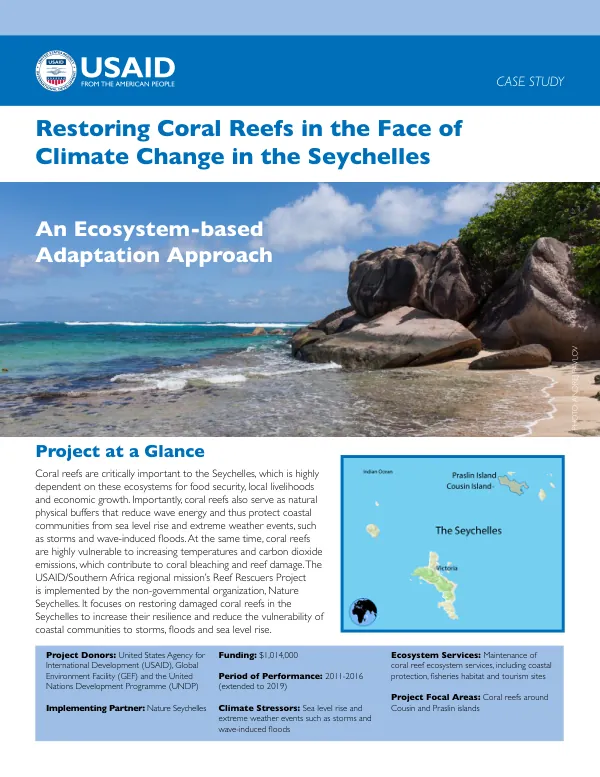
USAID Restoring Coral Reefs in the Face of Climate Change in the Seychelles CASE STUDY
Sign inUNITED NATIONS ENVIRONMENTAL PROGRAMME , NAIROBI
USAID Restoring Coral Reefs in the Face of Climate Change in the Seychelles CASE STUDY
The Reef Rescuers Project in the Seychelles is a USAID-funded initiative aimed at restoring damaged coral reefs to increase their resilience and reduce the vulnerability of coastal communities to storms, floods, and sea level rise.
2019 · 4 pages
Sign in to readA free account is required to download.
Abstract
The project is implemented by Nature Seychelles and focuses on the Praslin and Cousin islands, which were chosen due to minimal non-climate threats to coral reefs. The project's primary goal is to enhance the resilience of local communities by restoring coral reefs and the important ecosystem goods and services they provide, including fish and coastal protection. Coral reefs are critically important to the Seychelles, providing food security, local livelihoods, and economic growth. However, coral reefs are highly vulnerable to increasing temperatures and carbon dioxide emissions, which contribute to coral bleaching and reef damage. The 1998 El Niño event caused an 85 to 95 percent decline in coral cover in the Seychelles, and some coral reef ecosystems experienced very little natural recovery. Given the country's dependence on coral reefs, their deterioration and poor recovery present a significant threat to the well-being and livelihoods of local communities. The Reef Rescuers Project is piloting an ecosystem-based adaptation approach to reduce the vulnerability of coastal communities to sea level rise and extreme weather events by improving the resilience of coral reefs. The project is developing, testing, and implementing coral reef rehabilitation techniques by collecting coral fragments from reefs that survived past bleaching events, cultivating these in coral nurseries, and transplanting them onto degraded sites to restore reef structure. The project has transplanted reefs at a large, ecologically meaningful scale, and the restored reefs have shown high resilience to bleaching, with survival rates ranging from 90 to 100 percent. The project has also trained stakeholders, including marine protected area managers, on the principles of reef restoration, how to build mid-water nurseries, and how to transplant corals onto degraded sites. The project has invested considerable resources to monitor the effectiveness of the transplantation process on reef resilience and has requested an extension to assess the impacts of a 2014-2016 regional bleaching event on the transplanted sites. The project has also identified the "super corals" that have been resistant to bleaching and has grown approximately 3,750 fragments of these corals in net nurseries to supply future transplantations. The project has achieved several key results and impacts, including a five-fold increase in fish abundance and a three-fold increase in fish species diversity in project sites compared to baseline. The project has also transplanted approximately 11,000 coral colonies onto degraded sites, with a total area of 5,225 square meters of coral reef transplanted with cultivated coral colonies. The project has also certified over 40 people in coral reef restoration techniques and has developed over 9 scientific manuscripts from data collected during the project. Additionally, the project has worked with 7 stakeholder groups to implement risk-reducing practices to improve climate resilience. The Reef Rescuers Project has demonstrated the effectiveness of an ecosystem-based adaptation approach to reducing the vulnerability of coastal communities to climate stressors. The project's innovative approaches, including working at a meaningful scale, designing pilots to minimize outside threats, maximizing opportunity for resilience, and allowing adequate time for assessment and validation, have contributed to its success. The project's results and impacts have the potential to inform and support the expansion of ecosystem-based adaptation approaches in the Seychelles and beyond.