GOVERNMENT OF KENYA
Western Indian Ocean Coastal Challenge (WIOCC)
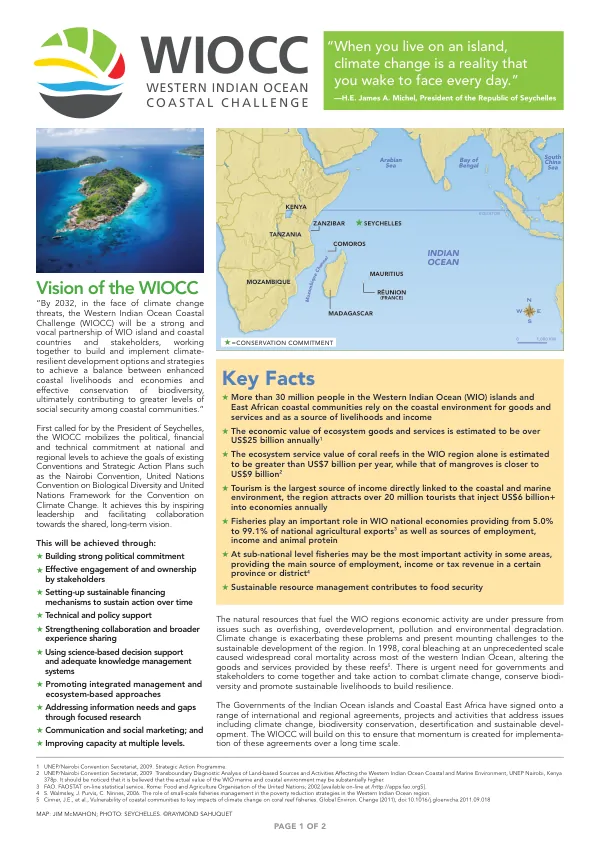
The Western Indian Ocean Coastal Challenge (WIOCC) is a regional initiative aimed at promoting climate-resilient development options and strategies to achieve a balance between enhanced coastal livelihoods and economies and effective conservation of biodiversity.
2013 · 2 pages
Sign in to readA free account is required to download.
Abstract
The WIOCC was first proposed by the President of Seychelles in 2007 as a platform to galvanize political, financial, and technical commitments and actions at national and regional levels on climate change adaptation, promoting resilient ecosystems, sustainable livelihoods, and human security. The WIOCC focuses on addressing issues such as overfishing, overdevelopment, pollution, and environmental degradation, which are exacerbated by climate change. The region's natural resources, including coral reefs, mangroves, and fisheries, are under pressure, and the economic value of ecosystem goods and services is estimated to be over US$25 billion annually. The WIOCC aims to build on existing international and regional agreements, projects, and activities that address climate change, biodiversity conservation, desertification, and sustainable development. The WIOCC has received funding from the European Union through the Indian Ocean Commission ISLANDS Project to support mobilization of WIO country-level engagement. Seychelles has committed to supporting efforts to build a common vision and regional strategy that addresses climate change impacts on coastal and marine ecosystems. The WIOCC has also received support from the Global Island Partnership (GLISPA), which has helped to catalyze over US$130 million dollars to support on-the-ground action for conservation of island biodiversity and sustainable livelihoods. The WIOCC has made significant progress since its inception, with several milestones achieved. The first Regional Technical Meeting of the WIOCC was held in Seychelles in March 2012, which established the vision of the WIOCC. The second Regional Technical Meeting was held in Mauritius in October 2012, resulting in a Declaration outlining next steps to achieve the vision. The Seventh Conference of Parties for the Nairobi Convention (COP7) in Mozambique in December 2012 requested Contracting Parties and other partners to support and encourage participation in the WIOCC. The WIOCC has also received interest from several countries, including Mauritius, which has shown its interest to formally join the WIOCC. Seychelles has sent high-level delegations to visit Mauritius and the Revolutionary Government of Zanzibar, who have given their in-principle support for the WIOCC. The WIOCC is expected to be formally launched at the Third International Meeting of Small Island Developing States (UNSIDS 2014) in Apia, Samoa in September 2014. The WIOCC has a clear vision for the future, which is to become a strong and vocal partnership of WIO island and coastal countries and stakeholders, working together to build and implement climate-resilient development options and strategies to achieve a balance between enhanced coastal livelihoods and economies and effective conservation of biodiversity. The WIOCC aims to achieve this vision through several key principles, including building strong political commitment, effective engagement of and ownership by stakeholders, setting up sustainable financing mechanisms, and promoting integrated management and ecosystem-based approaches. The WIOCC has the potential to make a significant impact on the Western Indian Ocean region, promoting climate-resilient development options and strategies that balance economic development with environmental conservation. The initiative has already received significant support from several countries and organizations, and it is expected to continue to grow and develop in the coming years.