USAID DEC
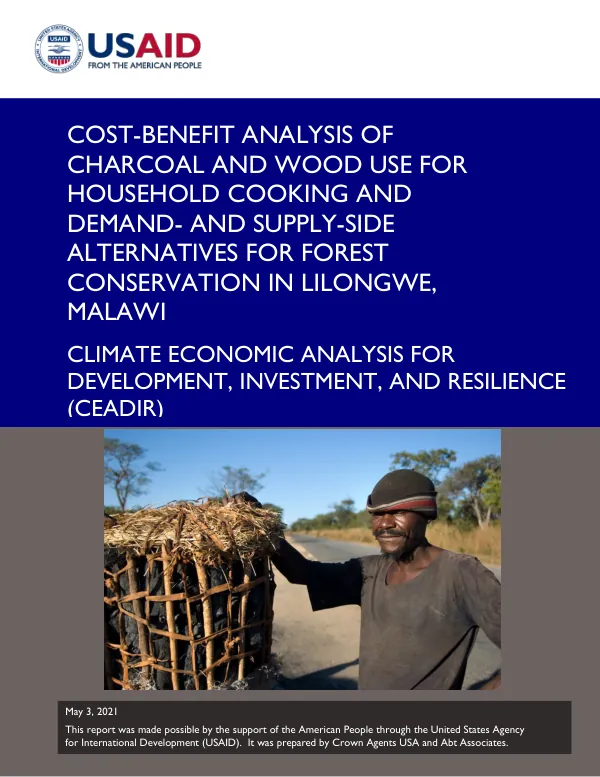
Cost-Benefit Analysis of Charcoal and Wood Use for Household Cooking and Demand- and Supply-Side Alternatives for Forest Conservation in Lilongwe, Malawi
Sign inABT ASSOCIATES
Cost-Benefit Analysis of Charcoal and Wood Use for Household Cooking and Demand- and Supply-Side Alternatives for Forest Conservation in Lilongwe, Malawi
The sustainability of woodfuel use in Malawi is a pressing concern due to the country's high dependence on charcoal and firewood for household cooking.
2021 · 71 pages
Sign in to readA free account is required to download.
Abstract
The use of woodfuels contributes significantly to greenhouse gas emissions, deforestation, and loss of income from forest products. To address these issues, a cost-benefit analysis was conducted to evaluate the effectiveness of supply- and demand-side alternatives for forest conservation in Lilongwe, Malawi. The analysis focused on the use of kilns, fuels, and stoves, with a particular emphasis on charcoal production and consumption. The study assumed that the cost of kilns, fuels, and stoves would be influenced by various factors, including taxes, subsidies, and market price distortions. The analysis also considered the economic costs of kilns and stoves, including the costs of greenhouse gas emissions, lost income from forest products, and premature mortality risk from fine particulates. The results of the base case kiln cost analyses showed that the financial costs of kilns varied significantly, ranging from $1,500 to $3,000 per ton of charcoal produced. The economic costs of kilns were also substantial, with a range of $2,500 to $5,000 per ton of charcoal produced. Sensitivity analyses were conducted to evaluate the impact of changes in kiln costs, fuel prices, and stove efficiency on the economic costs of kilns. The analysis also evaluated the cost-effectiveness of wood and bamboo plantations as an alternative to charcoal production. The results showed that the financial and economic costs of wood and bamboo plantations were lower than those of charcoal production, with a range of $1,000 to $2,000 per ton of wood produced. The study concluded that the use of kilns, fuels, and stoves can be a cost-effective alternative to charcoal production, particularly if the costs of kilns and stoves are reduced through subsidies or other forms of support. The analysis also highlighted the need for further research on the economic and environmental impacts of wood and bamboo plantations, as well as the development of policies and programs to promote the adoption of these alternatives. The study's findings have important implications for forest conservation and sustainable development in Malawi. The results suggest that the use of kilns, fuels, and stoves can help to reduce greenhouse gas emissions, deforestation, and loss of income from forest products, while also promoting economic development and poverty reduction. However, the study also highlights the need for further research and policy support to ensure the successful adoption of these alternatives. The analysis used a range of data sources, including government reports, academic studies, and industry data. The study's methodology involved a combination of financial and economic analysis, including the use of sensitivity analyses to evaluate the impact of changes in kiln costs, fuel prices, and stove efficiency on the economic costs of kilns. The study's results are presented in a range of tables and figures, including tables that summarize the financial and economic costs of kilns, fuels, and stoves, as well as figures that illustrate the impact of changes in kiln costs and fuel prices on the economic costs of kilns. The study's conclusions are based on a comprehensive analysis of the data and a careful consideration of the study's limitations and assumptions. The study's methodology involved a combination of financial and economic analysis, including the use of sensitivity analyses to evaluate the impact of changes in kiln costs, fuel prices, and stove efficiency on the economic costs of kilns. The study's results are presented in a range of tables and figures, including tables that summarize the financial and economic costs of kilns, fuels, and stoves, as well as figures that illustrate the impact of changes in kiln costs and fuel prices on the economic costs of kilns. The study's conclusions are based on a comprehensive analysis of the data and a careful consideration of the study's limitations and assumptions. The study's findings have important implications for forest conservation and sustainable development in Malawi, and highlight the need for further research and policy support to ensure the successful adoption of kilns, fuels, and stoves as alternatives to charcoal production.
Related documents
Documents in this collection
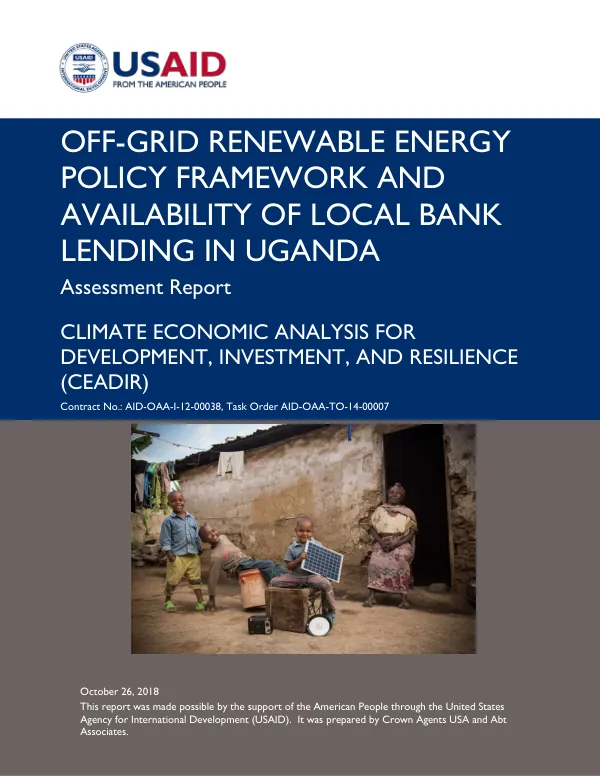 2018
2018USAID DEC
Off-Grid Renewable Energy Policy Framework and Availability of Local Bank Lending in Uganda
Open record 2021
2021USAID DEC