USAID DEC
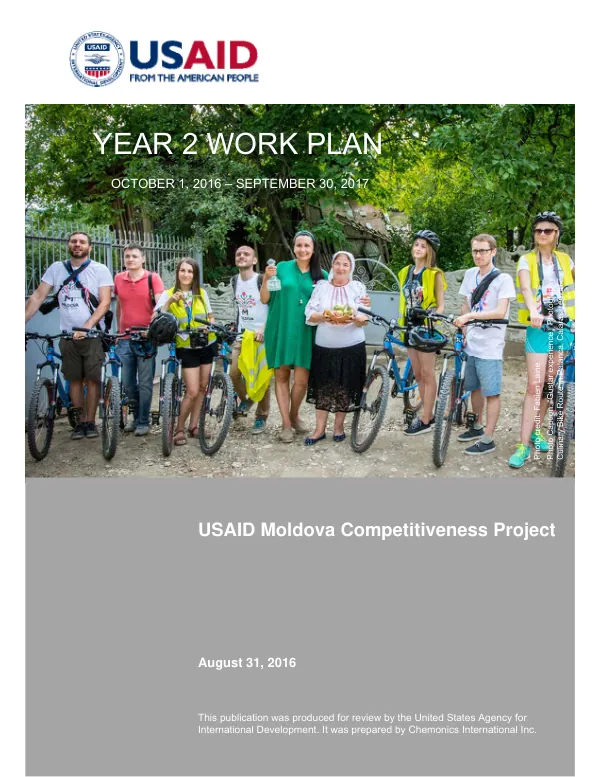
USAID Rural Competitiveness and Resilience Activity (RCRA) in Moldova: Year 2 Work Plan
Sign inCHEMONICS
USAID Rural Competitiveness and Resilience Activity (RCRA) in Moldova: Year 2 Work Plan
The USAID Rural Competitiveness and Resilience Activity (RCRA) in Moldova is a year 2 work plan, spanning from October 1, 2023, to September 30, 2024.
2023 · 72 pages
Sign in to readA free account is required to download.
Abstract
The activity aims to enhance the competitiveness and resilience of rural communities in Moldova through various interventions. High Value Agriculture (HVA) is a key component of the RCRA, focusing on improving the productivity and profitability of smallholder farmers. The HVA work plan for year 2 builds on the successes of year 1, with a focus on scaling up interventions and increasing the adoption of best practices among farmers. The HVA work plan includes activities such as farmer training programs, infrastructure development, and market linkage facilitation. The goal is to increase crop yields and improve the overall competitiveness of smallholder farmers in the HVA sector. The wine sector is another key focus area for the RCRA, with a goal of increasing the competitiveness and profitability of wine producers in Moldova. The wine work plan for year 2 includes activities such as wine quality improvement, market access facilitation, and tourism development. The goal is to increase wine exports and improve the overall competitiveness of the wine sector in Moldova. Tourism is also a key sector for the RCRA, with a goal of increasing the competitiveness and profitability of the tourism industry in Moldova. The tourism work plan for year 2 includes activities such as destination marketing, tourism infrastructure development, and human capacity building. The goal is to increase tourist arrivals and improve the overall competitiveness of the tourism industry in Moldova. Strategic Communications is a critical component of the RCRA, with a goal of promoting the activity's results and achievements to various stakeholders. The communications work plan for year 2 includes activities such as media outreach, social media engagement, and stakeholder engagement. The goal is to increase awareness and understanding of the RCRA's results and achievements among various stakeholders. Environmental Sustainability and Climate Change is another key focus area for the RCRA, with a goal of promoting sustainable agriculture practices and reducing the environmental impact of agricultural activities. The environmental sustainability work plan for year 2 includes activities such as sustainable agriculture training, climate change adaptation, and environmental monitoring. The goal is to reduce the environmental impact of agricultural activities and promote sustainable agriculture practices among smallholder farmers. Access to Finance is a critical component of the RCRA, with a goal of improving access to financial services for smallholder farmers and rural communities. The access to finance work plan for year 2 includes activities such as financial literacy training, financial inclusion, and microfinance support. The goal is to improve access to financial services for smallholder farmers and rural communities. Institutional Capacity Building is another key focus area for the RCRA, with a goal of strengthening the capacity of institutions and organizations to support the development of rural communities. The institutional capacity building work plan for year 2 includes activities such as training and capacity building, institutional strengthening, and policy reform. The goal is to strengthen the capacity of institutions and organizations to support the development of rural communities. Policy Reform is a critical component of the RCRA, with a goal of promoting policy reforms that support the development of rural communities. The policy reform work plan for year 2 includes activities such as policy analysis, policy advocacy, and policy reform. The goal is to promote policy reforms that support the development of rural communities. Workforce Development is another key focus area for the RCRA, with a goal of improving the skills and competencies of the workforce in rural communities. The workforce development work plan for year 2 includes activities such as vocational training, skills development, and human capacity building. The goal is to improve the skills and competencies of the workforce in rural communities. Inclusion of Gender, Youth, and Marginalized Groups is a critical component of the RCRA, with a goal of promoting the inclusion of gender, youth, and marginalized groups in the development of rural communities. The inclusion work plan for year 2 includes activities such as gender mainstreaming, youth empowerment, and marginalized group inclusion. The goal is to promote the inclusion of gender, youth, and marginalized groups in the development of rural communities. Monitoring, Evaluation, and Learning is a critical component of the RCRA, with a goal of monitoring and evaluating the activity's progress and learning from best practices. The MEL work plan for year 2 includes activities such as data collection, data analysis, and learning from best practices. The goal is to monitor and evaluate the activity's progress and learning from best practices. Administration, Financial, and Grants Management is a critical component of the RCRA, with a goal of ensuring the effective management of the activity's finances and resources. The administration work plan for year 2 includes activities such as financial management, grants management, and administrative support. The goal is to ensure the effective management of the activity's finances and resources.
Related documents