CHEMONICS
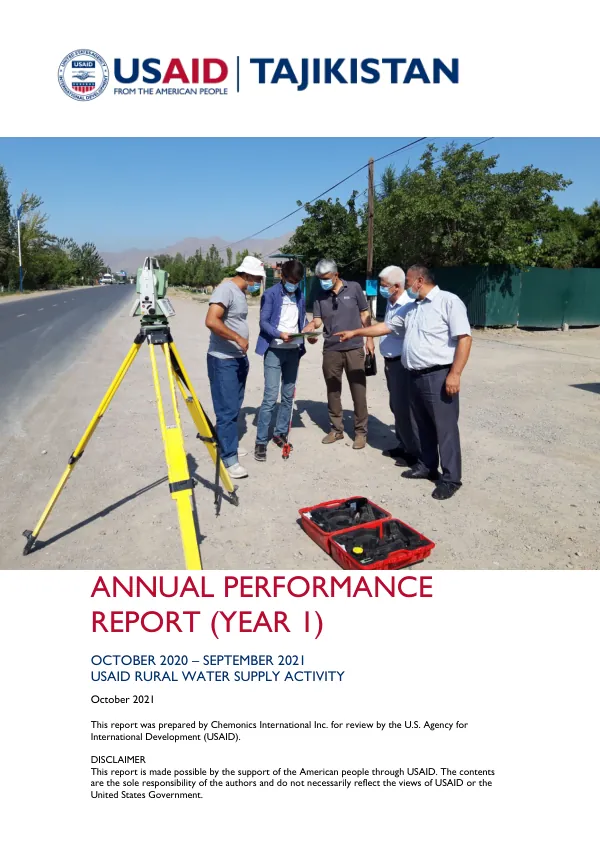
USAID Rural Water Supply Activity Annual Report Year 1
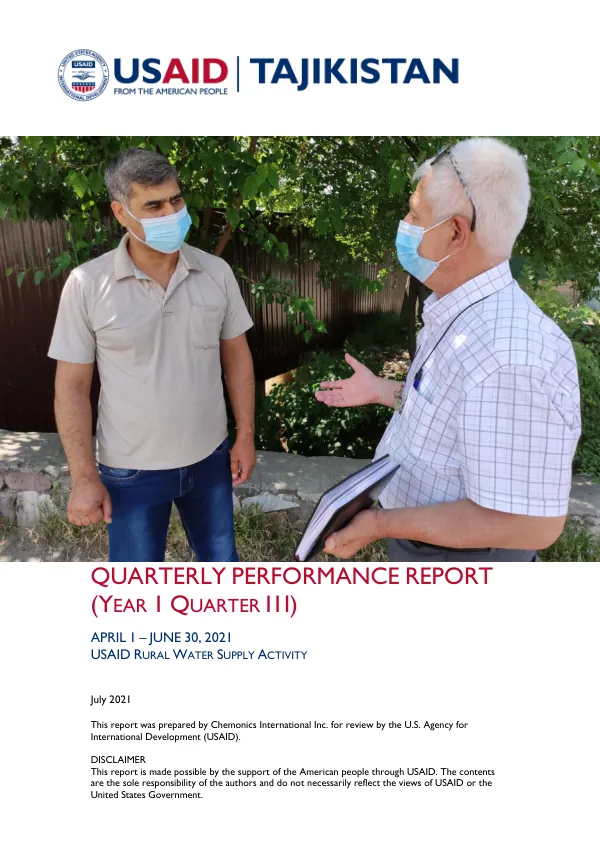
The USAID Rural Water Supply Activity (RWS) aims to improve health and resilience in Tajikistan through increased sustainable access to safe drinking water in rural communities.
2021 · 38 pages
Sign in to readA free account is required to download.
Abstract
The period of performance of the contract is October 1, 2020 to September 30, 2025. RWS targets three mutually reinforcing objectives: Increase access to safely managed drinking water in rural Tajikistan through the rehabilitation/construction of small-scale infrastructure projects. This includes the rehabilitation of existing water supply systems, construction of new water supply systems, and installation of water treatment facilities. The goal is to increase access to safe drinking water for rural communities, particularly in areas where the water supply is inadequate or unreliable. Establish reliable and commercially viable drinking water services through improved management and access to finance. This includes the development of a water tariff system, establishment of a water fund, and provision of training and capacity-building programs for water operators and local authorities. The goal is to ensure that drinking water services are financially sustainable and can be maintained over the long term. Increase engagement of communities in oversight and accountability of drinking water service providers. This includes the establishment of consumer advisory boards, provision of training and capacity-building programs for community members, and support for community-led monitoring and evaluation activities. The goal is to ensure that communities have a strong voice in the management and oversight of drinking water services. Key achievements in the first year of the RWS project include the completion of administrative tasks, such as project registration and VAT exemption, and the mobilization of key personnel. The project also established main offices in Dushanbe and Khujand, and set up subcontracts for technical, equipment, and logistical needs. Additionally, the project issued two Requests for Expression of Interest (RFEOIs) to prequalify design engineering firms and construction entrepreneurs. Initial technical tasks were also completed, including the engagement of main counterparts and other donors, and the selection of six target districts: Gafurov and Konibodom in Sughd province, A. Jomi and Yovon in Khatlon province, Hissor and Rudaki in DRS. Partnership agreements were signed with four target districts of B.Ghafurov, Konibodom, A.Jomi, and Rudaki. An inventory of over 300 water supply systems was conducted, and a water tariff system was developed. The project also made progress in establishing reliable and commercially viable drinking water services, including the development of a water fund and provision of training and capacity-building programs for water operators and local authorities. Additionally, the project supported the establishment of consumer advisory boards and provided training and capacity-building programs for community members. The RWS project has made significant progress in its first year, and is on track to achieve its objectives. The project's focus on increasing access to safe drinking water, establishing reliable and commercially viable drinking water services, and increasing community engagement in oversight and accountability of drinking water service providers is critical to improving health and resilience in Tajikistan. Implementation of the project's objectives will continue in the next quarter, with a focus on completing the rehabilitation and construction of small-scale infrastructure projects, establishing reliable and commercially viable drinking water services, and increasing community engagement in oversight and accountability of drinking water service providers. The project will also continue to work with local government, drinking water providers, and target communities to ensure reliable and sustainable drinking water services. The project's progress will be monitored and evaluated through a variety of mechanisms, including regular reporting, monitoring and evaluation activities, and applied political economy analysis. The project's learning agenda will also be implemented, which will provide a framework for identifying and addressing knowledge gaps and improving the project's effectiveness. Overall, the RWS project is making significant progress in improving access to safe drinking water in rural Tajikistan, and is on track to achieve its objectives. The project's focus on increasing access to safe drinking water, establishing reliable and commercially viable drinking water services, and increasing community engagement in oversight and accountability of drinking water service providers is critical to improving health and resilience in Tajikistan.