AGA KHAN FOUNDATION
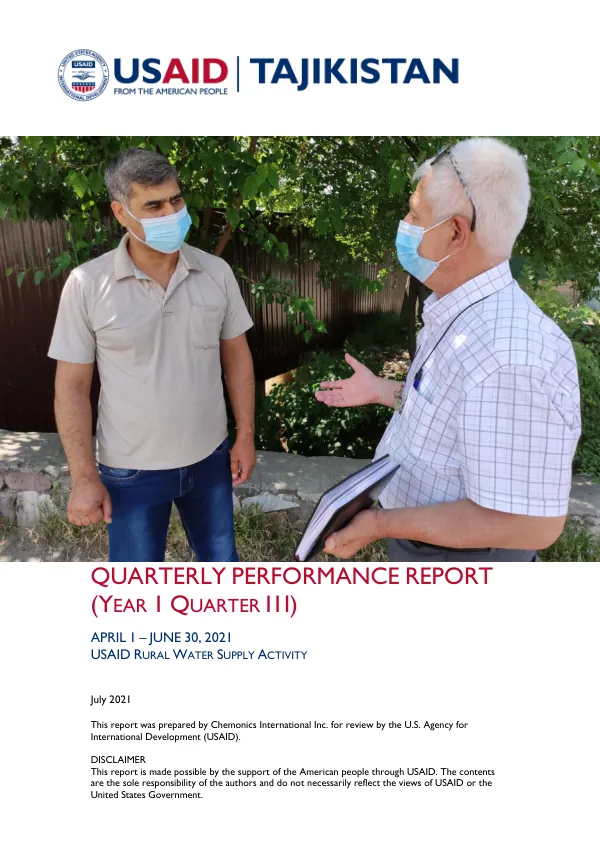
USAID Rural Water Supply Activity Quarterly Report Year 1, Quarter III
The USAID Rural Water Supply Activity aims to improve health and resilience in Tajikistan through increased sustainable access to safe drinking water in rural communities.
2021 · 24 pages
Sign in to readA free account is required to download.
Abstract
The activity targets three mutually reinforcing objectives: increasing access to safely managed drinking water in rural Tajikistan through the rehabilitation/construction of small-scale infrastructure projects, establishing reliable and commercially viable drinking water services through improved management and access to finance, and increasing engagement of communities in oversight and accountability of drinking water service providers. During Quarter III, the activity finalized initial technical assessments and initiated follow-up interventions. Key achievements included the completion of initial administrative tasks, such as staff hiring and onboarding, office setup, and main subcontracts. Initial technical tasks, such as engaging counterparts, site selection, and Applied Political Economy Analysis, were also completed or are being finalized. Partnership agreements were signed with Rudaki, A. Jomi, B. Gafurov, and Konibodom districts, and are upcoming with Yovon and Hissor districts. The activity also finalized technical assessments of 35 preselected Rural Drinking Water Systems using capacity performance assessment questionnaires in all six target districts and established a short-list of 14 target water systems for capacity-building and possible rehabilitation/expansion. Assessment, mapping, preliminary design, and initial cost estimate for rehabilitation/expansion of three priority water systems were completed. Three Tajik engineering design firms were prequalified to simplify future subcontracting of detailed engineering design interventions, and six Tajik construction companies were prequalified to simplify the future subcontracting of rehabilitation works. Initial estimates of rehabilitation/expansion needs of three selected RDWS were conducted, and justifications to proceed with three proposed rehabilitation/expansion interventions were drafted and submitted to USAID. Approval was received from USAID after review of preliminary engineering design for the three selected sites. Tendering of engineering design of these three rehabilitation/expansion interventions was conducted, and the first Environmental Review Checklist for Chorbog system was submitted to identify potential environmental impacts and mitigation/monitoring measures. A series of 12 introductory trainings for officials of four target districts' and five jamoats' authorities was conducted, with participation of a total of 143 persons, including 70 women. Delivery of these trainings included presentations, group work/brainstorming, role-playing games, videos, and practical discussions. Evaluation responses indicate participants found these trainings excellent and relevant. The activity also drafted a report on international water Public Private Partnership (PPP) case studies and prepared a series of PPP trainings on PPP principles and project life cycle, finance in PPPs, managing risk in PPP contracts, procurement of PPPs, and service standards and performance incentives in PPP contracts. Technical expertise was provided to the Center for Supporting the Implementation of PPP Projects under State Committee for Investments and State Property Management in the updating/upgrading of the Law on Concessions and Public-Private Partnerships. An online conference was organized to share lessons learned on the successful implementation of pilot drinking water supply PPP project initiated by USAID Local Governance Project in 2017. A series of district-level roundtables was prepared to sensitize and engage local authorities and private entrepreneurs on investing in rural drinking water services in collaboration with PPP center. An Annual Program Statement was prepared and posted to invite potential applicants to submit proposals for funding. The activity has made significant progress in Quarter III, with key achievements in completing initial administrative and technical tasks, finalizing technical assessments, and initiating follow-up interventions. The activity has also engaged with local authorities and private entrepreneurs to sensitize and engage them on investing in rural drinking water services.