AGA KHAN FOUNDATION
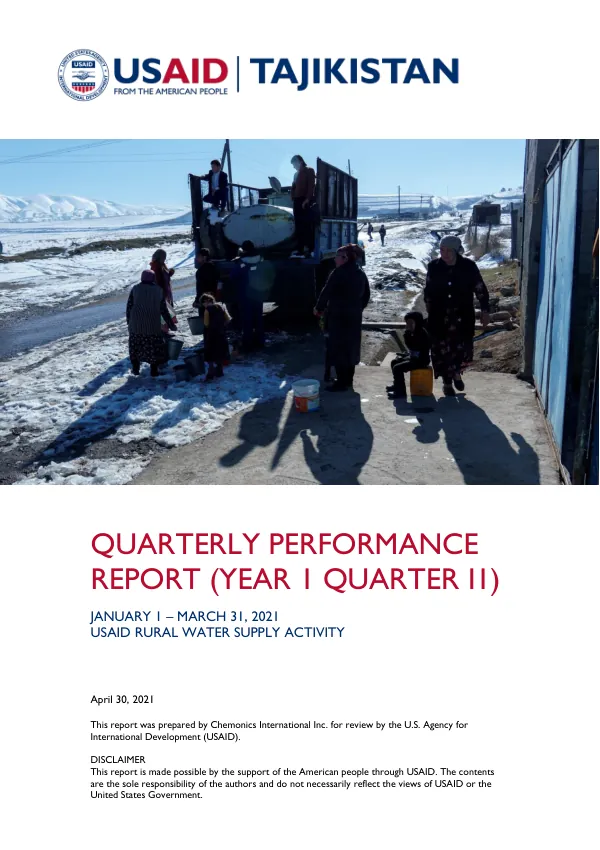
USAID Rural Water Supply Activity Quarterly Report Year 1, Quarter II
The USAID Rural Water Supply Activity aims to improve health and resilience in Tajikistan through increased sustainable access to safe drinking water in rural communities.
2021 · 26 pages
Sign in to readA free account is required to download.
Abstract
The activity targets three mutually reinforcing objectives: increasing access to safely managed drinking water in rural Tajikistan through the rehabilitation/construction of small-scale infrastructure projects, establishing reliable and commercially viable drinking water services through improved management and access to finance, and increasing engagement of communities in oversight and accountability of drinking water service providers. During Quarter II, RWS focused on finalizing the initial operational start-up and technical assessments. Key achievements included the hiring and onboarding of two additional project staff, completion of staffing, establishment of a project office in Dushanbe, and operational service agreements for cellular phones, internet services, and stationery supply. Final initial deliverables were prepared and submitted on time to USAID, including a GESI integration strategy, FEMMP, and Construction Implementation Plan. Donor coordination meetings were held with AKF, EBRD, SDC, UNDP, and UNICEF to introduce the Activity and confirm other donors' rural drinking water activities. A template agreement was drafted and presented to be signed with the six target districts to define respective roles, secure proper authorizations, and manage expectations. Water system selection involved an inventory of 300+ rural drinking water systems in the six target districts, capacity assessment of 36 pre-selected systems, and short-listing of 14 systems for RWS assistance. An Applied Political Economy Analysis (APEA) was conducted, including 33 interviews of key informants, 78 interviews, and 12 focus groups in 12 villages from the six target districts. A Private Sector assessment was conducted using a specific questionnaire to interview ten local entrepreneurs involved in providing drinking water to villages or small neighborhoods. A Knowledge, Attitudes and Practices (KAP) survey was drafted, consisting of a questionnaire of 50 questions. The activity has made significant progress in Quarter II, with key achievements in staffing, operational setup, and technical assessments. The activity has also made progress in donor coordination, water system selection, and applied political economy analysis. The activity is on track to meet its objectives and is expected to continue making progress in the next quarter. The activity has established a project office in Dushanbe and has completed staffing. The project office is now functional, with RWS staff accessing it on a limited basis in accordance with the approved activity opening plan, which mitigates COVID-19-related risks. Operational service agreements have been set up for cellular phones, internet services, and stationery supply. The activity has also made progress in establishing reliable and commercially viable drinking water services through improved management and access to finance. Donor coordination meetings have been held with AKF, EBRD, SDC, UNDP, and UNICEF to introduce the Activity and confirm other donors' rural drinking water activities. A template agreement has been drafted and presented to be signed with the six target districts to define respective roles, secure proper authorizations, and manage expectations. The activity has also made progress in increasing engagement of communities in oversight and accountability of drinking water service providers. Water system selection has involved an inventory of 300+ rural drinking water systems in the six target districts, capacity assessment of 36 pre-selected systems, and short-listing of 14 systems for RWS assistance. An Applied Political Economy Analysis (APEA) has been conducted, including 33 interviews of key informants, 78 interviews, and 12 focus groups in 12 villages from the six target districts. The activity has also made progress in establishing reliable and commercially viable drinking water services through improved management and access to finance. Private Sector assessment has been conducted using a specific questionnaire to interview ten local entrepreneurs involved in providing drinking water to villages or small neighborhoods. A Knowledge, Attitudes and Practices (KAP) survey has been drafted, consisting of a questionnaire of 50 questions. The activity is expected to continue making progress in the next quarter, with planned activities including the completion of initial technical tasks, the establishment of reliable and commercially viable drinking water services through improved management and access to finance, and the increase of engagement of communities in oversight and accountability of drinking water service providers.