USAID DEC
USAID’s Child Survival & Health Grants Program: Innovations for Results in 16 Countries
Sign inJHPIEGO
USAID’s Child Survival & Health Grants Program: Innovations for Results in 16 Countries
The USAID Child Survival and Health Grants Program (CSHGP) is a partnership with 14 International Non-Governmental Organizations (INGOs) to test innovative maternal, newborn, and child health approaches in 16 countries.
2011 · 12 pages
Sign in to readA free account is required to download.
Abstract
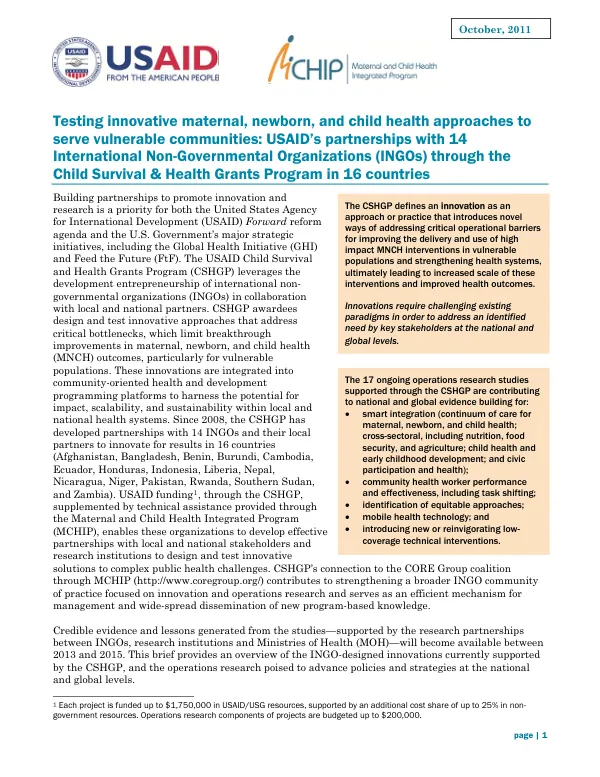
The program is part of the USAID Forward reform agenda and the U.S. Government's major strategic initiatives, including the Global Health Initiative (GHI) and Feed the Future (FtF). The CSHGP leverages the development entrepreneurship of INGOs in collaboration with local and national partners to design and test innovative approaches that address critical bottlenecks in maternal, newborn, and child health (MNCH) outcomes, particularly for vulnerable populations. The program focuses on building partnerships to promote innovation and research, with a priority on integrating community-oriented health and development programming platforms to harness the potential for impact, scalability, and sustainability within local and national health systems. Since 2008, the CSHGP has developed partnerships with 14 INGOs and their local partners to innovate for results in 16 countries, including Afghanistan, Bangladesh, Benin, Burundi, Cambodia, Ecuador, Honduras, Indonesia, Liberia, Nepal, Nicaragua, Niger, Pakistan, Rwanda, Southern Sudan, and Zambia. The CSHGP defines an innovation as an approach or practice that introduces novel ways of addressing critical operational barriers for improving the delivery and use of high-impact MNCH interventions in vulnerable populations and strengthening health systems. Innovations require challenging existing paradigms to address an identified need by key stakeholders at the national and global levels. The program supports 17 ongoing operations research studies, contributing to national and global evidence building for smart integration, community health worker performance and effectiveness, identification of equitable approaches, mobile health technology, and introducing new or reinvigorating low-coverage technical interventions. The studies are designed to generate credible evidence and lessons that will become available between 2013 and 2015. The CSHGP's connection to the CORE Group coalition through the Maternal and Child Health Integrated Program (MCHIP) contributes to strengthening a broader INGO community of practice focused on innovation and operations research. The program's funding, supplemented by technical assistance provided through MCHIP, enables INGOs to develop effective partnerships with local and national stakeholders and research institutions to design and test innovative solutions to complex public health challenges. One of the 17 ongoing operations research studies is assessing the effectiveness of a new cadre of Home Health Promoters in providing an integrated package of services in Community Case Management and Home-Based Life Saving Skills in Southern Sudan. The study aims to inform the sustainability and scale-up of the Home Health Promoters strategy, which is part of a national strategy to undertake community-based interventions. The study will develop and test operational guidelines for implementing the Home Health Promoters strategy to effectively deliver an integrated package of Community Case Management and Home-Based Life Saving Skills services at the household level. Another study is integrating the delivery of a new national community-based newborn care package with maternal care while strengthening health systems for high-impact in Nepal. The study aims to supplement the existing Newborn Care Package by strengthening maternal and newborn care services at both the community and facility level, and by creating an integrated continuum of care from pregnancy through the postnatal period. The results will be the first of their kind clearly documenting the impact of facility strengthening combined with community-facility linkage building and investigating barriers to seeking care. A new Essential Obstetric and Neonatal Care network model is being piloted in Ecuador to improve survival of hard-to-reach mothers and newborns. The model integrates public and private service delivery with community-based care, using an Essential Obstetric and Neonatal Care (EONC) network that coordinates community- and facility-based services. The model aims to increase coverage and improve quality of care in remote, indigenous communities, and the evidence and lessons generated from the evaluation will inform the Ecuadorian Ministry of Health's policies and strategies as well as regional strategic initiatives in Latin America and the Caribbean.
Related documents