USAID DEC
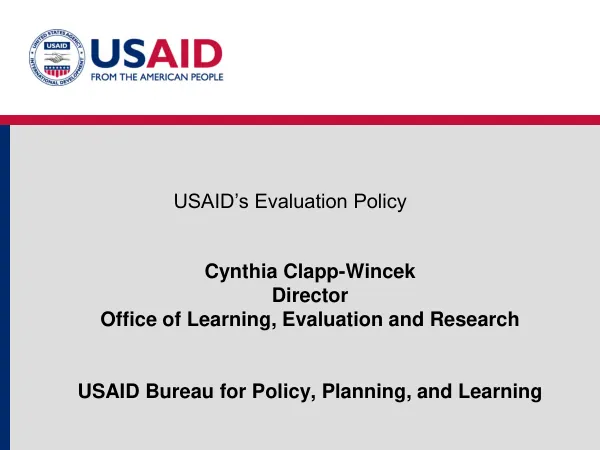
USAID’s Evaluation Policy
The USAID Evaluation Policy emphasizes the importance of evaluation in informing decision-making and improving project outcomes.
2011 · 6 pages
Sign in to readA free account is required to download.
Abstract
For accountability, evaluation measures project outcomes and efficiency, disseminating findings to stakeholders and using them to inform resource allocation. Evaluation also serves to learn and improve project and strategy design and implementation by systematically generating knowledge. Impact evaluations are a narrow category that requires defining a counterfactual and comparison group using randomization or statistical methods. This type of evaluation aims to measure the change in a development outcome attributable to a given intervention with a high level of confidence. In contrast, performance evaluations are a broader category that focuses on questions linked to program design or management decisions, such as how a project is being implemented. Both qualitative and quantitative methods are used in performance evaluations. At USAID, evaluations are categorized into large projects, innovative or pilot projects, and other evaluations identified as needed for learning or management purposes. Evaluations at the program or sector level are particularly valuable in the period preceding the development of a new strategy. The agency also recognizes the importance of building evaluation capacity, creating an Agency Evaluation Agenda, and developing systems to transparently share data and findings. The USAID Evaluation Policy Implementation Process involves several key steps, including creating an Agency Evaluation Agenda for priority, multi-country evaluation questions. The agency is seeking suggestions for the Agency Evaluation Agenda through a short form available online. This process aims to ensure that evaluations are aligned with the agency's priorities and that findings are used to inform decision-making and improve project outcomes. The policy also emphasizes the importance of evaluation training and communities of practice. This includes outreach and operational guidance to support the implementation of the evaluation policy. By building evaluation capacity and creating a culture of evaluation, USAID aims to improve the quality and relevance of its evaluations and ultimately achieve better development outcomes.