USAID
USAID's Five Year Vision: Affordable Food for All
The global challenge of hunger affects one billion people, with over half of all child deaths in developing countries related to malnutrition.
2009 · 4 pages
Sign in to readA free account is required to download.
Abstract
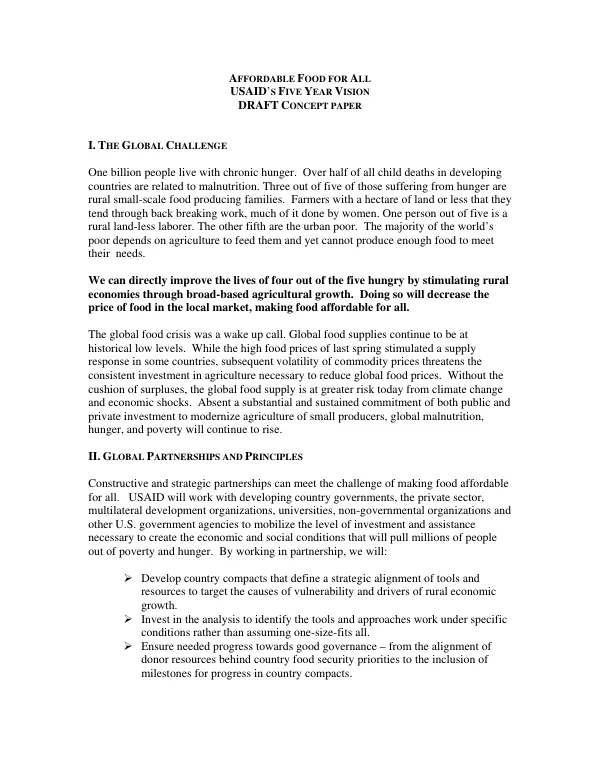
Three out of five individuals suffering from hunger are rural small-scale food producing families, with farmers working on less than a hectare of land, often through backbreaking labor, predominantly performed by women. One person in five is a rural landless laborer, and the remaining fifth are urban poor, relying on agriculture to feed themselves despite being unable to produce enough food to meet their needs. Stimulating rural economies through broad-based agricultural growth can directly improve the lives of four out of five hungry individuals by decreasing the price of food in local markets, making it affordable for all. The global food crisis served as a wake-up call, with global food supplies at historical low levels. While high food prices stimulated a supply response in some countries, subsequent commodity price volatility threatens consistent investment in agriculture necessary to reduce global food prices. Without a substantial and sustained commitment of public and private investment to modernize agriculture of small producers, global malnutrition, hunger, and poverty will continue to rise. USAID will work with developing country governments, the private sector, multilateral development organizations, universities, non-governmental organizations, and other U.S. government agencies to mobilize the level of investment and assistance necessary to create economic and social conditions that will pull millions of people out of poverty and hunger. By working in partnership, USAID will develop country compacts that define a strategic alignment of tools and resources to target the causes of vulnerability and drivers of rural economic growth. The U.S. will continue its commitment as the leading donor in responding to urgent food needs when crises arise, shifting from decades of perceiving hunger as an emergency humanitarian situation to making the longer-term investments necessary to address the chronically hungry and vulnerable at the scale proportionate to the problem. The global community must redouble its efforts to cut the number of hungry people in half. USAID will work with partners to reach this goal in 25 to 30 countries with the highest prevalence of hungry people. In five years, in these focus countries, USAID will cut the number of hungry in half, ensuring food security for an additional 300 million people, double the incomes of an estimated 60 million households, improve the nutritional status of 50 percent of children under five, and reduce reliance on international food aid for chronic food insecurity by 75 percent. To achieve these targets, USAID will expand its monitoring, forecasting, and targeting capacities, utilize local and regional procurement mechanisms when appropriate, build local and regional capacity to anticipate and respond to food security threats, increase its capacity to pre-position commodities, improve the nutritional value of food aid commodities, and develop new tools to assist critically affected urban households. Additionally, USAID will reduce hunger through sustainable broad-based agricultural growth by sustainably increasing yields and net incomes per hectare by 40 to 100 percent depending on the region, double the area under conservation agriculture in Asia, and expand trade of targeted commodities by 50 to 100 percent depending on the region. USAID will also make rural growth work for the poorest by addressing policy and governance issues that limit the ability of the poor to participate in rural growth, assist governments to implement social and productive safety nets to prevent increases in destitution and provide a platform for economic recovery, identify best practices in asset protection and income diversification, and link these to value chain development efforts. With this investment mix in emergency aid and social and agricultural development programs, USAID can eliminate the most dire suffering and ensure affordable food for all.