THE LOUIS BERGER GROUP, INC.
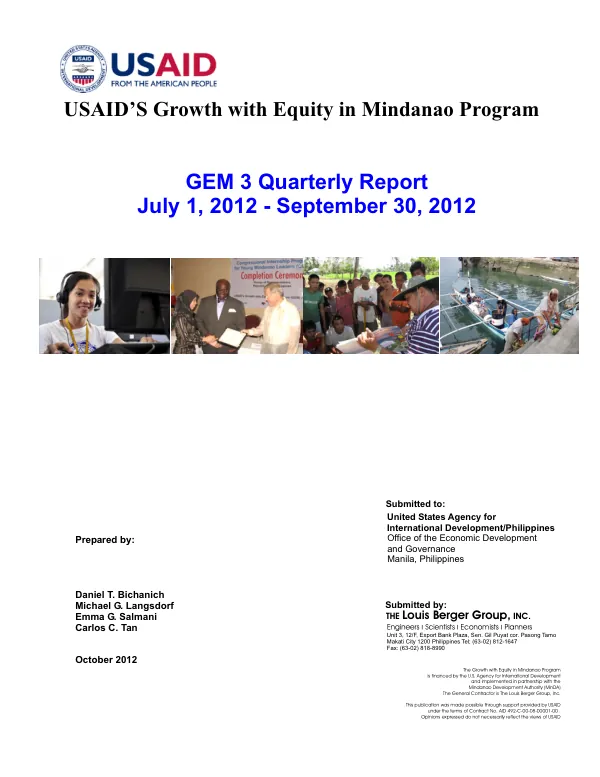
USAID’S Growth with Equity in Mindanao Program GEM 3 Quarterly Report
The Growth with Equity in Mindanao Program is a development initiative implemented in partnership with the Mindanao Development Authority (MinDA) and the United States Agency for International Development (USAID).
2012 · 162 pages
Sign in to readA free account is required to download.
Abstract
The program aims to promote economic growth and development in the Autonomous Region in Muslim Mindanao (ARMM) and other conflict-affected areas of Mindanao (CAAM). The program's infrastructure development component focuses on designing and constructing community water systems, warehouses, solar dryers, boat landings, barangay bridges, pedestrian bridges, market centers, and farm-to-market roads. The program has made significant progress in completing Barangay Infrastructure Projects (BIPs) and Regional Impact Projects (RIPs). As of the end of the 4th quarter of Fiscal Year 2012, a total of 712 BIPs had been completed, with 49 subprojects completed during the quarter. The program has also completed 12 RIPs, with 13 subprojects concurred by USAID and MinDA. The completed RIPs include the Jolo Water Supply Upgrading, Sanga-Sanga Airport Runway Improvement, Jolo Airport Runway Improvement, Tawi-Tawi Bridge/Road Partnership Project, and Midsayap-Datu Piang National Highway Upgrading (Midsayap Section). The program's infrastructure development component has a per-project cost range of $5,000 to $50,000 for BIPs and over $50,000 to $1 million for RIPs. The program has been undertaken in partnership with national government agencies, the ARMM regional government, provincial and local governments, community groups, and cooperatives. The program's progress is monitored through regular reporting and evaluation, with a focus on achieving the program's performance objectives and expected outputs. The program's performance objectives for the 4th quarter of Fiscal Year 2012 included completing 49 subprojects for a total of 712 completed BIPs. The program has made significant progress in achieving this objective, with 712 BIPs completed as of the end of the quarter. The program's progress is also reflected in the completion of 12 RIPs, with 13 subprojects concurred by USAID and MinDA. The program's infrastructure development component has a significant impact on the communities in which it operates. The completed BIPs and RIPs have improved access to basic services such as water, sanitation, and transportation, and have created employment opportunities for local residents. The program's progress has also contributed to the economic growth and development of the region, with a focus on promoting inclusive and sustainable development. The program's implementation is overseen by the Louis Berger Group, Inc., which is the general contractor for the program. The program's progress is monitored through regular reporting and evaluation, with a focus on achieving the program's performance objectives and expected outputs. The program's success is dependent on the continued support of USAID, MinDA, and other stakeholders, and on the effective implementation of the program's infrastructure development component.