USAID
USAID’s Mobile Application to Secure Tenure (MAST)
The Mobile Application to Secure Tenure (MAST) is a technology-based solution designed to address challenges related to securing property rights in rural and urban areas.
2018 · 2 pages
Sign in to readA free account is required to download.
Abstract
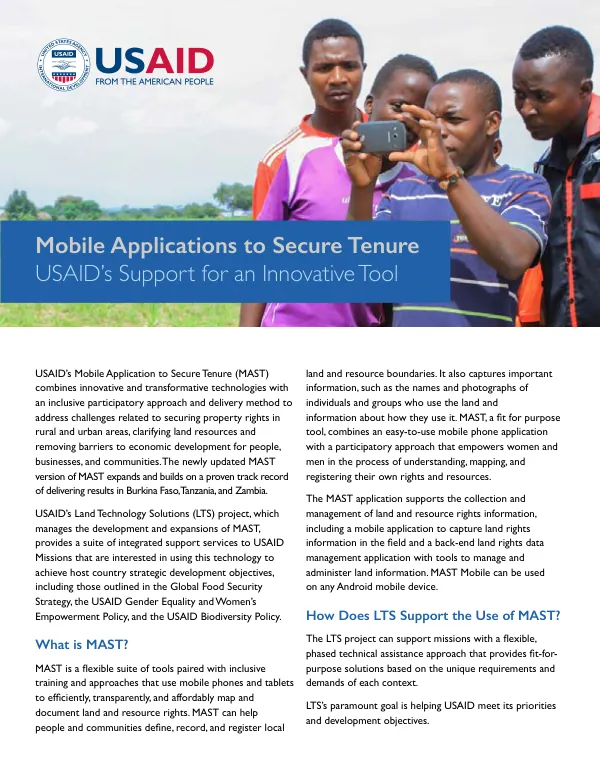
MAST combines innovative and transformative technologies with an inclusive participatory approach to clarify land resources and remove barriers to economic development. The application is a flexible suite of tools paired with inclusive training and approaches that use mobile phones and tablets to efficiently, transparently, and affordably map and document land and resource rights. MAST can help people and communities define, record, and register local land and resource boundaries. It captures important information, such as the names and photographs of individuals and groups who use the land and information about how they use it. The application supports the collection and management of land and resource rights information, including a mobile application to capture land rights information in the field and a back-end land rights data management application with tools to manage and administer land information. MAST Mobile can be used on any Android mobile device. The Land Technology Solutions (LTS) project manages the development and expansions of MAST and provides a suite of integrated support services to USAID Missions. LTS's primary goal is to help USAID meet its priorities and development objectives. The project conducts a feasibility assessment to determine how MAST might help a mission more efficiently achieve its goals. LTS's initial assessment includes desk research and a stakeholder landscape assessment, which results in a report outlining the feasibility and need for MAST and how it might be implemented. Following the feasibility study, LTS conducts site visits to develop an implementation plan and budget. The project solicits extensive stakeholder engagement to ensure that the project design and scale is informed by feedback, evidence, and requirements from the field. LTS ensures that the potential project activities are validated by all stakeholders. The project also provides training to support partners and staff during implementation and monitors project activities through collaborative working with partners and host governments. The implementation of MAST is divided into three phases: Phase 1 involves understanding feasibility and opportunities for implementing MAST, given spatial, legal, and institutional contexts in the host country and strategic development priorities of Missions. Phase 2 involves developing an Implementation Plan with indicative budget and technical requirements for future implementation. Phase 3 provides high-quality technical assistance to implement MAST, as required and desired by Missions, whether remotely or in-field, or a combination of both.
Related documents