USAID DEC
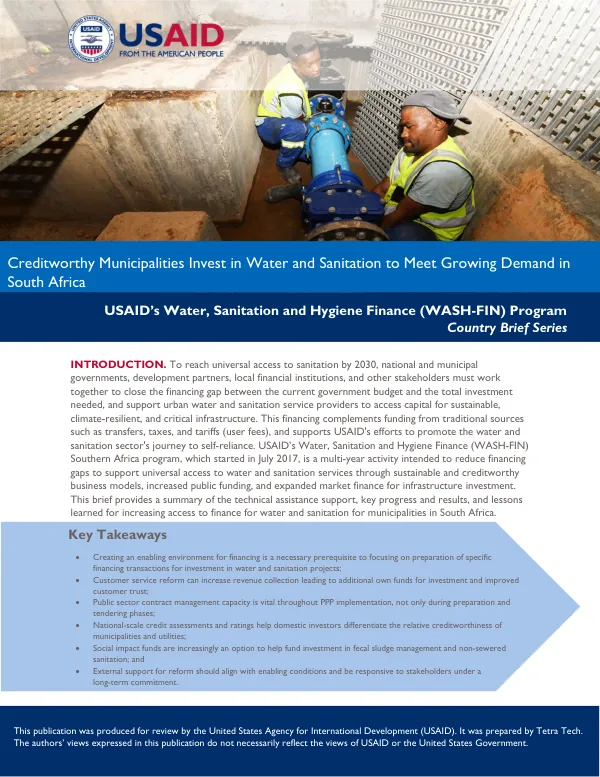
USAID's Water, Sanitation, and Hygiene Finance (WASH-FIN) Program Country Brief Series: Creditworthy Municipalities Invest in Water and Sanitation to Meet Growing Demand in South Africa
Sign inTETRA TECH
USAID's Water, Sanitation, and Hygiene Finance (WASH-FIN) Program Country Brief Series: Creditworthy Municipalities Invest in Water and Sanitation to Meet Growing Demand in South Africa
In South Africa, the Constitution affords everyone the right to water.
2021 · 10 pages
Sign in to readA free account is required to download.
Abstract
The Water Resources Act No. 36 of 1998 entrusts the National Government with water resource management to ensure the sustainable use of water through the protection of the quality of water resources for the benefit of all water users. The Water Services Act 108 of 1997 provides the legal framework for entities managing water services, including the Department of Water and Sanitation (DWS), the Trans-Caledon Tunnel Authority (TCTA), Water Boards, Catchment Management Agencies (CMAs), Water Users Associations, and Local Governments. The South African government budget has been under significant strain due to years of stagnant economic growth, falling from three percent GDP growth in 2010 to nearly zero in 2019. The COVID-19 pandemic has further impacted the economy, with GDP expected to decline by over seven percent in 2020. As a result of the fiscal crunch, the national government is expected to reduce transfers to municipalities, including those that provide basic services like water and sanitation. Meanwhile, municipal water and sanitation costs such as wages, bulk water, and electricity are expected to grow faster than inflation. USAID's Water, Sanitation and Hygiene Finance (WASH-FIN) Southern Africa program, which started in July 2017, is a multi-year activity intended to reduce financing gaps to support universal access to water and sanitation services through sustainable and creditworthy business models, increased public funding, and expanded market finance for infrastructure investment. The program aims to support municipalities in South Africa to access capital for sustainable, climate-resilient, and critical infrastructure. Key institutions involved in water sector financing in South Africa include the Department of Water and Sanitation (DWS), the Trans-Caledon Tunnel Authority (TCTA), Water Boards, Catchment Management Agencies (CMAs), Water Users Associations, and Local Governments. These institutions are subject to the Public Financial Management Act (PFMA), which determines their respective borrowing authority. The South Africa National Water and Sanitation Master Plan (NWSMP) estimates that there is a capital investment funding gap of approximately $20 billion, a little more than a third of the $55 billion required over the next ten years to meet the national objectives of universal access to water and sanitation.
Related documents
Documents in this collection
 2021
2021USAID DEC
Assessing the Effects of COVID-19 on Access to Water, Sanitation, and Hygiene in USAID High Priority and Strategy-Aligned Countries: Country Deep Dive Report - Mozambique
Open record 2021
2021USAID DEC