USAID DEC
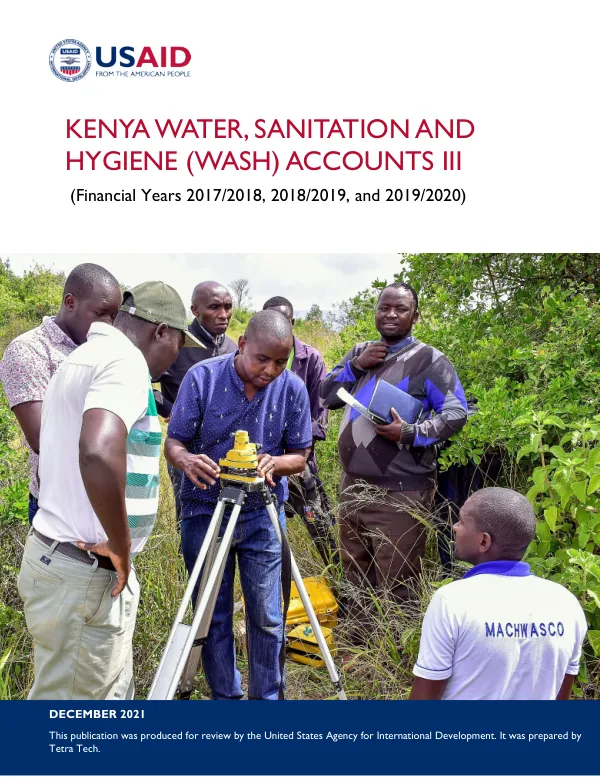
Kenya Water, Sanitation, and Hygiene (WASH) Account III (Financial Years 2017/2018, 2018/2019, and 2019/2020)
Sign inTETRA TECH
Kenya Water, Sanitation, and Hygiene (WASH) Account III (Financial Years 2017/2018, 2018/2019, and 2019/2020)
The Government of Kenya has set an ambitious target of achieving universal access to water, sanitation, and hygiene (WASH) services by 2030.
2021 · 36 pages
Sign in to readA free account is required to download.
Abstract
The Ministry of Water, Sanitation, and Irrigation's Strategic Plan (2018-2022) underscores the government's commitment to accelerating development and delivery of public services to citizens in a more efficient manner with better resource utilization. The Strategic Plan is in line with the Third Medium Term Plan (MTP III) 2018-2022 and the "Big Four" Agenda, which outline the main policies, legal and institutional reforms, as well as programs and projects that the government plans to implement between 2018 and 2022. Kenya needs to invest US$930 million annually to meet the goal of universal access to water and sanitation by 2030. As of 2018, only about US$370 million annually was available from public sources to address gaps in water access (40%) and sewerage coverage (75%). Thus, there is a need for concerted efforts to increase financial resources for WASH infrastructural investments as well as resources required for regular operation and maintenance of the services. In addition to increasing financial resources for WASH, governments are encouraged to track existing investments in the sector to improve understanding of current expenditures in WASH and to enable sound, evidence-based planning, and budgeting decisions. In Kenya, many actors are involved in the financing of WASH services, such as the national and county governments, development partners, nongovernmental organizations (NGOs), water and sanitation services companies, households, and the private sector. Kenya adopted the TrackFin methodology of monitoring funding for the WASH sector in 2014. TrackFin was developed by the World Health Organization (WHO) in association with the United Nations (UN), Organisation for Economic Co-operation and Development (OECD), and the World Bank as part of UN Water's Global Analysis and Assessment of Sanitation and Drinking Water (GLAAS) program, to address knowledge gaps of financial data in the WASH sector. The TrackFin methodology aims to help countries develop National WASH Accounts using a globally accepted methodology. The methodology builds on the experience of the health sector for which National Health Accounts have been developed in more than 100 countries, on a regular basis, for more than 20 years. Presently, TrackFin is being implemented in 17 countries. USAID through the Water, Sanitation, and Hygiene Finance (WASH-FIN) program facilitated data collection, report preparation, and TrackFin technical committee meetings with the Ministry of Water, Sanitation, and Irrigation (MoWSI) and WHO. This TrackFin Report, which covers fiscal years (FY) 2017/18, 2018/19, and 2019/20, was discussed and validated in these meetings. The report highlights the importance of tracking WASH financing to improve understanding of current expenditures in WASH and to enable sound, evidence-based planning, and budgeting decisions. The report also emphasizes the need for concerted efforts to increase financial resources for WASH infrastructural investments as well as resources required for regular operation and maintenance of the services. The report provides a comprehensive overview of the WASH sector in Kenya, including the development context, access to WASH services, water and sanitation sector reforms, institutional framework of the WASH sector, and WASH sector financing. The report also presents the TrackFin methodology, which aims to help countries develop National WASH Accounts using a globally accepted methodology. The report highlights the importance of tracking WASH financing to improve understanding of current expenditures in WASH and to enable sound, evidence-based planning, and budgeting decisions. The report provides a comprehensive overview of the WASH sector in Kenya, including the development context, access to WASH services, water and sanitation sector reforms, institutional framework of the WASH sector, and WASH sector financing. The report presents the findings of the TrackFin study, which include the total WASH expenditure in the sector at the national level, the distribution of funds to the WASH sector, and the use of funds by different actors. The report also presents the policy implications of the findings, including the need for increased financial resources for WASH infrastructural investments and the importance of tracking existing investments in the sector. The report concludes by emphasizing the need for concerted efforts to increase financial resources for WASH infrastructural investments as well as resources required for regular operation and maintenance of the services.