GREEN POWERED TECHNOLOGY
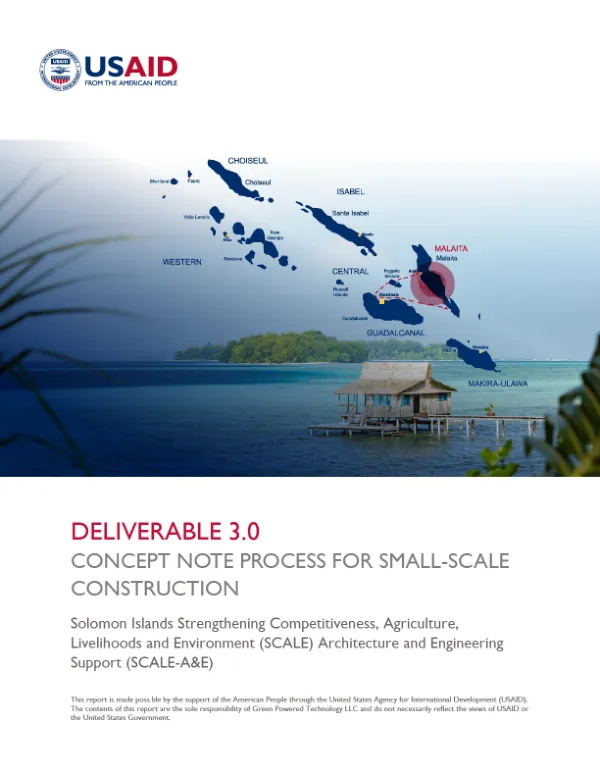
USAID SCALE A&E Concept Note Process for Small-Scale Construction
The Solomon Islands Strengthening Competitiveness, Agriculture, Livelihoods, and Environment (SCALE) activity aims to support the Government of Solomon Islands National Development Strategy 2016-2035.
2021 · 9 pages
Sign in to readA free account is required to download.
Abstract
The activity's purpose is to develop local economies in Malaita at a community scale to support further growth at the provincial and national levels and drive expansion of market access and supporting infrastructure. The SCALE activity is funded by USAID and is implemented by Green Powered Technology, with subcontractors Kramer Ausenco, Planet Partnerships, and CDM Australia. The activity works closely with major counterpart organizations, including the Solomon Islands Government, the Solomon Islands Chamber of Commerce, and non-state actors in Malaita Communities. The project delivery and project selection processes are outlined in Figure 1, which illustrates the typical planning, design, construction, and operation and maintenance life cycle common to infrastructure construction projects. The first phase, planning, starts with strategic planning activities on the part of implementing organizations to define processes and mutual understanding for project implementation. Projects are identified in two tracks: first, those that were previously identified by national or provincial governmental entities, and second, those identified directly by project stakeholders in government, the private sector, or non-governmental organizations. All projects, regardless of how they were identified, undergo the same screening and prioritization process. Projects are screened according to estimated capital cost for construction, with projects estimated to cost less than $500,000 considered "small-scale infrastructure" and eligible for USAID funding. Projects estimated to cost more than $500,000 are considered "large-scale infrastructure" and may be supported by SCALE A&E through the development of feasibility and the provision of transaction advisory services. Concept notes will be captured utilizing the Concept Note Form developed by SCALE A&E. The form is divided into three parts: Overview, Snapshot, and Project Parameters. The Overview section includes general project information, while the Snapshot section describes the project, the sponsor and/or beneficiaries, the opportunity the project is exploiting, the project's objective, project location, and an area for the applicant to sign confirming their understanding of the project selection process. The Project Parameters section describes the project concept in greater detail, including space for defining the implementation model, estimated capital and operating costs, institutional stakeholders, implementation risks, and additional data that may be required in a follow-up pre-feasibility or feasibility study. Interpretive guidance is provided on the Concept Note components, including a description of the project, objective, sponsor and beneficiaries, opportunity, location, and USAID SCALE A&E project selection process familiarity. The SCALE activity aims to support the development of local economies in Malaita, with a focus on agricultural development goals. The activity works closely with stakeholders, including government, private sector, and non-governmental organizations, to identify and develop projects that contribute to the local agricultural development goals and objectives.
Related documents
Documents in this collection
 2021
2021USAID DEC
FY 2021 Quarter 3 Progress Report: Solomon Islands Strengthening Competitiveness, Agriculture, Livelihoods, and Environment – Natural Resource Management (SCALE-NRM)
Open record 2021
2021USAID DEC