THE CADMUS GROUP, INC.
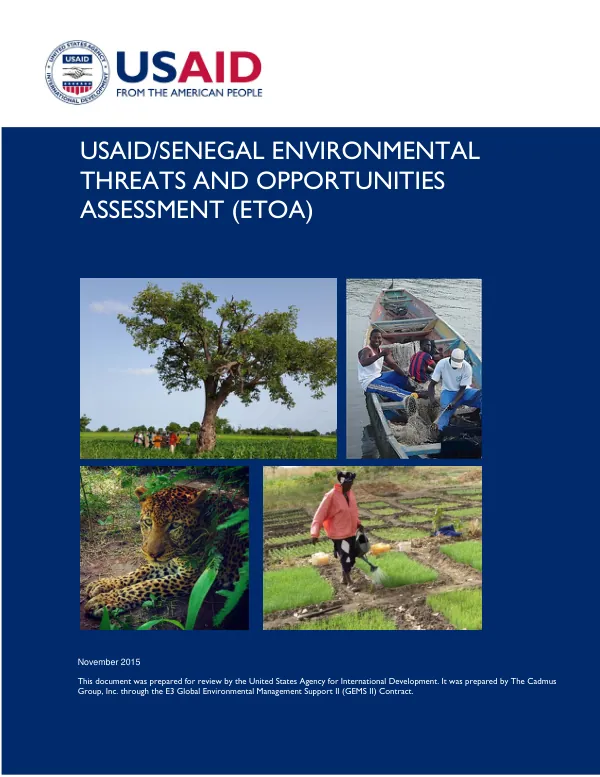
USAID/Senegal Environmental Threats and Opportunities Assessment (ETOA)
The agricultural sector in Senegal is a significant contributor to the country's economy, with the majority of the population engaged in farming and livestock production.
2015 · 189 pages
Sign in to readA free account is required to download.
Abstract
The sector is primarily driven by small-scale farmers, with the majority of them being women. The country's geography is characterized by a diverse range of ecosystems, including savannas, forests, and coastal areas, which support a wide variety of flora and fauna. Senegal's population is projected to continue growing, with an estimated 15.3 million people by 2025. The population growth rate is expected to decline, but the country's population will remain largely rural, with approximately 60% of the population living in rural areas. The economy is primarily driven by agriculture, with the sector accounting for approximately 15% of the country's GDP. The country's energy sector is also significant, with a focus on renewable energy sources, including solar and wind power. The country's biodiversity is rich and diverse, with a wide range of ecosystems and species found throughout the country. The Niokolo-Koba National Park is a significant protected area, covering over 9,000 square kilometers of savanna and forest habitats. The park is home to a wide range of wildlife, including lions, leopards, and elephants. The country is also home to several Ramsar sites, which are designated as wetlands of international importance. The USAID/Senegal Environmental Threats and Opportunities Assessment (ETOA) was conducted to identify the country's environmental challenges and opportunities. The assessment was conducted in 2015 and was prepared by The Cadmus Group, Inc. under the E3 Global Environmental Management and Support II (GEMS II) Contract. The assessment identified several key environmental challenges facing Senegal, including deforestation, soil degradation, and water pollution. The assessment also identified opportunities for environmental conservation and sustainable development, including the development of renewable energy sources and the promotion of sustainable agriculture practices. The assessment highlighted the importance of protected areas and Ramsar sites in maintaining the country's biodiversity. The Niokolo-Koba National Park and the Saloum Delta Ramsar site were identified as key areas for conservation efforts. The assessment also emphasized the need for sustainable forest management and the development of policies to promote sustainable agriculture practices. The country's energy sector was identified as a key area for development, with a focus on renewable energy sources. The assessment recommended several key actions to address the country's environmental challenges and opportunities. These included the development of a national environmental policy, the establishment of a protected areas management system, and the promotion of sustainable agriculture practices. The assessment also recommended the development of renewable energy sources and the implementation of policies to promote sustainable forest management.