USAID DEC
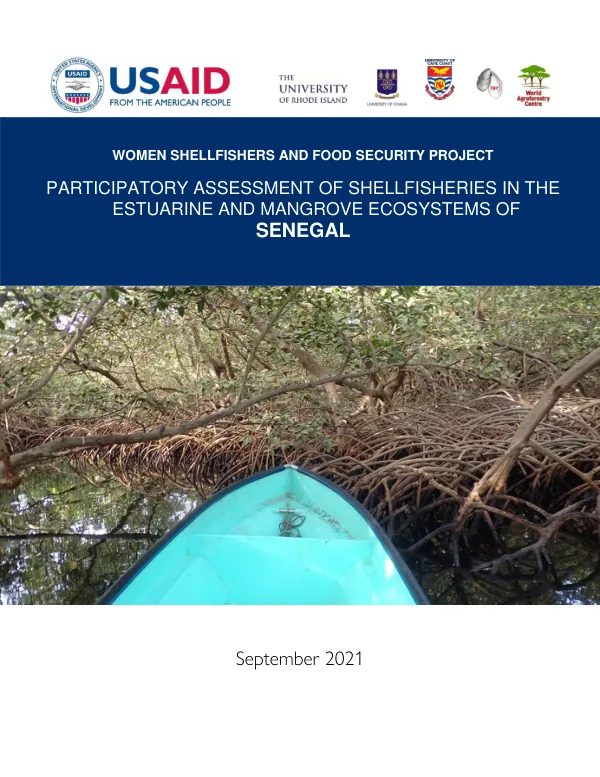
Participatory Assessment of Shellfisheries in the Estuarine and Mangrove Ecosystems of Senegal
Sign inCOASTAL RESOURCES CENTER
Participatory Assessment of Shellfisheries in the Estuarine and Mangrove Ecosystems of Senegal
The Women Shellfishers and Food Security Project in Senegal aimed to improve the livelihoods of women shellfishers through a participatory assessment of shellfisheries in the estuarine and mangrove ecosystems.
2021 · 26 pages
Sign in to readA free account is required to download.
Abstract
The project was implemented in collaboration with various partners, including the Coastal Resources Center, University of Rhode Island, and the Centre for Coastal Management, University of Cape Coast. The assessment revealed that shellfisheries in Senegal are a significant source of income for many communities, with an estimated 10,000 shellfishers involved in the industry. Women make up a substantial proportion of shellfishers, with 55% of resource users identified as female. However, women face significant challenges in accessing markets and receiving fair prices for their catch. The assessment also highlighted the importance of mangrove ecosystems in supporting shellfisheries. Mangroves provide a habitat for a diverse range of shellfish species, including oysters, mussels, and clams. However, mangrove ecosystems are under threat from climate change, pollution, and over-harvesting. The project team conducted a detailed analysis of the shellfish value chain, including harvesting methods, processing, and marketing. The assessment revealed that shellfish are primarily harvested using traditional methods, including hand collection and diving. The most commonly harvested species are oysters, mussels, and clams. The project team also examined the governance and management regime for shellfisheries in Senegal. The assessment revealed that there is a lack of effective management and regulation of shellfisheries, leading to over-harvesting and degradation of mangrove ecosystems. The project team made several recommendations to improve the livelihoods of women shellfishers and to sustainably manage shellfisheries in Senegal. These recommendations include the establishment of community-based management systems, the development of sustainable harvesting practices, and the provision of training and capacity-building programs for women shellfishers. The assessment also highlighted the importance of climate risk mitigation in shellfisheries. Climate change is projected to have significant impacts on shellfisheries, including changes in water temperature and sea level rise. The project team recommended the development of climate-resilient shellfisheries management plans and the implementation of adaptation measures, such as the use of climate-resilient shellfish species. Overall, the Women Shellfishers and Food Security Project in Senegal demonstrated the importance of participatory assessments in improving the livelihoods of women shellfishers and in sustainably managing shellfisheries. The project's findings and recommendations provide a valuable contribution to the development of effective management and conservation strategies for shellfisheries in Senegal and beyond.
Related documents