BANYAN GLOBAL
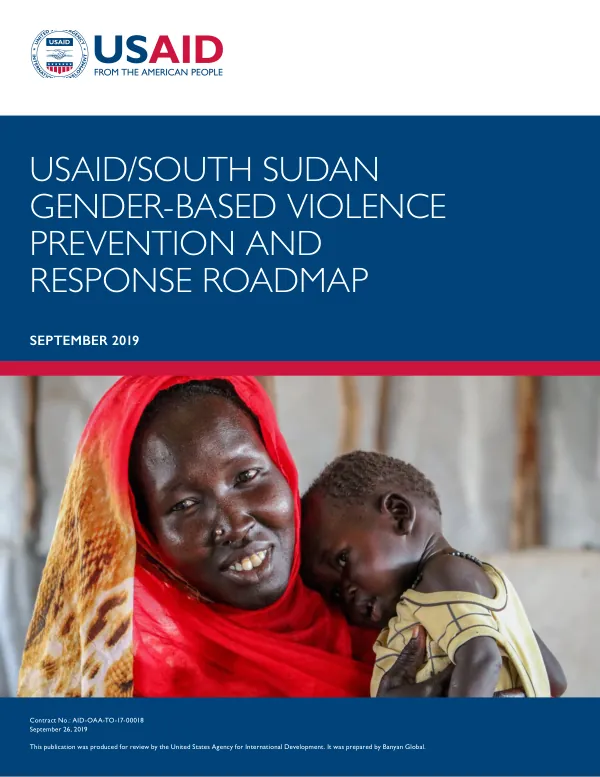
USAID/South Sudan Gender-Based Violence Prevention and Response Roadmap
The USAID/South Sudan Gender-Based Violence Prevention and Response Roadmap aims to equip USAID/South Sudan staff with guidance to design and implement effective strategies and interventions that integrate GBV prevention and response within the current USAID/South Sudan Operational Framework.
2019 · 116 pages
Sign in to readA free account is required to download.
Abstract
The Roadmap identifies GBV programming gaps and proposes next steps for the remaining two years of the current Interim Performance Management Plan to implement in coordination with other key stakeholders. The Roadmap recognizes the scale and scope of GBV in South Sudan, providing specific and measurable recommendations for the Mission to raise awareness and commitment and ultimately to mitigate and respond to GBV in targeted communities. The GBV Roadmap has four core sections: Integrating GBV in the USAID/South Sudan Operational Framework, GBV Roadmap Programmatic Guiding Principles, GBV Prevention and Response Roadmap: Key Pathways for Action, and Guidelines to address GBV in Monitoring, Evaluation and Learning. The Roadmap's goal is to make a measurable and trackable contribution to GBV prevention, mitigation, and response in South Sudan. This contribution will be measured by the amount of USD invested per sector that is specifically for GBV prevention, mitigation, and response and by measuring sector-based results. The Roadmap draws linkages to the guiding principles in Section 3, which offers cross-sectoral guidance on approaches to GBV programming within the South Sudan context. GBV is a significant threat to the overall well-being of South Sudan's population, particularly women and children. A recent study estimated that in some conflict-affected locations, 65 percent of women and girls in South Sudan have experienced physical and/or sexual violence in their lifetime. The USAID/South Sudan Mission recognizes that GBV has negative consequences for those who experience violence and also has a negative impact on efforts to promote peace, resilience, economic prosperity for women/girls and men/boys, and for development in South Sudan across all sectors. The Roadmap includes key resources and tools that are particularly applicable in the South Sudan context. These resources and tools are designed to support the implementation of next steps and to enhance the mission staff's GBV literacy and capacity. The Roadmap also includes proposed actions for USAID/South Sudan to enhance monitoring, evaluation, and learning on the GBV programming included in Section 4. The Roadmap's recommendations are based on a Theory of Change (TOC) that outlines how to integrate GBV into the Mission's current operational framework. The TOC provides a framework for understanding how GBV programming can contribute to the Mission's overall goals and objectives. The Roadmap also includes a Literature Review that provides part of the evidence for the Roadmap, as well as a list of key documents consulted and key stakeholders interviewed. The Roadmap's programmatic guiding principles offer cross-sectoral guidance on approaches to GBV programming within the South Sudan context. These principles are designed to provide a framework for understanding how to design and implement effective GBV programming in different sectors, including health and water, sanitation and hygiene; education; economic growth; democracy and governance/peace and reconciliation; and humanitarian assistance. The Roadmap's key pathways for action provide a strategic and programmatic roadmap for the Mission's GBV prevention and response programming in alignment with the Mission's operational framework. These pathways outline key actions to make the TOC actionable, including how to enhance the mission staff's GBV literacy and capacity, and how to implement programming in priority sectors. The Roadmap's guidelines to address GBV in Monitoring, Evaluation and Learning (MEL) include proposed actions for USAID/South Sudan to enhance monitoring, evaluation, and learning on the GBV programming included in Section 4. These guidelines are designed to provide a framework for understanding how to monitor and evaluate GBV programming and to identify areas for improvement. Overall, the USAID/South Sudan Gender-Based Violence Prevention and Response Roadmap provides a comprehensive framework for understanding how to prevent and respond to GBV in South Sudan. The Roadmap's recommendations are based on a Theory of Change that outlines how to integrate GBV into the Mission's current operational framework, and the Roadmap includes key resources and tools that are particularly applicable in the South Sudan context.