CATHOLIC RELIEF SERVICES ORGANIZATION
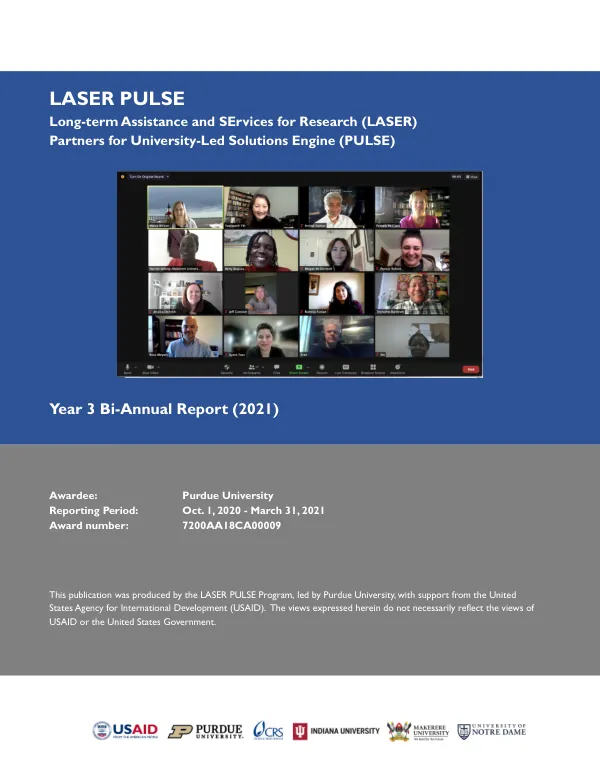
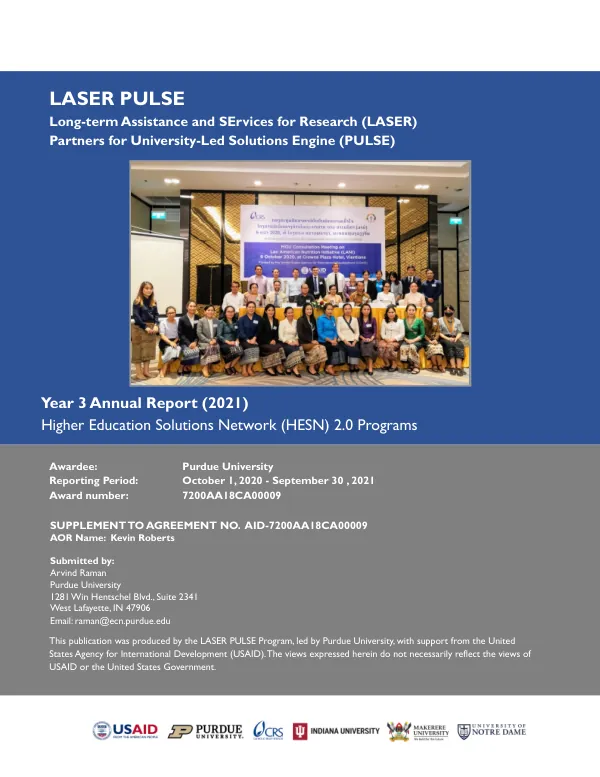
LASER Year 3 Annual Report 2021
The LASER PULSE program is a five-year, $70-million initiative funded by USAID's Innovation, Technology, and Research Hub.
2021 · 18 pages
Sign in to readA free account is required to download.
Abstract
The program delivers research-driven solutions to field-sourced development challenges in USAID partner countries. A consortium led by Purdue University, with core partners Catholic Relief Services, Indiana University, Makerere University, and the University of Notre Dame, implements the LASER PULSE program through a network of researchers and development practitioners in 61 countries. The program currently manages 31 research awards in 15 countries. The Innovation, Technology, and Research Hub leads USAID in original experimentation, using data and evidence in decision-making, harnessing scientific and technological advances, open innovation, and digital technology to transform development. The LASER PULSE program focuses on increasing the delivery of collaborative and effective development-focused research, synthesizing, exchanging, and translating research results into usable development products and practices, and disseminating translated research results for evidence-based solutions. In FY 2021, LASER conducted exit interviews with research teams and USAID technical Activity Managers. The interviews revealed a change in the mindset of researchers and practitioners involved in the projects, with a shift towards a collaborative approach to research methodology. The researchers and practitioners credited the success of the projects to the involvement of stakeholders from the beginning through conceptualization, design, and implementation. This approach helped to create a sense of ownership among participants, which was a boost to all. The Self-Reliance Learning Agenda (SRLA) project, commissioned by the USAID Office of Learning, Evaluation, and Research, concluded in this reporting period. The project focused on measuring local-level capacity and commitment to self-reliance. The researchers found no standard indicators and determined it was necessary to develop context-specific indicators. Through extensive co-creation, the team developed an annotated literature and measurement matrix, and identified points for USAID to consider when determining what and how to measure changes to capacity and commitment in various technical areas and at different phases of scale. The project produced six main deliverables, including a full report and guidance manuals that represent translated research outputs. The links to the deliverables were shared in the bi-annual report. The LASER award process was also improved to speed up the timeline for making awards and enable RFAs to be issued without a prior in-country R4D conference. The RFA process for Ethiopia and Vietnam was changed from a two-step review to a one-step review, reducing the time from RFA issuance to funding recommendation to USAID from eight months to four months. Private Sector Engagement (PSE) Phase 1 buy-in work was completed in September 2021. The buy-in implemented a private sector engagement strategy that leveraged local capacity and attention to local context. The strategy was designed to improve the quality of applications that LASER recommended to USAID. The LASER Gender Training was also required as a mandatory part of RFAs by USAID's Feed the Future Innovation Lab for Food Safety at Purdue, indicating the quality of the training material. The LASER PULSE program continues to grow and expand its network of researchers and development practitioners. The program's focus on collaborative research methodology and context-specific indicators has led to significant impact outcomes, including a change in the mindset of researchers and practitioners involved in the projects. The program's deliverables, including the SRLA project's annotated literature and measurement matrix, have been well-received by USAID and other stakeholders. The program's award process has been improved to speed up the timeline for making awards and enable RFAs to be issued without a prior in-country R4D conference.
Related documents