BANK FOR WEST AFRICAN DEVELOPMENT
USAID Southern Africa Energy Program Angola Country Profile
The USAID Southern Africa Energy Program (SAEP) is a Power Africa initiative that aims to increase power generation and access in Southern Africa while promoting investment in the energy sector.
2024 · 2 pages
Sign in to readA free account is required to download.
Abstract
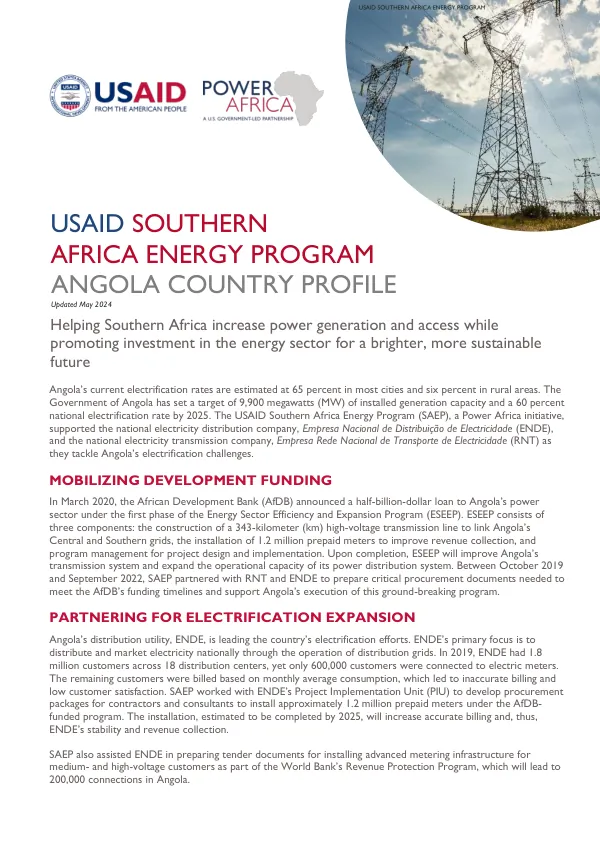
In Angola, SAEP has been working to support the national electricity distribution company, Empresa Nacional de Distribuição de Electricidade (ENDE), and the national electricity transmission company, Empresa Rede Nacional de Transporte de Electricidade (RNT), as they tackle the country's electrification challenges. Angola's current electrification rates are estimated at 65 percent in most cities and six percent in rural areas. The Government of Angola has set a target of 9,900 megawatts (MW) of installed generation capacity and a 60 percent national electrification rate by 2025. To achieve this goal, SAEP has been supporting ENDE and RNT in various initiatives, including the Energy Sector Efficiency and Expansion Program (ESEEP), which aims to improve Angola's transmission system and expand the operational capacity of its power distribution system. ESEEP consists of three components: the construction of a 343-kilometer (km) high-voltage transmission line to link Angola's Central and Southern grids, the installation of 1.2 million prepaid meters to improve revenue collection, and program management for project design and implementation. SAEP has been working closely with ENDE and RNT to prepare critical procurement documents needed to meet the African Development Bank's (AfDB) funding timelines and support Angola's execution of this ground-breaking program. One of the key initiatives supported by SAEP is the installation of prepaid meters by ENDE. The project aims to increase accurate billing and improve customer satisfaction. SAEP has also assisted ENDE in preparing tender documents for installing advanced metering infrastructure for medium- and high-voltage customers as part of the World Bank's Revenue Protection Program, which will lead to 200,000 connections in Angola. Additionally, SAEP has designed a business intelligence process model and reporting solution that allows for the periodic sharing of information in user-friendly dashboards to stakeholders. SAEP has also been working to strengthen Angola's transmission backbone by connecting the Central and Southern systems with a 343 km line from Huambo to Lubango, including one new substation and the expansion of another. The transmission line will evacuate around 1,000 MW from North to South, improving access to electricity, strengthening the financial viability of the power sector, and potentially connecting Angola to regional markets. SAEP has provided technical assistance to RNT to improve both the preparation and implementation phases of the Central-South transmission project. Furthermore, SAEP has been working to improve the regulatory environment in Angola's power sector. In collaboration with the Angolan Regulatory Authority for Energy and Water, Instituto Regulador dos Serviços de Electricidade e de Água (IRSEA), SAEP has developed a roadmap that addresses gaps in Angola's regulatory environment that impede investment in the power sector. The roadmap includes recommendations on rules, licensing and permitting schemes, and annual reporting by utilities, as well as an approach to reduce and ultimately eliminate government subsidies paid to utilities, facilitating movement towards cost-reflective tariffs and enabling the government to allocate subsidy funds to other critical budget items.