INTERNATIONAL FINANCE CORPORATION
USAID Southern Africa Energy Program South Africa Country Profile
The South African energy sector in 2024 is characterized by a mix of energy sources, with renewable energy accounting for a large portion of the mix.
2024 · 2 pages
Sign in to readA free account is required to download.
Abstract
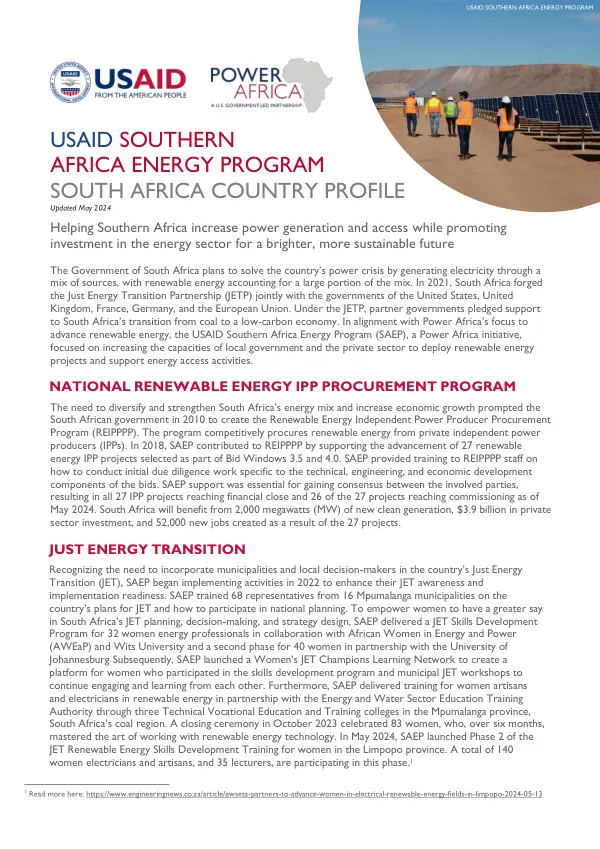
The Government of South Africa has forged the Just Energy Transition (JET) with the governments of the United States, the United Kingdom, France, Germany, and the European Union. Under the JET, the governments pledged to support South Africa's transition from coal to a low-carbon economy. The USAID Southern Africa Energy Program (SAEP), a Power Africa initiative, focused on increasing the capacities of local government and the private sector to develop renewable energy projects and support energy access activities. SAEP supported the advancement of 27 renewable energy Independent Power Producer Procurement (REIPPPP) projects selected as part of Bid Windows 3.5 and 4.4. SAEP provided training to REIPPPP staff on conducting initial due diligence work specific to the technical, engineering, and economic development components of the bids. The REIPPPP program competitively procures renewable energy from private independent power producers. In 2018, SAEP supported the advancement of 27 renewable energy IPP projects, which reached financial close and 26 of the 27 projects reached commissioning as of May 2024. The projects will benefit South Africa with 2,000 megawatts of new clean generation, $3.9 billion in private sector investment, and 52,000 new jobs created. SAEP also began collaborating with the South African Local Government Association (SALGA) in 2021 to support municipalities at various energy planning and management stages and introduce innovative energy solutions. SAEP trained around 350 energy professionals from various municipalities on power project financing, public-private partnerships for power development, and renewable energy integration. SAEP also provided technical assistance to municipalities on developing and implementing their energy plans. One such municipality is the City of Cape Town, where SAEP assisted with the city's rooftop solar project by developing a financial model to demonstrate the efficiency of a U.S. residential solar model known as Property Assessed Clean Energy. SAEP also provided the city with recommendations to mitigate load shedding. SAEP worked with municipalities to package renewable energy projects and prepare the necessary documentation to apply for project preparation funding from development finance institutions. In April 2023, the Council of Scientific and Industrial Research (CSIR) and SAEP launched a partnership to establish a microgrid and smart grid research center at the CSIR and support Eskom's microgrids feasibility studies. The studies will provide a blueprint for Eskom to develop additional microgrids as part of its JET activities and electrification projects. SAEP also supported municipalities in addressing metering and billing challenges, improving financial controls, and implementing measures to prevent, detect, and correct errors and fraud. By December 2023, SAEP had identified revenue opportunities valued at $87.1 million. The municipalities had recouped $3.6 million by the end of the year. SAEP also provided municipalities with hands-on assistance to advance their electrification plans. The Department of Mineral Resources and Energy supported the completion of provincial electrification plans for six provinces to drive funding for municipal electrification projects. SAEP supported the development of the plans, which will drive funding for municipal electrification projects. The USAID Southern Africa Energy Program is funded by the United States Agency for International Development (USAID) in support of Power Africa. Power Africa is a U.S. government-led partnership that harnesses the collective resources of over 200 public and private sector partners to double access to electricity in sub-Saharan Africa. Power Africa's goal is to add at least 30,000 megawatts of cleaner and more reliable generation capacity and 60 million connections by 2030.
Related documents