USAID
USAID SOUTHERN AFRICA ENERGY PROGRAM MOZAMBIQUE COUNTRY PROFILE
The Government of Mozambique aims to electrify all households by 2030, with a current electrification rate of 29 percent and only 13 percent in rural areas.
2024 · 2 pages
Sign in to readA free account is required to download.
Abstract
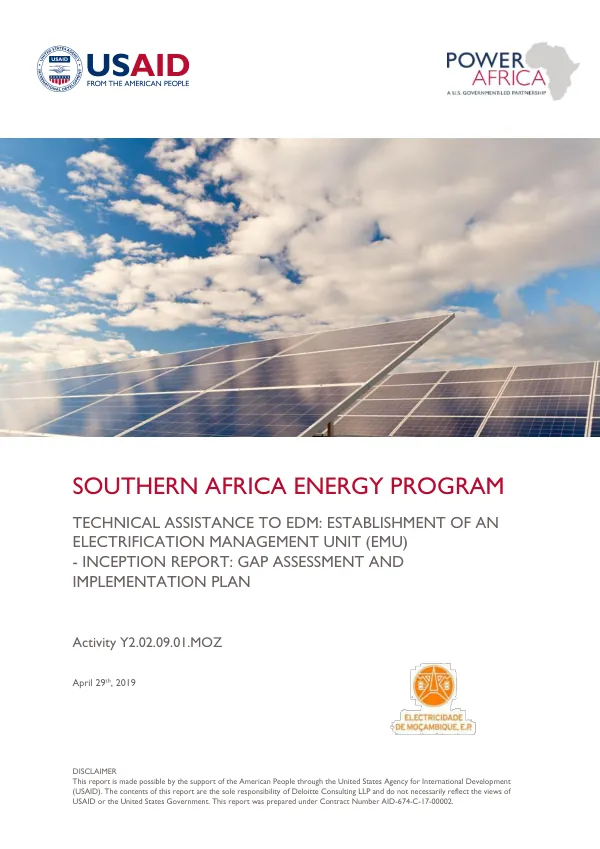
In response to these objectives, the USAID Southern Africa Energy Program (SAEP), a Power Africa initiative, supported the national utility on electrification and transmission and private sector companies with off-grid electrification. SAEP cooperated with the national utility Electricidade de Mocambique (EDM) to design, set up, and operationalize an Electrification Management Unit (EMU) through technical advisory and on-the-job training. The EMU is successfully managing, planning, and implementing Mozambique's electrification program in a cost-efficient and sustainable manner. To further support new connections, SAEP and EDM worked to enhance the customer experience, identifying three key focus areas based on a human-centered design process to improve customer engagement. By March 2023, SAEP's support to EDM has led to just over 1 million connections to electricity. A well-managed and financially viable utility is vital to increasing generation, transmission, and distribution capacity and connecting new customers. SAEP assisted EDM to reduce commercial losses and improve financial viability, developing a commercial loss reduction tool that enables EDM to understand the source and magnitude of its commercial losses. Transmission infrastructure is critical to delivering electricity to those who need it. EDM is building the Temane Transmission Project (TTP), a 563-kilometer transmission line that will supply electricity from power plants at Temane, in the north, to the nation's capital, Maputo, in the south, boosting energy reliability and economic development in communities along the way. SAEP supported the TTP through an embedded advisor who provided organizational and technical support to the TTP project team up to the project's financial close in December 2020. SAEP is also providing off-grid electrification support to players in Mozambique, focusing on route-to-market (RTM) approaches, incorporating geospatial analysis to facilitate company expansion. In 2021, SAEP released an RTM geospatial tool that combines population density, electrification, and road infrastructure data into one user-friendly dashboard. The tool helps companies refine their market expansion strategy by identifying the highest-impact areas for the location of service centers and sales agents. The Government of Mozambique enacted new legislation in 2017 that replaced the National Electricity Council with an independent energy regulatory authority, Autoridade Reguladora de Energia (ARENE). SAEP is working with ARENE to develop guidelines that will assist the regulator in evaluating power purchase agreements (PPAs). Empowering ARENE to fairly evaluate PPAs will have the positive long-term effect of attracting independent power producers to develop power projects in Mozambique. SAEP also provided comments on a new electricity act that has recently passed the parliament and received presidential approval, which will reduce uncertainty for potential investors and unlock private investment in the mini-grid sector. Through its support, SAEP has helped connect around 209,175 households and businesses to electricity through off-grid systems. In addition to the RTM tool, SAEP completed an analysis to enable the Government of Mozambique to implement fiscal incentives for solar products to improve their affordability.
Related documents