DELOITTE CONSULTING, LLP
USAID Southern Africa Energy Program
The USAID Southern Africa Energy Program (SAEP) aimed to increase power generation and access to electricity in 10 countries throughout the region.
2024 · 2 pages
Sign in to readA free account is required to download.
Abstract
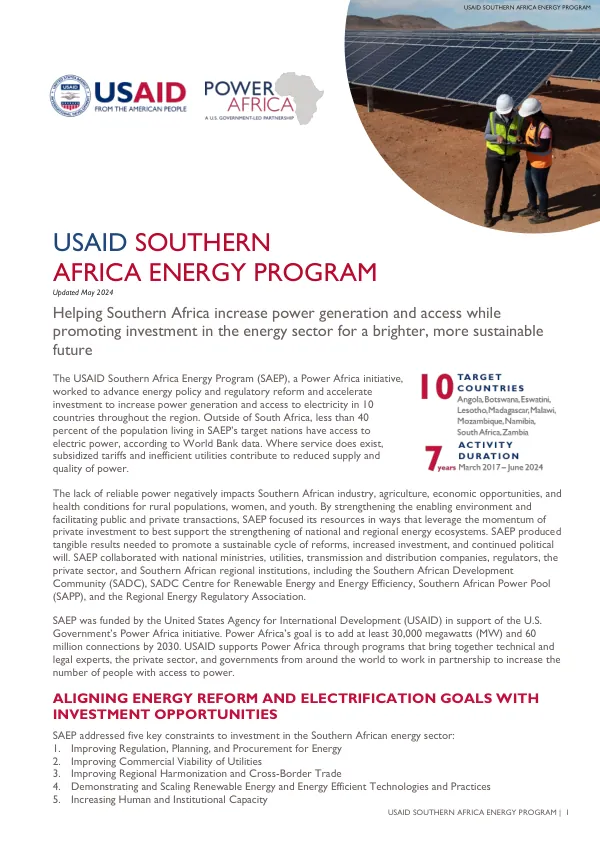
SAEP worked to advance energy policy and regulatory reform and accelerate investment to achieve this goal. The program focused on strengthening the enabling environment and facilitating public and private transactions to leverage private investment and support the strengthening of national and regional energy ecosystems. SAEP addressed five key constraints to investment in the Southern African energy sector: improving regulation, planning, and procurement for energy; improving commercial viability of utilities; improving regional harmonization and cross-border trade; demonstrating and scaling renewable energy and energy-efficient technologies and practices; and increasing human and institutional capacity. To achieve these goals, SAEP collaborated with national ministries, utilities, transmission and distribution companies, regulators, the private sector, and Southern African regional institutions. SAEP produced tangible results, including the management of the procurement and planning aspects of the African Development Bank's $500 million program to add 1.2 million grid connections and build a 343-kilometer transmission line connecting the central and southern grids in Angola. The program also contributed to Botswana's journey towards clean energy by developing rooftop solar guidelines and guided Eswatini's regulator in reviewing the utility's tariff application, resulting in an average decrease in electricity tariffs that will save consumers around $44 million over the next two years. SAEP's efforts led to significant increases in power generation and access. The program supported the development of a national transmission backbone in Mozambique and assisted Namibia's regional electricity distribution company to model and analyze incorporating battery energy storage systems into its grids. SAEP also trained over 1,000 South African municipal officials and energy professionals on power project financing, revenue management, and renewable energy integration. In addition, the program helped Zambia's electricity company recognize environmental constraints on hydro generation and forecast variable renewable energy generation from solar plants. SAEP's results in numbers include a total of 3,032,974 connections, with 1,474,311 off-grid connections and 1,558,663 on-grid connections. The program reached financial close on 5,771.38 MW of power generation, with 2,871.38 MW of generation, 2,900.00 MW of transmission, and 2,358.60 MW started commercial operations. SAEP also trained 2,618 people, including 1,624 males and 994 females. The program's successes demonstrate its effectiveness in promoting a sustainable cycle of reforms, increased investment, and continued political will in the Southern African energy sector.
Related documents