USAID DEC
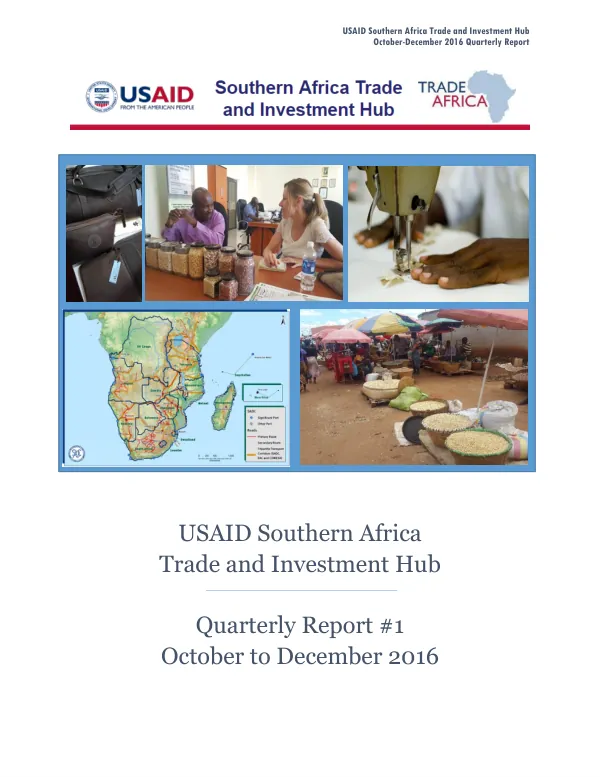
USAID Southern Africa Trade and Investment Hub October-December 2016 Quarterly Report
Sign inDAI
USAID Southern Africa Trade and Investment Hub October-December 2016 Quarterly Report
The USAID Southern Africa Trade and Investment Hub was launched in Pretoria, South Africa, and Gaborone, Botswana, in the first quarter of FY 2017.
2016 · 44 pages
Sign in to readA free account is required to download.
Abstract
The Trade Hub uses a market-driven approach to increase trade and investment in eight of the Southern Africa Development Community's (SADC) 11 countries: Botswana, Lesotho, Malawi, Mozambique, Namibia, South Africa, Swaziland, and Zambia. The Trade Hub's work is implemented under five components: Export Competitiveness, Finance and Investment, Enabling Environment and Trade Facilitation, Agribusiness Trade, and Association Building/Strategic Partnership Fund. The first quarter of FY 2017 was focused on start-up activities and assessments as the Trade Hub prepared its FY 2017 Workplan. Trade Hub component teams met with dozens of stakeholders in the public and private sectors to build relationships critical to effective collaboration, identify challenges and opportunities, establish consensus on approaches and activities, and set objectives and goals that would reflect progress toward increasing trade and investment across Southern Africa. In Export Competitiveness, the Trade Hub developed an export readiness questionnaire to identify companies with the potential to compete successfully in international markets. Working with public and private stakeholders, the Trade Hub began to develop strategy to increase utilization of the African Growth and Opportunity Act (AGOA). Stakeholder interviews led to the identification of 11 companies from Malawi, Mozambique, and Swaziland to participate in Gulfood, a major international food trade show held in Dubai, and 14 companies from Lesotho and South Africa to participate in MAGIC, one of the world's largest apparel sourcing trade shows held in Las Vegas. The Trade Hub's Enabling Environment & Trade Facilitation team worked closely with stakeholders at the Southern Africa Development Community (SADC), representatives of national governments, to assess the challenges affecting regional trade. These meetings led to specific movement on a National Single Window in Malawi and One Stop Border Posts in Namibia. These initiatives can reduce delays that impede trade across the region – and lead to significant increases in trade: By improving cross-border delays by one day intra-SADC trade can improve by USD 400 million and SADC global exports by USD 2 billion per annum. The Trade Hub's Finance and Investment team seeks to address the most common challenge firms cite when queried about their ability to compete: significant barriers to raising capital. The team met with potential partners in Malawi, South Africa, and Zambia during the first quarter of the fiscal year to introduce the project and objectives and to better understand opportunities with stakeholders. The team subsequently identified nine private financing opportunities in Botswana, Malawi, Mozambique, Namibia, Zambia, and regionally; five banking sector financing opportunities in Botswana, Malawi, and Zambia; five policy/enabling environment opportunities for Trade Hub support in Botswana, Lesotho, Malawi, Zambia, and SADC; and multiple opportunities for the Trade Hub to support financing platforms/vehicles. The Trade Hub's Agribusiness Trade component focused on increasing trade in agricultural products. The team worked with stakeholders to identify opportunities for trade in staple crops, including maize and beans, and to develop strategies for increasing market access for smallholder farmers. The team also worked with the private sector to identify opportunities for investment in agricultural processing and value addition. The Trade Hub's Association Building/Strategic Partnership Fund component focused on building partnerships between the public and private sectors to support trade and investment. The team worked with stakeholders to identify opportunities for collaboration and to develop strategies for increasing trade and investment across the region. The team also worked with the private sector to identify opportunities for investment in trade facilitation and logistics. Overall, the first quarter of FY 2017 was focused on building relationships, identifying challenges and opportunities, and setting objectives and goals that would reflect progress toward increasing trade and investment across Southern Africa. The Trade Hub's work is critical to reducing poverty and promoting economic growth in the region.