MANAGEMENT SYSTEMS INTERNATIONAL
USAID SPR – AMANI KWA MAENDELEO QUARTERLY PROGRESS REPORT (Y2 Q1)
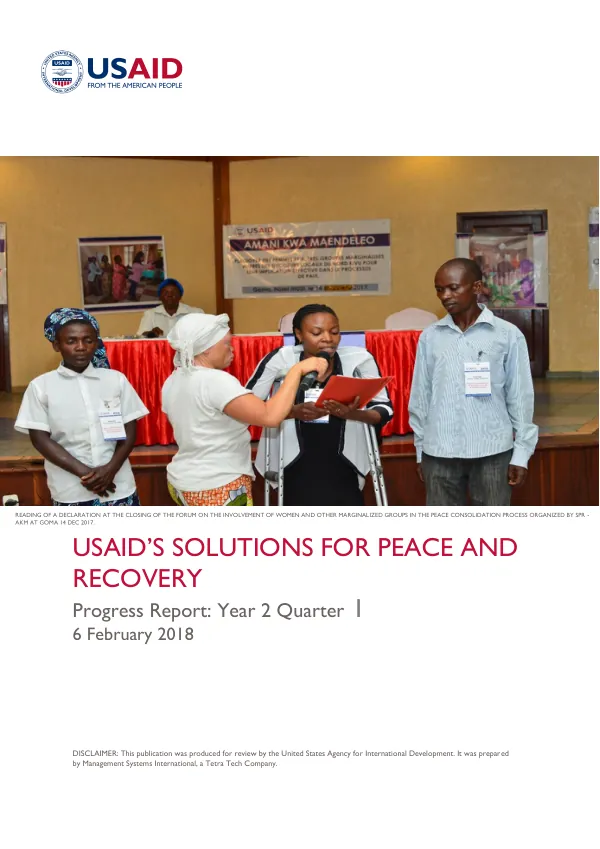
The USAID's Solutions for Peace and Recovery (SPR)/Amani Kwa Maendeleo (AKM) project aims to increase social cohesion through the inclusion of women and marginalized groups in communities in seven priority territories of Eastern DRC.
2018 · 50 pages
Sign in to readA free account is required to download.
Abstract
The project's goal is to enable communities to analyze conflict, develop processes that produce effective solutions, and increase participation of women and marginalized groups in community-based decision-making. Three hypotheses support the USAID's SPR team's approach to achieving progress in pursuit of the project goal. The project's progress in the first quarter of Year 2 (October-December 2017) marked the beginning of a gradual shift of responsibility for project implementation from the USAID's SPR team to local partners. During this period, USAID's SPR and partners registered several key accomplishments, including the approval of eight grants, the finalization of seven target groupements and communes in North and South Kivu, and the presentation of SPR to authorities and communities in three recently added groupements. The project also conducted preliminary data collection to inform the design of the planned social cohesion perception survey, completed the second phase of the Do No Harm (DNH) study in select target zones, and trained SPR staff on DNH principles and approaches to integrating DNH in project implementation. The project's progress on performance plan indicators is as follows: 6 conflict prioritizations were conducted in Kabare (Lugendo and Ishungu), 2 needs prioritizations were conducted in Kabare (Lugendo and Ishungu), and 2 system analyses were conducted in Goma and Walungu. Additionally, 6 consensus-building processes were conducted in Q1, with 100% resulting in agreement. The project also strengthened local organizations' capacity to conduct conflict analysis, with the first capacity evaluation completed for ACUDI and BOAD, and an improvement plan to be elaborated in Q2. The project's training activities included training local authorities and leaders, women, and other marginalized groups on participatory governance, training female leaders, representatives of other marginalized groups, local authorities, and other local leaders on transformational leadership, and convening a conference aimed at supporting peace advocates to develop advocacy strategies and engage with government officials on priorities in the peace-building sector. The project also trained local authorities and other actors on the process of elaboration of the local development and services improvement plans in the Ishungu groupements in Lugendo, city of Goma and Bukavu. The project's progress on performance plan indicators for the training activities includes the completion of the first module by 139 CSOs, with 9 more CSOs to be added in Q2 to make the total of 148 CSOs trained. The project also approved 4 grantees, ACUDI, BOAD, ICJP, and TPO, and provided training in financial, grants, and program/M&E management to 5 pre-selected CSOs in N. Kivu and 13 in S. Kivu. The project's quarterly progress report highlights the challenges faced by the project, including understaffing, the volume of proposal submissions, and limited access to Walikale. The report also highlights the opportunities available to the project, including collaboration and coordination with USAID IPS, high volume of proposal submissions, and limited access to Walikale. The report provides a detailed account of the project's progress, challenges, and opportunities, and highlights the importance of continued support to achieve the project's goal of increasing social cohesion through the inclusion of women and marginalized groups in communities in Eastern DRC.