USAID DEC
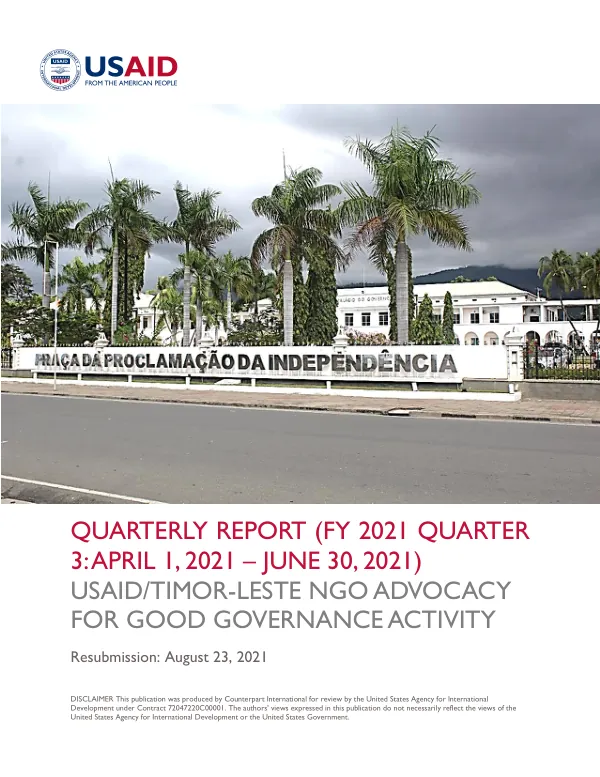
USAID/TIMOR-LESTE NGO ADVOCACY FOR GOOD GOVERNANCE ACTIVITY QUARTER 3 REPORT (APRIL – JUNE 2021)
Sign inCOUNTER PART INTERNATIONAL
USAID/TIMOR-LESTE NGO ADVOCACY FOR GOOD GOVERNANCE ACTIVITY QUARTER 3 REPORT (APRIL – JUNE 2021)
The USAID/Timor-Leste NGO Advocacy for Good Governance Activity is a five-year, $9.5 million contract funded by the U.S.
2021 · 23 pages
Sign in to readA free account is required to download.
Abstract
Agency for International Development (USAID), implemented by Counterpart International. The Activity seeks to expand the Non-Governmental Organizations (NGO) enabling environment and strengthen the organizational, research, networking, and financial capacity of local advocacy NGOs in Timor-Leste to provide increased evidence-based, sustainable advocacy services on behalf of citizens. Operational challenges presented in Quarter 3, including the surge of COVID cases and severe flooding and displacement of citizens in April, directly impacted the Activity team and its NGO partners. The Activity delayed initiatives on several occasions to accommodate the team and partners' safety and participation in response and recovery work. The Activity requested an adjustment to the contract Deliverable Schedule to reflect the changes caused by the disruptions, which included an extension of the deliverable 10 activities through June 30, along with other modifications to the schedule throughout the rest of Fiscal Year 2021 and part of Fiscal Year 2022. Despite the disruptions and impact of the crises on their teams, the Activity's partner NGOs remained enthusiastic about participating in the scheduled events. The Activity held events and delivered all internal operations virtually due to the government-mandated lockdown and the shift to full telework. The Activity developed several strategies to overcome the challenges, including facilitating NGO participation by providing internet credit directly to staff phones, patching NGOs into workshops using phonelines when internet was weak, and inviting NGO members to use rooms in the Activity office to connect when their power or internet had failed. During this reporting period, the Activity submitted drafts of the Political Economy Analysis (PEA), Rapid Partnership Appraisal (RPA), and Legal and Policy Inventory. The Inventory revealed that while there are some constraints on NGOs regarding their organizational structure, human resources systems, and financial sustainability, these policies are either not overly onerous or weakly enforced, such that NGOs are still able to be registered and operate. The regulatory barriers for advocacy engagement are more significant burdens on NGO engagement, including ineffective systems for accessing public records, overly restrictive public assembly/demonstration laws, and limited opportunities for NGOs to use judicial pathways for government accountability or oversight. The NGOs shared that the workshop taught them about their rights and opportunities for engaging in policy advocacy that they were previously unaware of, such as the legal framework for accessing public records, barriers for NGOs to compete for government contracts, and points of entry for NGOs to engage in policy dialogues with elected officials. In addition to the larger research reports, the team also executed Memoranda of Understanding with each NGO. The NGOs were able to complete their Transformational Change Goals and develop the associated Transformational Change Action Plan Matrixes, complete their financial sustainability diagnostic tools establishing financial sustainability baselines, and completing their Advocacy Impact self-assessments. The Advocacy Impact Assessments revealed that the NGO partners have an informal and ad hoc approach to advocacy. Most of the NGOs indicate they have very little experience or capacity to design and execute formal research. Furthermore, few of the NGOs have clearly defined or engaged constituencies and most lack experience in building, leading, or acting as part of a coalition. None of the NGOs have specific advocacy plans with clearly defined priorities and mechanisms of strategic engagement. Beyond their advocacy capacity, the Assessments also revealed that all nine NGOs have a rudimentary understanding of research and generally believe that any primary data collection (via survey, Focus Group Discussions (FGDs), etc.) constitutes "research" and all the NGOs believed they had the skills to conduct this level of study. The COVID-19 pandemic had a significant impact on Timor-Leste during the reporting period, with a rapid escalation of cases leading to an extended lockdown for residents in Dili until June 15, 2021. The Government lifted the mandatory confinement in Dili on June 16, 2021, although the sanitary fences in Dili and three municipalities (Baucau, Bobonaro, and Covalima) were maintained to prevent virus circulation between the affected municipalities. The total positive confirmed cases of COVID in Timor-Leste as of June 30th was 9,222 with 23 deaths. Timor-Leste launched its national COVID vaccination program on April 7, 2021, with the aim of vaccinating 70% of the population by the end of 2021.
Related documents
Documents in this collection
 2016
2016USAID DEC
Quarterly Report 10, Year 3 – January 2016 – March 2016: Building Alliances for Local Advancement, Development and Investment - Capacity Building (BALADI CAP)
Open record 2015
2015USAID DEC