ROBERT NATHAN ASSOCIATES
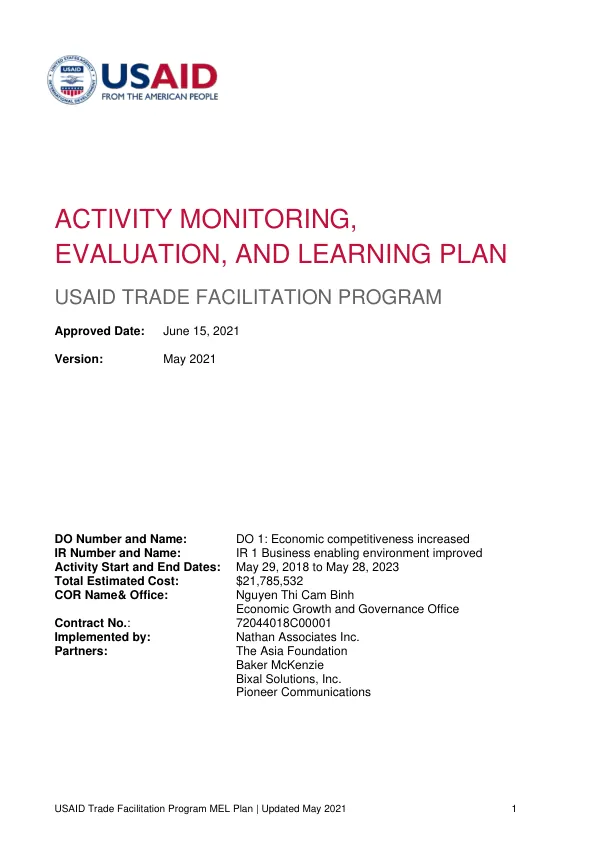
USAID Trade Facilitation Program MEL Plan
The USAID Trade Facilitation Program aims to improve Vietnam's trade environment and attract more investment by reducing the time and cost of trade.
2021 · 57 pages
Sign in to readA free account is required to download.
Abstract
The program is implemented under the USAID Vietnam Trade and Growth Project, which contributes to the achievement of Development Objective 1, "Governance enhanced to facilitate broader-based sustainable growth" under the USAID Vietnam Country Development Cooperation Strategy. The Trade Facilitation Program will help Vietnam improve its trade environment by reducing delays in border clearance, promoting transparent international standards, and fostering effective collaboration between Vietnam's public and private sectors. The program's theory of change is based on the development hypothesis that if trade facilitation policies are simplified across Government of Vietnam (GVN) units, trade policies are harmonized between the national and provincial level, customs implementation is harmonized and professionalized at the provincial level, and customs management adopts modern, risk-reducing approaches, then Vietnam presents a more attractive and predictable trade and investment climate for domestic small and medium enterprises (SMEs) and international global value chain (GVC) investors. The Trade Facilitation Program will achieve its objectives through targeted technical assistance, which will support United States (US) foreign policy priorities and enhance the partnership between the US and Vietnam in trade and competitiveness. The program will focus on improving the business enabling environment, enhancing the capacity of the General Department of Vietnam Customs, and promoting the adoption of risk-based management procedures and streamlined specialized inspections protocols. The program's monitoring, evaluation, and learning (MEL) plan is designed to provide a robust framework for collecting and reporting high-quality performance data. The plan includes outcome and output-level indicators that are linked to the program's expected results, and it lays the foundation for continuous monitoring, assessment, and reflection to inform adaptive management and influence the effectiveness of the program's implementation. The MEL plan will be revisited on an annual basis to ensure that it is providing the most applicable data for decision-makers and adequately capturing program progress towards results. The plan will be submitted to the USAID Contracting Officer's Representative (COR) for review and approval, and any proposed updates will be submitted for review and approval as well. The program's implementation will be led by Nathan Associates Inc., with support from subcontractors, Government of Vietnam partners, and other relevant donor-funded programs. The program will be implemented from May 29, 2018, to May 28, 2023, with a total estimated cost of $21,785,532. The program's performance will be monitored through a range of indicators, including the improvement of the business enabling environment, the enhancement of the capacity of the General Department of Vietnam Customs, and the adoption of risk-based management procedures and streamlined specialized inspections protocols. The program's progress will be evaluated through a midterm evaluation, which will assess the program's achievements and identify areas for improvement. The program's learning plan will focus on building a shared evidence base critical to informing adaptive management and influencing the effectiveness of the program's implementation. The program will contribute to the development of replicable approaches to facilitate a more attractive and predictable trade and investment climate for domestic and international investors.
Related documents