ROBERT NATHAN ASSOCIATES
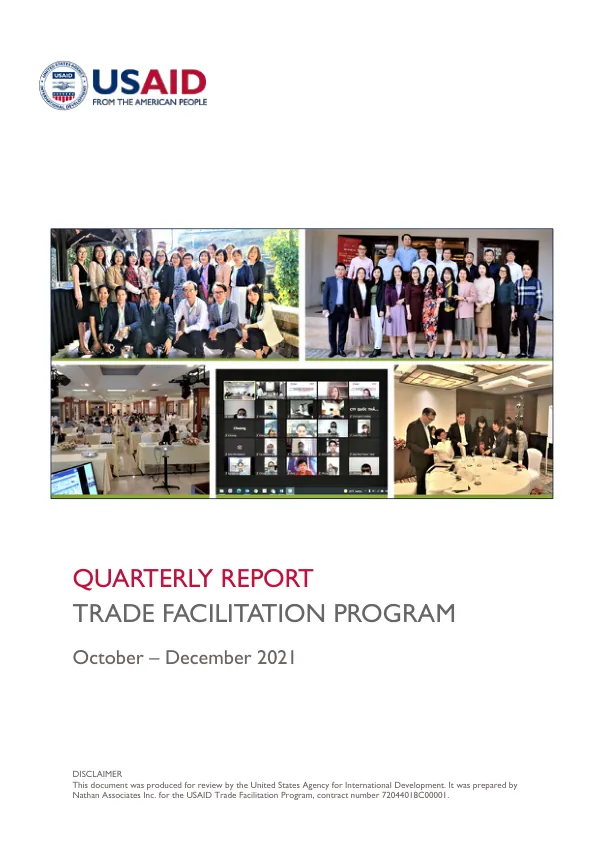
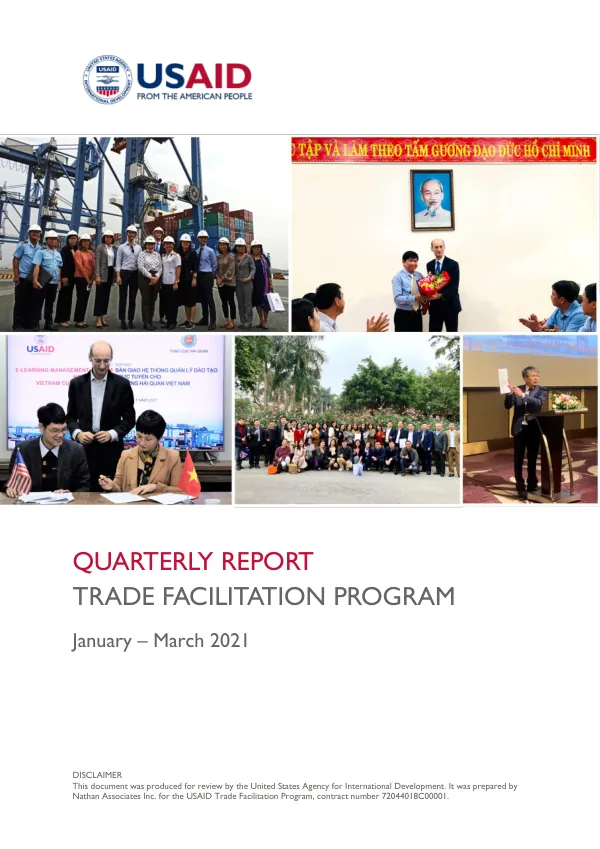
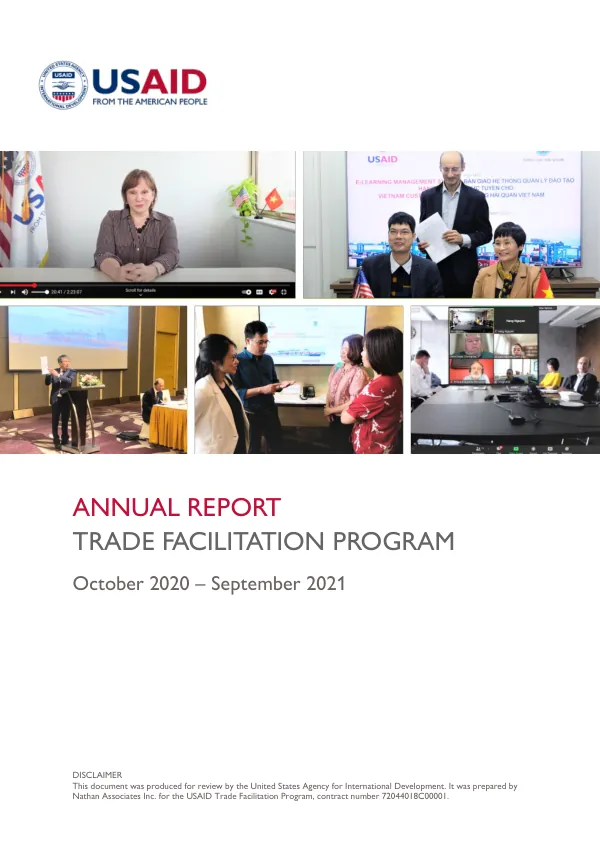
USAID Trade Facilitation Program Annual Report FY 2021
The USAID Trade Facilitation Program in Vietnam made significant progress in fiscal year 2021 (FY 2021) towards its goal of expediting cross-border trade.
2021 · 67 pages
Sign in to readA free account is required to download.
Abstract
The program's engagement expanded beyond its primary counterpart, the General Department of Vietnam Customs (GDVC), to other Government of Vietnam (GVN) units. The program also made substantial progress in specialized inspections reform and activities in the provinces, despite the challenges posed by the ongoing COVID-19 pandemic. Reforming Specialized Inspections (SI) was a key objective of the program. On January 12, 2021, the Prime Minister issued Decision 38/QD-TTg approving the new Scheme on reforming SI for imported goods, developed by GDVC with program support. The program supported GDVC in drafting a decree outlining the implementation of the Scheme, which aims to streamline procedures for businesses and facilitate international and cross-border trade. A regulatory impact assessment (RIA) was completed to estimate the cost-savings for businesses once the decree enters into force, bolstering the Ministry of Finance's (MOF) advocacy for the decree. Vietnam's implementation of the World Trade Organization (WTO) Trade Facilitation Agreement (TFA) was also a focus area. The program undertook a situational assessment of Vietnam's implementation of the WTO TFA, concluding that Vietnam was on the right track towards full compliance with the provisions of the WTO TFA. The assessment found that 74 percent of measures were in full compliance by the beginning of 2021, and only 13 measures still required further reform. The program also facilitated trade through e-commerce by assisting GDVC in drafting a decree regulating customs procedures for imported and exported goods transacted via e-commerce. The decree fills an existing legal gap, which has caused confusion leading to delays and bottlenecks in the clearance of goods. A research paper and international survey on best practices for management of goods transacted via cross-border e-commerce were also completed, based on the experience of customs authorities in China, the European Union (EU), Japan, Singapore, and the United States. The program's impact assessment findings indicate that implementation of the new SI decree may generate annual cost savings of $66.8 million for businesses, $10.2 million in compliance costs savings by simplifying 13 administrative procedures, and $56.6 million in savings for businesses by cutting other costs and time to complete procedures. At the provincial level, the program continued to support the Vietnam Customs School (VCS) in improving VCS capabilities to deliver e-learning courses. Highlights of the program's support include the handover of management of the e-Learning Management System (eLMS) to VCS, training of trainers (ToT) courses, and the enhancement of existing features and interface of the eLMS. The program also engaged with GVN stakeholders to gather information and provide recommendations to address congestion at Vietnam's busiest port, Cat Lai Terminal in Ho Chi Minh City. The program's engagement with the business community was also deepened in FY 2021, with a focus on supporting trade in the provinces. The program worked with GVN stakeholders to gather information and provide recommendations to address challenges faced by businesses in the provinces. The program's support for the establishment of Provincial Trade Facilitation Committees (PTFCs) also continued, with the aim of improving coordination and cooperation among GVN units at the provincial level. Overall, the USAID Trade Facilitation Program in Vietnam made significant progress in FY 2021 towards its goal of expediting cross-border trade. The program's engagement expanded beyond its primary counterpart, the GDVC, to other GVN units, and substantial progress was made in specialized inspections reform and activities in the provinces. The program's impact assessment findings indicate that implementation of the new SI decree may generate significant cost savings for businesses, and the program's support for the establishment of PTFCs and e-learning courses for Customs officials will continue to facilitate trade in the provinces.
Related documents