USAID DEC
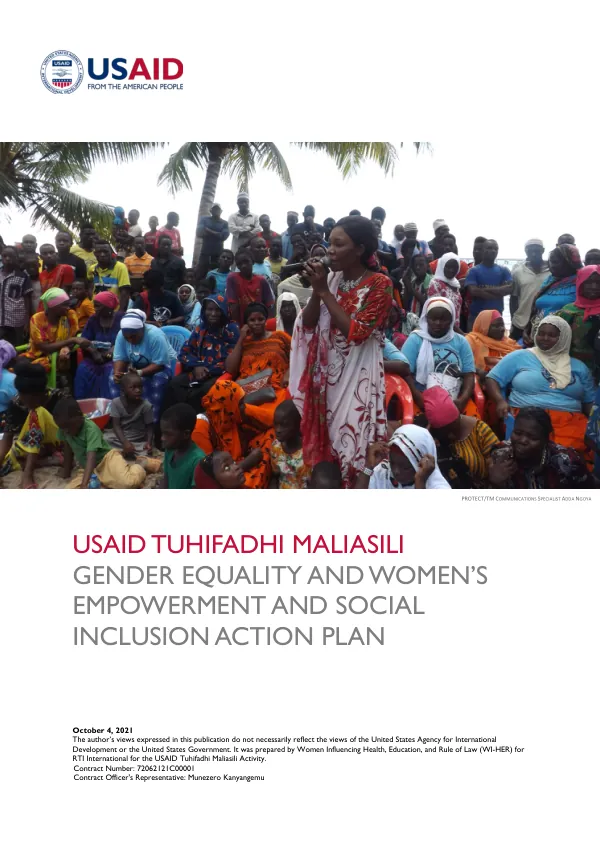
USAID Tuhifadhi Maliasili Gender Equality and Women’s Empowerment and Social Inclusion Action Plan
Sign inRTI INTERNATIONAL
USAID Tuhifadhi Maliasili Gender Equality and Women’s Empowerment and Social Inclusion Action Plan
The Tuhifadhi Maliasili Activity is a five-year initiative aimed at addressing the dynamics that threaten animal movement, habitat connectivity, and biodiversity in Tanzania.
2021 · 14 pages
Sign in to readA free account is required to download.
Abstract
The Activity supports and strengthens government and civil society capacity for biodiversity conservation, with the ultimate goal of reducing threats to biodiversity in Tanzania and moving Tanzanian institutions further on their journey to self-reliance. The Activity is designed to achieve three primary objectives: building institutional capacities of both public and private stakeholders, increasing private sector engagement in biodiversity conservation and natural resources management, and improving the policy, regulatory, and enabling environment for biodiversity conservation and natural resource management. The Activity will be implemented in six wildlife corridors, which are areas connecting different wildlife habitats. The protection of wildlife and conservation has broad impacts on the livelihoods and well-being of populations living close to major wildlife corridors in Tanzania. The rural poor, especially women, who often lack access to land and other assets, are heavily dependent on natural resources for subsistence as well as for livelihoods. At the same time, the practices and activities of the population have positive and negative impacts on the wildlife and ecosystems, with men and women depending, to varying degrees, on natural resources for their livelihoods as well as their daily needs. However, men and women have unequal access to resources and opportunities to manage those resources, and are differently affected by restrictions or strains on natural resources. Women tend to suffer more from the negative impacts of biodiversity loss as well as from restrictions imposed to preserve biodiversity and wildlife, which exacerbates existing inequalities. Tuhifadhi Maliasili's Gender Equality and Women's Empowerment and Social Inclusion Action Plan describes the Activity's approach to incorporate opportunities for gender equality and social inclusion. The plan proposes entry points to integrate gender equality and women's empowerment into the Tuhifadhi Maliasili 12-Month Work Plan, including actions specific to each of the six wildlife corridors covered by the Activity. The plan also describes the role of gender and social inclusion in biodiversity conservation and natural resource management, highlighting the importance of integrating gender into conservation efforts to preserve and leverage women's knowledge about the environment and to reduce their work burden. The Activity has conducted a broad, rapid landscape assessment of gender, youth, and social inclusion factors related to the project context to inform programming. The assessment encompassed a desk review, virtual key informant interviews with organizations involved in conservation and natural resources management, and virtual focus group discussions with communities in the Kwakuchinja and Nyerere-Selous-Udzungwa corridors. The assessment highlighted the importance of integrating gender into conservation efforts to address the different roles, resources, and power of men and women in promoting gender equality and women's empowerment. The Activity's approach to incorporating opportunities for gender equality and social inclusion is based on the understanding that women and excluded groups, such as persons with disabilities, pastoralists, farmers, and the elderly, often suffer the most from poor natural resource management practices, weak governance, and lack of livelihood opportunities. The Activity aims to address the different roles, resources, and power of men and women to promote gender equality and women's empowerment in achieving objectives and results.
Related documents