AFRICAN WILDLIFE FOUNDATION
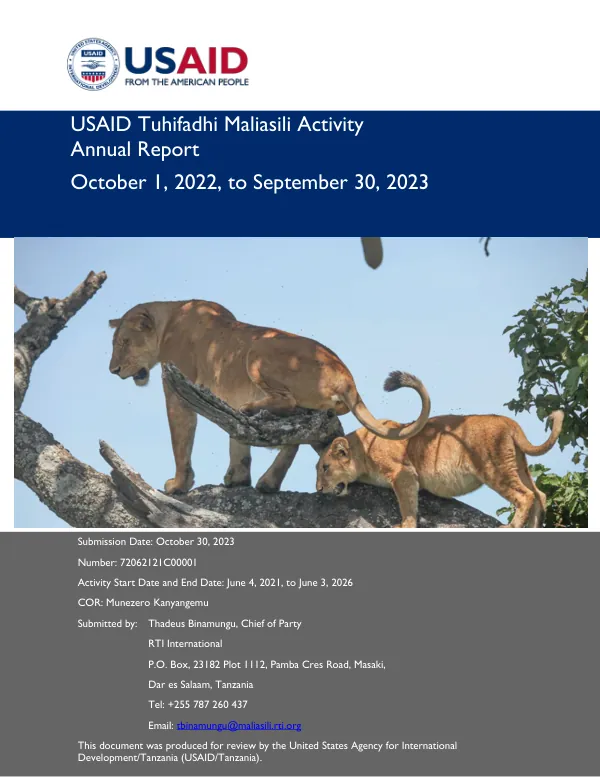
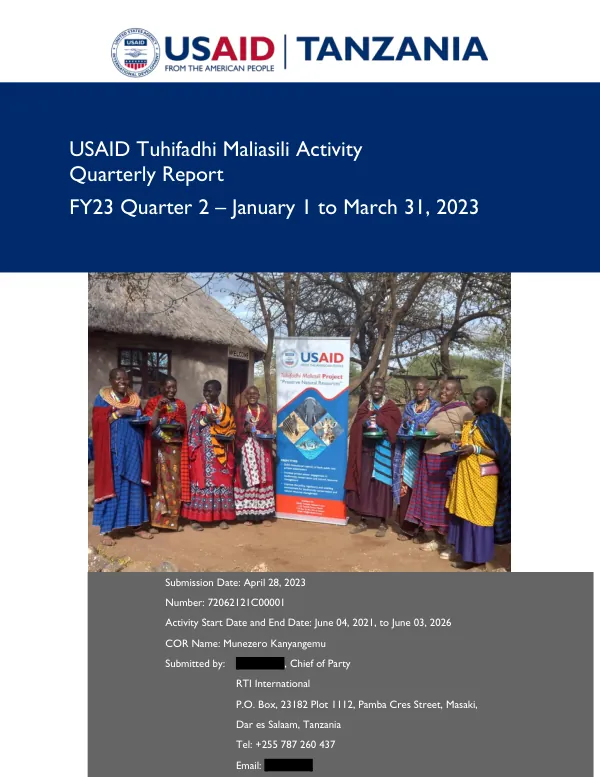
USAID Tuhifadhi Maliasili Activity Monthly Report April 2023
The USAID Tuhifadhi Maliasili Activity is a conservation initiative focused on protecting wildlife corridors and promoting biodiversity conservation in Tanzania.
2023 · 8 pages
Sign in to readA free account is required to download.
Abstract
The activity began in 2023 with the goal of strengthening institutional capacities of public and private stakeholders, increasing private sector engagement in biodiversity conservation, and improving the policy, regulatory, and enabling environment for biodiversity conservation. In April 2023, the activity made significant progress in its objectives. The installation of a 3.5 km long solar-powered strobe light and metal strip fence was completed in the Nyerere Selous – Udzungwa corridor as a measure to mitigate human-elephant conflict. Additionally, the development of Asilia Giving's five-year Strategic Plan (2023 – 2028) was concluded, and a feasibility study report on voluntary carbon credit and biodiversity credit financing models for the Nyerere Selous – Udzungwa corridor was drafted. The activity also continued to strengthen reporting on biodiversity conservation among trained journalists. Six trained journalists visited the Kwakuchinja corridor to learn about various efforts carried out by civil society organizations, government, and community members to protect the corridor. The journalists learned about community-led land use planning, campaigns to reduce the illegal consumption of game meat, and livelihood activities that reduce threats to biodiversity resources. A total of 19 articles were published by Tanzanian popular newspapers as a result of the journalists' learning visit. The activity also supported the development of a comprehensive capacity-building plan to support civil society organizations (CSOs) to achieve self-reliance in conservation efforts. The plan involves conducting an assessment to identify technical and organizational capacity gaps and developing a capacity-building plan to address the identified gaps. Asilia Giving was supported to complete its Strategic Plan (2023 – 2028) after stakeholders' validation and board approval. In terms of private sector engagement, the activity consulted tourism stakeholders in Arusha Region and Monduli District Council to gather basic information that will guide the review of the Master Plan for Tourism Development in Monduli District, Kwakuchinja corridor. The activity also gathered inputs from owners of Maasai cultural bomas (Emanyata) in Kwakuchinja corridor. The activity continued conducting joint patrols in the Kwakuchinja corridor with a grant to Chem Chem Association (CCA). The antipoaching team arrested a poacher who killed a giraffe contrary to wildlife conservation act No. 5 of 2009. The poacher was handed over to Babati police station for further legal proceedings. The joint antipoaching team also arrested three herds of cattle illegally grazing in the restricted area within the Burunge Wildlife Management Area (WMA). The herds were sent to Vilima Vitatu village office and owners were fined a sum of TZS 150,000/= as per village by-laws. The activity also started tracking lions in the Kwakuchinja corridor to understand their home range. It was established that it is the same pride of five lions that have been frequently reported attacking livestock in Makirinya, Ngoley, and Mdori villages. The team is putting together a strategy to mitigate these conflicts, including providing an early warning system through collaring of these lions for tracking their movement. In April 2023, the activity supported 116 households from three villages of Makuyuni, Naitolia, and Mswakini Juu with artificial insemination of 320 cows for breed improvement. This involves administering a series of hormones (estrus synchronization) that helps in shortening the breeding season which allows efficient labor management during the breeding and calving season. Supplementary feeds and minerals were provided to improve animal health and increase milk production. The activity also continued to support the National Land Use Planning Commission (NLUPC) to upgrade and operationalize the National Land Use Information System (NLUIS).
Related documents